





From one organism to a whole ecosystem
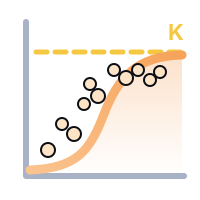
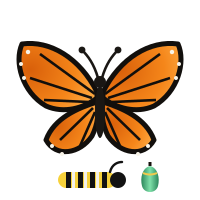
Ecology works at four scales, and each has a simulator. A single life: the Butterfly Life Cycle Simulator takes a monarch from egg to adult on a degree-day clock. A population: the Population Growth Simulator grows bacteria, yeast, reindeer and people along J and S curves. A community: Build the Food Chain lets students draw the arrows of a food web and run it. An ecosystem: the Nitrogen Cycle Simulator follows nitrogen through soil, crops, cows and a pond.
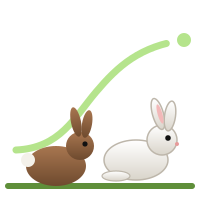
Evolution needs generations, and the Natural Selection Simulator runs them on a 3D island where rabbits with real genes are hunted by foxes. The Animal Kingdom Classification and Plant Classification Game pages then sort the results of that evolution onto the tree of life.
Which simulation for which topic
| Topic | Open |
|---|---|
| Food chains, food webs, trophic levels, energy pyramids, biomagnification | Build the Food Chain |
| Who eats whom, from the bones in a pellet | Virtual Owl Pellet Dissection |
| Nitrogen fixation, nitrification, fertilizer runoff and dead zones | Nitrogen Cycle Simulator |
| Exponential and logistic growth, carrying capacity, predator and prey cycles | Population Growth Simulator |
| Natural selection, genetic drift, Hardy–Weinberg | Natural Selection Simulator |
| Vertebrates and invertebrates, phyla, dichotomous keys, cladograms | Animal Kingdom Classification |
| Mosses, ferns, conifers and flowering plants, monocots and dicots | Plant Classification Game |
| Complete metamorphosis and how temperature sets its pace | Butterfly Life Cycle Simulator |
| Drinking water, sewage treatment and polluted rivers | Water Filtration Simulator |
Experiments that would take years
Removing the wolves from a forest, counting reindeer on an island for twenty years or following a gene through fifty generations cannot be done in a lesson. Here each runs in minutes from a model fitted to real data, so students can predict first, run it, and explain why the graph turned out the way it did.
Updated