
Plant Kingdom Classification Game: Sort Mosses, Ferns, Conifers and Flowering Plants
Drag 160 real plants onto the tree of the plant kingdom, then morph it from the ranks you learn into the evolutionary tree of plants. Tell monocots from dicots, walk the plant dichotomous key, compare relatives, fill your field guide, then level up through 20 game stages from Beginner to Expert.
The seven ranks
Lab notebook
Every plant you classify, every key you walk, every comparison and every quiz result is written here. Export a CSV, or turn the session into a PDF lab report.
| # | Activity | Plant / group | What you did | Result |
|---|
Concept library
Click "New problem" to begin.
Click "Start quiz" for 5 questions: ranks and names, algae, mosses and ferns, seed plants, keys and evolution.
1 Overview
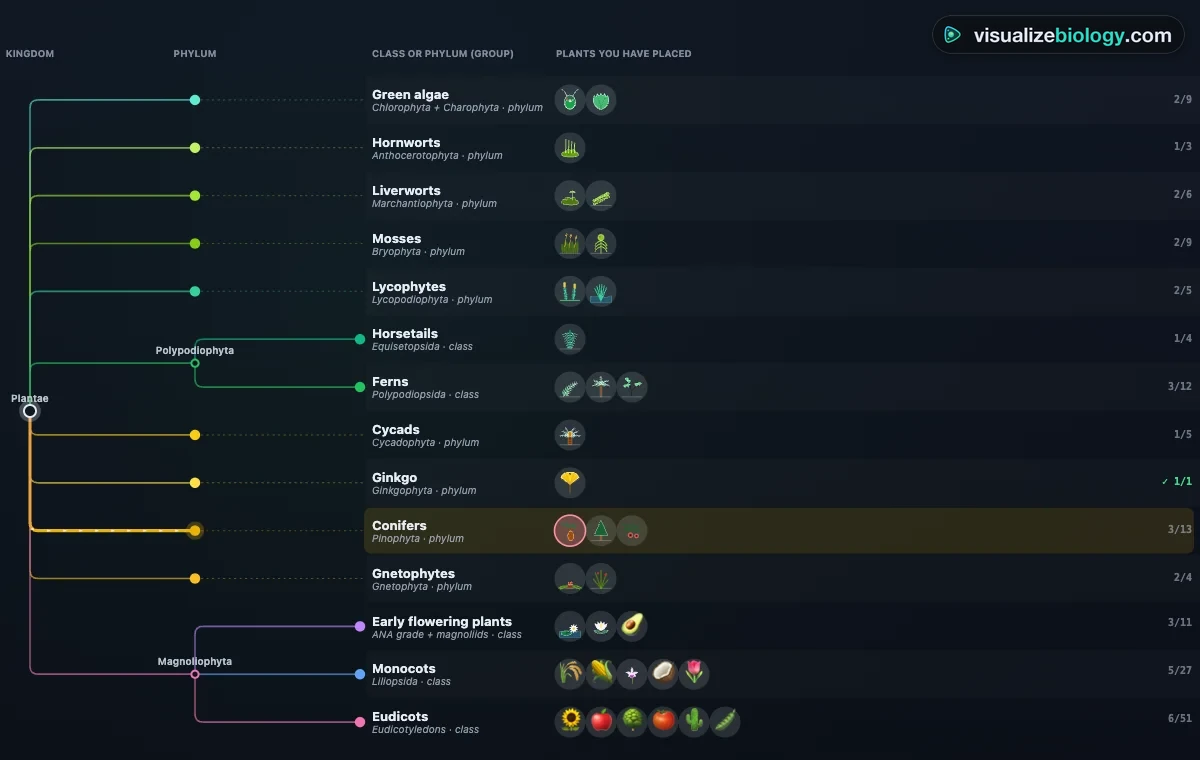
The left of the lab is the tree of the plant kingdom: Plantae at the root, the phyla and classes on the way out, and 14 groups at the tips, from green algae to eudicots. The right is a card that shows whatever you pick: a group, a plant, the key, a comparison or your field guide. Pick an activity from the row of cards above the lab (Sort, Key, Compare, Evolution, Collect). Four modes: Simulate (free lab with learning aids and the concept library), Game (20 levels from Beginner to Expert), Experiment (six practicals with a method, a conclusion and a PDF report) and Quiz (ten interactive levels and a theory quiz).
2 Sorting plants onto the tree
A handful of plants waits in the tray at the bottom of the tree. Drag one onto the row of its group, or tap it and then tap the row (with a keyboard: Tab to a plant, Enter to pick it up, ↑ ↓ to choose a row, Enter to drop). With "Check each drop" on, a right answer flies into place and adds the plant to your field guide; a wrong one comes back with the reason (for example, a sago palm has naked seeds and no flowers, so it is a cycad, not a palm). If you were close (the right phylum but the wrong class, such as a horsetail dropped on the ferns) the coach says so. 🔀 New plants deals another handful; Find (🔍) looks up any plant by its common or scientific name.
3 Ranks and evolution
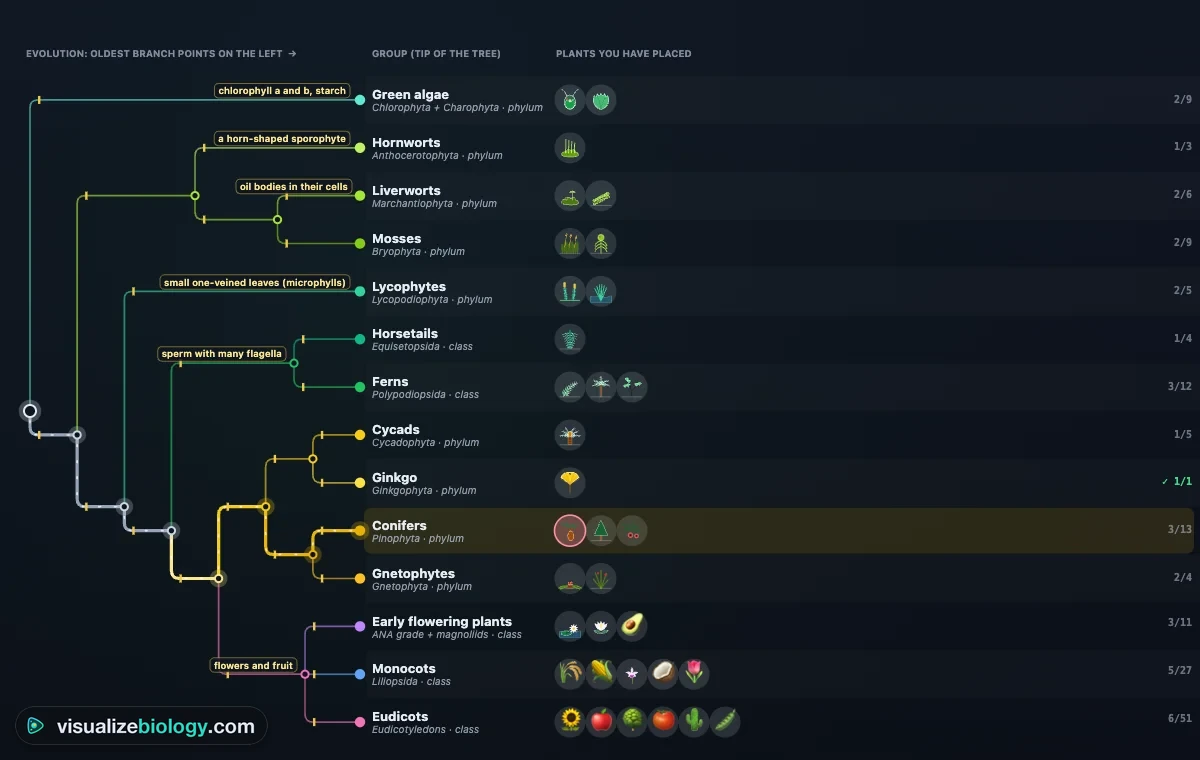
🪜 Ranks draws the hierarchy you learn: kingdom, phylum (division) and class in columns. 🌳 Evolution morphs the same groups into the evolutionary tree of plants: the oldest branch points are on the left, and each branch carries the trait it gained (a protected embryo, xylem and phloem, large veined leaves, seeds and pollen, naked seeds, flowers and fruit). Watch where the groups move: hornworts, liverworts and mosses form one branch, horsetails sit inside the ferns, and the gnetophytes join the conifers. Turn on "Number of species" to see how many species each group has (the eudicots dwarf everything).
4 Group, plant, key and compare
Click a row or a branch point for its Group card: what defines it, how many species, and its plants. Click a plant for its Plant card: the binomial name, all seven ranks, vascular tissue, body, leaves, life cycle, how it spreads, its seeds, size and a fact; the seven-rank ladder below the lab shows how many species share each rank. The Key walks any plant (or a mystery one) through a 13-couplet plant dichotomous key: every answer fades the groups it rules out, and with hints on a wrong answer is explained. Compare puts two plants side by side, lights both paths on the tree and the branch point they share, and counts the ranks they have in common.
5 Field guide, XP and badges
Every plant you classify correctly (by sorting, the key, or the game) is added to your field guide (🏆 Guide). Undiscovered plants show as silhouettes. You earn XP, a rank from Beginner to Taxonomist, and a badge for each group you complete. Progress is saved in this browser only; Reset clears it.
6 Game mode: Kingdom Quest: Plants
Press Game for 20 stages in four worlds (Beginner, Intermediate, Advanced, Expert). Pick a glowing stage on the map, read the mission brief, then play: drag cards onto boxes (or tap the card, then the box), reveal clues, answer key couplets, build towers, tick a character table, or race the timer in a boss rush. One star unlocks the next stage; beating a boss opens the next world. Stars, XP, specimen cards (🃏) and badges (🏅) are saved in this browser only. The Daily Hike gives the same 10 cards to everyone each day.
6b Printable worksheet for your class
Press Download worksheet in the top bar, next to the unit switch, for a printable PDF worksheet of up to three pages: key words, sorting plants into algae, bryophytes, ferns and allies, gymnosperms, monocots and dicots, the seed-plant part of the dichotomous key, the seven ranks and a scientific name, true or false, a plant cladogram from a table of characters, Simpson's index for a lawn quadrat and a task checked with Compare in this simulator. Pick a preset (Quick check 10 marks, Class test 20, Simulator homework 20, Full worksheet 30) or open Customize to choose the questions and the marks for each. Every version number has different plants and numbers, and the same number always gives the same sheet. Tick Add the answer key for a teacher's page. The PDF is made in your browser: nothing you type is sent or saved.
7 Experiment mode and the lab report
Six practicals: identify school-ground plants (lawn, wall, hedge and pond) with a key; sort a herbarium sample with no hints (marked at the end); build your own dichotomous key for six plants; build a plant cladogram from a table of characters; find out which "pepper" is the tomato's cousin by comparing ranks; and survey a lawn quadrat, identify each kind and calculate Simpson's index of diversity. Each has an aim, a method that ticks itself off, a conclusion question and a PDF lab report.
8 Quiz: interactive and theory
The interactive quiz has ten levels: flowers or not, the five plant groups, plant phyla, monocot or dicot, match the feature, odd one out, use the key, the closest relative, ranks in order and build the cladogram. Earn up to three stars per level (3 first time, 2 on a second try or after a hint, 1 after that); 🔀 New puzzle makes another at the same level. The theory quiz has a practice mode with worked solutions and a 5-question test.
9 Units, keys and phones
SI | US switches the plant sizes on the cards (mm, cm and m ↔ inches and feet). Keys: T switch the tree, N new plants, K key, C compare, F find, Esc cancel. On a phone the switch at the top picks the Tree or the Card, messages appear in the strip above it, and the deck at the bottom holds the plants, Find, Tree and Aids.
Plant classification: how the plant kingdom is sorted
- Plants
- 160 real species with binomial names and all seven ranks, from Chlamydomonas to the giant sequoia
- Groups
- 14: green algae, hornworts, liverworts, mosses, lycophytes, horsetails, ferns, cycads, ginkgo, conifers, gnetophytes, early flowering plants, monocots and eudicots
- You do
- Sort, tell monocots from dicots, walk a plant dichotomous key, compare relatives, build keys and cladograms, collect a field guide
- Modes
- Simulate, Game (20 levels, Beginner to Expert), Experiment (6 practicals with a PDF report) and Quiz (10 interactive levels + theory)
- Courses
- IGCSE 0610 topic 1; NGSS MS-LS1-4, MS-LS4-2, HS-LS4-1; AP Bio 7.9; AQA GCSE 4.6.4; KS2 Year 6; IB A3.2; NCERT 11 ch. 3
- Price
- Free, with no account or download; works on Chromebooks, tablets and phones
How plants are classified
Botanists sort plants into groups inside groups, ranked from the broadest to the narrowest: kingdom, phylum (or division), class, order, family, genus and species (King Philip Came Over For Good Soup). An apple is Plantae › Magnoliophyta › Magnoliopsida › Rosales › Rosaceae › Malus › Malus domestica. Plant orders end in -ales and families in -aceae. About 340,000 plant species are named. The big splits follow four steps in plant evolution, so a plant classification chart reads like a history of plants: Does it have vascular tissue? Does it make seeds? Are the seeds naked or inside a fruit? Does it have one seed leaf or two? Linnaeus gave every plant a two-part binomial name in Species Plantarum (1753), such as Quercus robur for the English oak.
Vascular and nonvascular plants
Vascular plants have xylem, which carries water up from the roots, and phloem, which carries sugar. With these tubes they grow true roots, stems and leaves and stand tall. Nonvascular plants have neither, so they stay small, live in damp places and are held down by thin rhizoids. Names can mislead here. A clubmoss is vascular, so it is not a moss. Spanish moss is a flowering plant, a relative of the pineapple. A haircap moss stands up like a tiny pine but still has no xylem.
Bryophytes: mosses, liverworts and hornworts
The bryophytes are the three nonvascular phyla. Mosses have leafy shoots with spore capsules on long stalks. Liverworts are a flat lobed thallus or have leaves in flat rows. In hornworts the capsule grows up from the thallus as a long green horn. In all three the green plant you see is the haploid gametophyte, and the spore capsule is a small sporophyte living on it. Their sperm swim, so they need water to reproduce.
Seedless vascular plants: ferns, horsetails and clubmosses
Ferns, horsetails and lycophytes (clubmosses, spikemosses and quillworts) have xylem and phloem but no seeds. They spread by spores, which on a fern sit in brown sori under the fronds. Ferns unroll their fronds from fiddleheads. Horsetails have hollow, jointed stems; DNA shows they are a branch of the ferns. Lycophytes have small leaves with one vein each. Schools often call this group the pteridophytes. Here the plant you see is the sporophyte, and the gametophyte is a tiny heart-shaped prothallus that lives on its own.
Gymnosperms vs angiosperms
Both make seeds and pollen, so neither needs water for fertilisation. Gymnosperms ("naked seeds") carry their seeds on cone scales or leaves and never flower. There are four phyla: cycads, ginkgo, conifers and gnetophytes. Angiosperms, the flowering plants, grow their seeds inside an ovary that ripens into a fruit, and double fertilisation gives each seed its endosperm. Nine in ten plant species flower. The tricky ones are worth learning: a sago palm is a cycad, a yew's red "berry" is a naked seed in a fleshy cup, and a larch is a conifer that drops its needles in autumn.
Monocot vs dicot
| Feature | Monocots | Dicots (eudicots) |
|---|---|---|
| Seed leaves (cotyledons) | One | Two |
| Leaf veins | Parallel | Net (branching) |
| Flower parts | In threes | In fours or fives |
| Vascular bundles in the stem | Scattered | In a ring |
| Roots | Fibrous | Usually a tap root |
| Examples | Grasses, corn, rice, lilies, orchids, palms, onions, bananas | Roses, beans, sunflowers, oaks, cacti, tomatoes |
Check more than one feature. Ribwort plantain has parallel ribs but its flower parts are in fours, so it is a dicot. Bamboo grows like a tree but is a grass. Water lilies, magnolias and avocados have two seed leaves. Older books call them dicots, but DNA places them on early branches of the flowering-plant tree. For leaf anatomy, see the monocot and dicot leaf sections in the Leaf Structure & Stomata Virtual Lab. Hibiscus and lily flowers are compared in the Pollination Simulator.
How to use a plant dichotomous key
A plant dichotomous key identifies a plant through couplets of two contrasting choices. Couplet 1a might read "has vascular tissue" and 1b "no vascular tissue", and each choice leads to another couplet or to a name. Good couplets use features you can check with a hand lens: veins, spore capsules, sori, cones, flowers, leaf veins, flower parts. A key that names n groups always has n − 1 couplets. The key in this simulator has 13 couplets leading to 14 groups, and it greys out every group your answer rules out. In Experiment mode you build your own key for six plants.
Plant cladogram and evolution
A cladogram shows the order in which groups branched. Each branch point is a common ancestor, and each shared derived character is marked where it first appeared. The plant ladder runs: a protected embryo (land plants, about 470 million years ago), vascular tissue (about 430), large veined leaves, seeds (about 360), flowers and fruit (about 140) and, for monocots, one seed leaf. A stonewort has none of these characters, a moss has the embryo, a clubmoss adds vascular tissue, a fern adds large leaves, a pine adds seeds and a water lily adds flowers. "Green algae", "pteridophytes" and "dicots" are useful labels, but none of them is a single clade.
Alternation of generations
Every land plant alternates a haploid gametophyte, which makes eggs and sperm, with a diploid sporophyte, which makes spores. In bryophytes the gametophyte is the main plant. In ferns and their allies the sporophyte is the main plant and the gametophyte lives on its own. In seed plants the gametophytes shrink to a few cells inside the pollen grain and the ovule. The game's Expert stage "Which Generation Rules?" makes you sort plants this way.
The plant classification game: 20 levels from beginner to expert
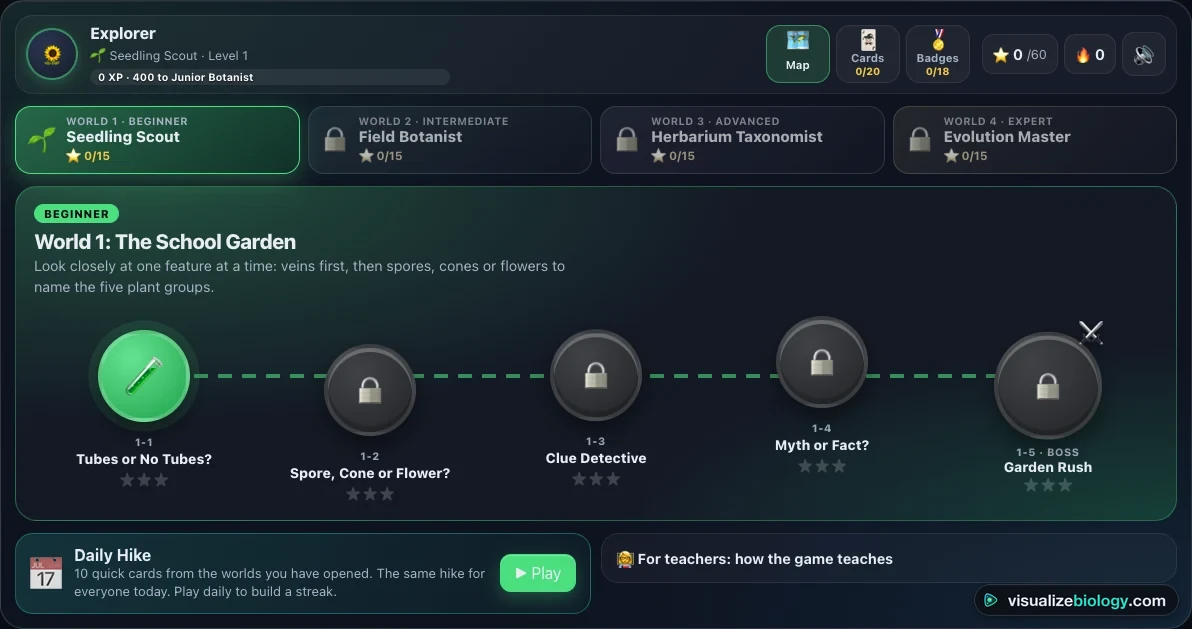
Press Game to open Kingdom Quest: Plants, a plant kingdom classification game in four worlds of five stages. Each stage teaches one skill with its own kind of play. It opens with a mission brief and a worked example, names the deciding feature after every answer, and ends with a recap. Clues on the cards fade as you level up, and each world ends with a timed boss rush with three hearts.
| World | Level | What you play |
|---|---|---|
| 1 · The School Garden | Beginner | Tubes or No Tubes? (vascular or not), Spore, Cone or Flower? (five groups), Clue Detective, Myth or Fact?, Garden Rush |
| 2 · Woods, Bogs & Meadows | Intermediate | Vein Reader (monocot vs dicot), Phylum Party, Feature Match, Key Runner (plant dichotomous key), Expedition Rush |
| 3 · The Herbarium | Advanced | Rank Tower (the seven ranks), Nesting Boxes, Name Smith (binomial names), Cousin Finder, Herbarium Curator |
| 4 · The Tree of Life | Expert | Character Matrix, Which Generation Rules? (alternation of generations), Key Architect, Tree Builder (plant cladogram), Tree of Life Showdown |
Each stage gives up to three stars for first-try accuracy. You also earn XP, a rank from Seedling Scout to Grand Botanist, a specimen card for every stage, 18 badges and a Daily Hike streak. Progress stays in your browser, with no login. Teachers can unlock every stage or link a class straight to one with ?mode=game&stage=2-1.
Printable plant classification worksheet
Press Download worksheet for a printable classification of plants worksheet: a PDF of up to three pages with a QR code back to the tool. It covers key words, sorting picture cards into algae, bryophytes, ferns and allies, gymnosperms, monocots and dicots, the seed-plant part of the dichotomous key, a table of ranks with blanks, true or false, a plant cladogram from a character table, Simpson's index for a lawn quadrat and a Compare task. Choose 10, 20 or 30 marks, and tick the answer key for a teacher's copy. Every version number gives different plants.
Experiments and course links
| Practical | What you find out | Course links |
|---|---|---|
| School-ground plants and a key | Identify lawn, wall, hedge and pond plants with a dichotomous key | IGCSE 0610 1.2–1.3; KS2 Year 6 |
| Sort a herbarium sample | Classify 12 plants with no hints, marked at the end | Florida SC.912.L.14.53; NCERT 11 ch. 3 |
| Build your own key | Write a plant dichotomous key for six plants (n − 1 couplets) | IGCSE 0610 1.2; IB A3.2 |
| Build a plant cladogram | Order plants by shared derived characters | AP Bio 7.9; NGSS HS-LS4-1 |
| Which pepper is the tomato's cousin? | Compare relatives by the ranks they share | AQA GCSE 4.6.4 |
| Lawn quadrat survey | Simpson's index of diversity from a quadrat count | AQA A-level 3.4.6; IB C4.1 |
Who uses this plant classification game?
Middle and high school students in the US use it for vascular and nonvascular plants, seedless and seed plants, and gymnosperms vs angiosperms. In England, IGCSE and GCSE students use it for keys, ferns and flowering plants, and monocots and dicots. AP, A-level, IB and NCERT students use it for cladograms, alternation of generations and biodiversity indices, and teachers project it in class. It is an educational model of a subject that keeps changing: classifications are revised as new DNA evidence arrives, and species counts are rounded estimates.
Frequently asked questions
How are plants classified?
Plants are sorted into groups inside groups by the features they share, which reflect how closely they are related. The big splits follow evolution: plants with or without vascular tissue (xylem and phloem), with spores or with seeds, and with naked seeds (gymnosperms) or seeds inside fruits (flowering plants). The seven ranks are kingdom, phylum (also called division), class, order, family, genus and species: an apple is Plantae, Magnoliophyta, Magnoliopsida, Rosales, Rosaceae, Malus, Malus domestica. Plant family names end in -aceae.
What is the difference between monocots and dicots?
Monocots have one seed leaf (cotyledon), long leaves with parallel veins, flower parts in threes, vascular bundles scattered through the stem and fibrous roots: grasses, lilies, orchids, palms and onions. Dicots have two seed leaves, broad net-veined leaves, flower parts in fours or fives, bundles in a ring and usually a tap root: roses, beans, daisies, oaks and tomatoes. Modern botany calls most dicots eudicots; a few early branches such as water lilies and magnolias are counted separately.
What is the difference between gymnosperms and angiosperms?
Both make seeds, but gymnosperms (cycads, ginkgo, conifers and gnetophytes) carry naked seeds on cone scales or leaves and never flower, while angiosperms (flowering plants) grow their seeds inside an ovary that ripens into a fruit. Angiosperms also have double fertilisation, which makes the endosperm food store, and xylem vessels. About 1100 gymnosperm species are known, against about 295 000 flowering plants.
What are vascular and nonvascular plants?
Vascular plants have xylem, which carries water and minerals up from the roots, and phloem, which carries sugar; this lets them grow true roots, stems and leaves and stand tall. Ferns, horsetails, clubmosses and all seed plants are vascular. Nonvascular plants, the bryophytes (mosses, liverworts and hornworts), have no xylem or phloem, so they stay small, live in damp places and are held down by thin rhizoids instead of roots.
Is there a free plant classification game with levels?
Yes. The Game mode on this page, Kingdom Quest: Plants, is a free plant kingdom classification game with 20 levels in four worlds, from Beginner (vascular or not, the five plant groups) to Expert (derived characters, alternation of generations, building a plant dichotomous key and a cladogram). It gives stars, XP, specimen cards and badges, saves progress in the browser with no login, and works on iPads, Chromebooks and phones.
Is there a free printable plant classification worksheet?
Yes. Press Download worksheet in the top bar, next to the unit switch, and the simulator makes a printable classification of plants worksheet as a PDF of up to three pages: key words, sorting plants into algae, bryophytes, ferns, gymnosperms, monocots and dicots, a plant dichotomous key, the seven ranks and scientific names, true or false, a plant cladogram, Simpson's index for a lawn quadrat and a task checked in the simulator. Choose 10, 20 or 30 marks, and tick the answer key for a teacher's copy. Nothing you type is sent or saved.
Explore related simulators
Sort the other kingdom in the Animal Kingdom Classification game. Watch a seed's embryo and its one or two seed leaves wake up in the Seed Germination Virtual Lab. Follow pollen to the ovule in the Pollination Simulator, see how xylem and phloem move water and sugar in the Xylem and Phloem Simulator, and count stomata on a monocot and a dicot leaf in the Leaf Structure & Stomata Virtual Lab. Monocots and dicots differ inside too: see their stems and roots in section in the Plant Tissues Virtual Lab.
Sources: OpenStax Biology 2e, chapters 25 and 26; Urry et al., Campbell Biology, 12th edition, chapters 29 and 30; Christenhusz and Byng, Phytotaxa 261 (2016) for species counts; PPG I (2016) for lycophytes and ferns; APG IV (2016) for flowering plants; Christenhusz et al. (2011) for gymnosperms; One Thousand Plant Transcriptomes Initiative, Nature 574 (2019) for the land-plant tree.
Updated