
Animal Classification: Sort the Animal Kingdom into Phyla and Classes
Drag real animals onto the tree of life, then morph it from the ranks you learn (kingdom, phylum, class) into the evolutionary tree. Walk the dichotomous key, compare relatives, fill your field guide and beat ten quiz levels.
The seven ranks
Lab notebook
Every animal you classify, every key you walk, every comparison and every quiz result is written here. Export a CSV, or turn the session into a PDF lab report.
| # | Activity | Animal / group | What you did | Result |
|---|
Concept library
Click "New problem" to begin.
Click "Start quiz" for 5 questions: ranks and names, vertebrates, invertebrates, keys and evolution.
1 Overview
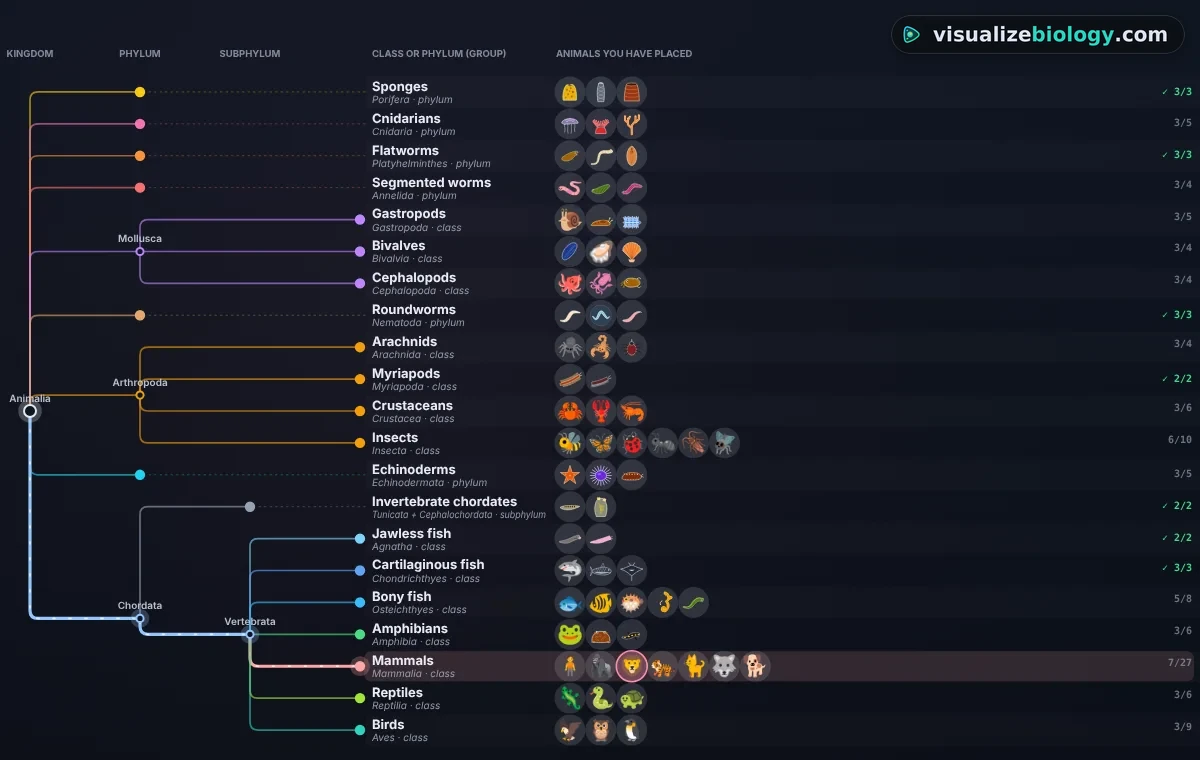
The left of the lab is the tree of the animal kingdom: Animalia at the root, the phyla, subphyla and classes on the way out, and 21 groups at the tips. The right is a card that shows whatever you pick: a group, an animal, the key, a comparison or your field guide. Pick an activity from the row of cards above the lab (Sort, Key, Compare, Explore, Collect). Three modes: Simulate (free lab with learning aids and the concept library), Experiment (six practicals with a method, a conclusion and a PDF report) and Quiz (ten interactive levels and a theory quiz).
2 Sorting animals onto the tree
A handful of animals waits in the tray at the bottom of the tree. Drag one onto the row of its group, or tap it and then tap the row (with a keyboard: Tab to an animal, Enter to pick it up, ↑ ↓ to choose a row, Enter to drop). With "Check each drop" on, a right answer flies into place and adds the animal to your field guide; a wrong one comes back with the reason (for example, a whale has hair and feeds its calf on milk, so it is a mammal). If you were close (the right phylum but the wrong class) the coach says so. 🔀 New animals deals another handful; Find (🔍) lets you look up any animal by name.
3 Ranks and evolution
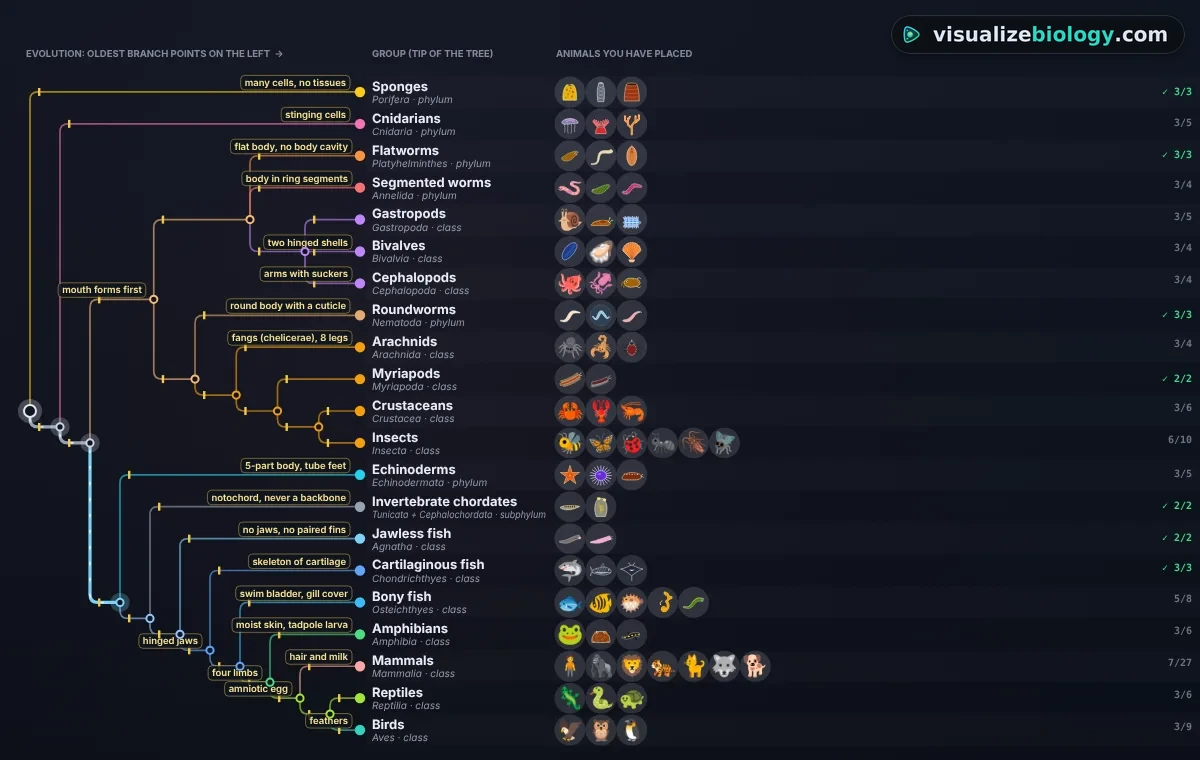
🪜 Ranks draws the Linnaean hierarchy you learn: kingdom, phylum, subphylum and class in columns. 🌳 Evolution morphs the same groups into the evolutionary tree (a cladogram): the oldest branch points are on the left, and each branch carries the trait it gained (true tissues, bilateral symmetry, a backbone, jaws, four limbs, the amniotic egg, feathers…). Watch where the groups move: fish are not one branch, birds sit inside the reptiles, and starfish are closer to you than to jellyfish. Turn on "Number of species" to see how many species each group has (the arthropods dwarf everything).
4 Group, animal, key and compare
Click a row or a branch point for its Group card: what defines it, how many species, and its animals. Click an animal for its Animal card: the binomial name, all seven ranks, its features, size and a fact; the seven-rank ladder below the lab shows how many species share each rank. The Key walks any animal (or a mystery one) through a 20-couplet dichotomous key: every answer fades the groups it rules out, and with hints on a wrong answer is explained. Compare puts two animals side by side, lights both paths on the tree and the branch point they share, and counts the ranks they have in common.
5 Field guide, XP and badges
Every animal you classify correctly (by sorting, the key, or a quiz) is added to your field guide (🏆 Guide). Undiscovered animals show as silhouettes. You earn XP, a rank from Beginner to Taxonomist, and a badge for each group you complete. Progress is saved in this browser only; Reset clears it.
6 Experiment mode and the lab report
Six practicals: identify minibeasts from a pond and leaf litter with a key; sort a mixed sample with no hints (marked at the end); build your own dichotomous key for six animals; build a cladogram from a table of characters; compare relatives rank by rank; and survey a rock pool, identify each kind and calculate Simpson's index of diversity. Each has an aim, a method that ticks itself off, a conclusion question and a PDF lab report.
7 Quiz: interactive and theory
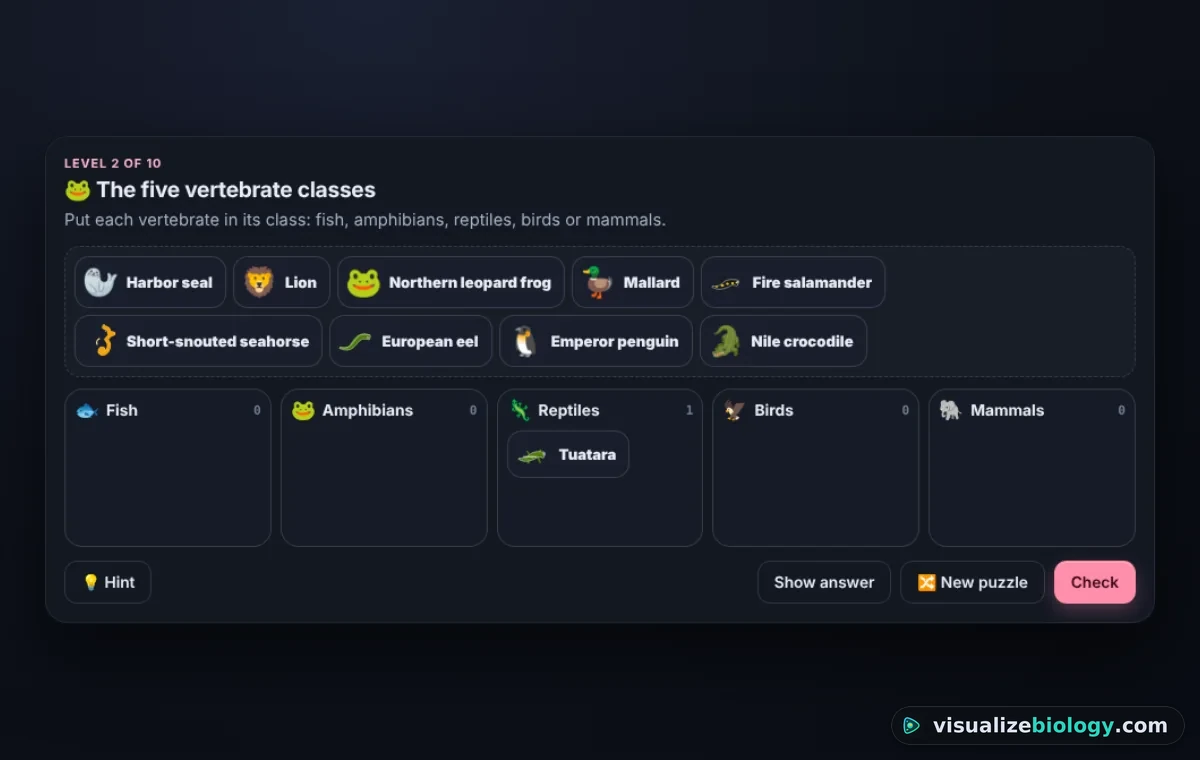
The interactive quiz has ten levels: backbone or not, the five vertebrate classes, invertebrate phyla, count the legs (arthropods), match the feature, odd one out, use the key, the closest relative, ranks in order and build the cladogram. Earn up to three stars per level (3 first time, 2 on a second try or after a hint, 1 after that); 🔀 New puzzle makes another at the same level. The theory quiz has a practice mode with worked solutions and a 5-question test.
8 Units, keys and phones
SI | US switches the sizes and masses on the animal cards (cm, m and kg ↔ inches, feet and pounds). Keys: T switch the tree, N new animals, K key, C compare, F find, Esc cancel. On a phone the switch at the top picks the Tree or the Card, messages appear in the strip above it, and the deck at the bottom holds the animals, Find, Tree and Aids.
Animal classification: how the animal kingdom is sorted
- Animals
- 121 real species with binomial names and all seven ranks, from sponges to people
- Groups
- 21: nine phyla, the arthropod and mollusc classes, and the vertebrate classes
- You do
- Sort, walk a dichotomous key, compare relatives, build keys and cladograms, collect a field guide
- Modes
- Simulate, Experiment (6 practicals with a PDF report) and Quiz (10 interactive levels + theory)
- Courses
- NGSS MS-LS4-2, HS-LS4-1; AP Bio 7.9; AQA GCSE 4.6.4; IGCSE 0610 topic 1; A-level 3.4.5–3.4.6; IB A3.2; NCERT 11 ch. 4
- Price
- Free, with no account or download; works on Chromebooks, tablets and phones
How animals are classified: the seven ranks
Biologists sort living things into groups inside groups, ranked from the broadest to the narrowest: kingdom, phylum, class, order, family, genus and species (remember it as King Philip Came Over For Good Soup). A lion is Animalia › Chordata › Mammalia › Carnivora › Felidae › Panthera › Panthera leo. Each rank holds fewer, more closely related species than the one above it: about 1.5 million described animals, 78,000 chordates, 6,600 mammals, about 290 carnivores, 41 cats, 5 big cats and one lion. Two animals that share more ranks are more closely related: a lion and a tiger share six, a lion and a house cat five, a lion and a wolf four. Carl Linnaeus gave each species a two-part binomial name, genus then species, written in italics with a capital letter only for the genus: Homo sapiens.
Vertebrates and invertebrates
The first question in most keys is "does it have a backbone?". Vertebrates have a backbone of vertebrae and a skull. They are the best-known animals but only about 5 % of animal species. Invertebrates have no backbone and belong to many different phyla. Tricky cases are the best lessons. A jellyfish and a starfish are not fish. A lancelet looks like a fish and has a notochord, but no backbone. A caecilian has no legs, yet it is an amphibian with a backbone.
The five classes of vertebrates
| Class | Body covering | Breathing | Eggs or young | Temperature | Tricky members |
|---|---|---|---|---|---|
| Fish | Wet scales (sharks: denticles) | Gills | Eggs in water | Ectotherm | Seahorse, eel, lungfish, whale shark |
| Amphibians | Moist skin, no scales | Gills as larvae; lungs and skin | Jelly eggs in water | Ectotherm | Toad, axolotl, caecilian |
| Reptiles | Dry scales or plates | Lungs | Shelled eggs on land | Ectotherm | Sea turtle, tuatara, snake |
| Birds | Feathers | Lungs with air sacs | Hard-shelled eggs | Endotherm | Penguin, ostrich |
| Mammals | Hair or fur | Lungs | Live young fed on milk (monotremes lay eggs) | Endotherm | Whale, bat, platypus |
The invertebrate phyla
Sponges (Porifera) have no true tissues; water is pumped through their pores. Cnidarians (jellyfish, corals, anemones) are radially symmetrical and sting. Flatworms are flat with one gut opening; roundworms are smooth and round; segmented worms (annelids) are built of rings. Molluscs have a mantle and a muscular foot: gastropods (snails), bivalves (clams) and cephalopods (octopuses). Echinoderms (starfish, sea urchins) have five-part bodies and tube feet. Arthropods, with jointed legs and an exoskeleton, are the largest phylum by far, with more than a million insect species. Count the legs to tell them apart: insects have 6, arachnids 8, crustaceans 10 or more (a woodlouse has 14) and myriapods many.
How to use a dichotomous key
A dichotomous key identifies an organism with a series of couplets. Each couplet gives two contrasting choices (1a: has a backbone; 1b: no backbone), and each choice leads to another couplet or to a name. Good couplets use features you can check yourself, such as the number of legs or whether the skin is dry. Avoid opinions ("is it big?"). A key that names n organisms always has n − 1 couplets. The key in this simulator has 20 couplets that lead to 21 groups. As you answer it, the tree greys out every group your answer rules out. In Experiment mode you build your own key for six animals.
Classification and evolution: reading a cladogram
Modern classification tries to make every group a clade: an ancestor and all its descendants. A cladogram shows the order in which groups branched off. Each branch point is a common ancestor, and each shared derived character (backbone, jaws, bony skeleton, four limbs, amniotic egg, hair) is marked where it first appeared. Morphing the ranks into the evolutionary tree shows some surprises. "Fish" is not a single clade, because lungfish are closer to you than to a tuna. Birds branch off inside the reptiles, closest to crocodiles. Starfish and humans are both deuterostomes, so a starfish is a closer relative of yours than of a jellyfish. DNA is now the main evidence. It showed, for example, that whales belong in the same order as hippos.
A gamified biology lesson on classification
The simulator is built as a game because sorting is a skill you learn by doing it, getting it wrong and seeing why. You drag an animal to a group and get feedback at once. A wrong answer is explained with the feature that decides it. Every animal you get right goes into your field guide, and you earn XP, ranks and a badge for each group you complete. The interactive quiz has ten levels, from sorting vertebrates and invertebrates up to building a cladogram. You earn up to three stars on each, and a new puzzle can be made at any level for practice. Teachers can project the tree, run the quiz as a class competition with the classroom QR code, or set a practical and collect the PDF lab reports.
Experiments and course links
| Practical | What you find out | Course links |
|---|---|---|
| Minibeasts and a key | Identify pond and leaf-litter invertebrates with a dichotomous key | IGCSE 0610 1.3; NGSS MS-LS1-1 |
| Sort a mixed sample | Classify 12 animals with no hints, marked at the end | AQA GCSE 4.6.4; NCERT 11 ch. 4 |
| Build your own key | Write a dichotomous key for six animals (n − 1 couplets) | IGCSE 0610 1.2; IB A3.2 |
| Build a cladogram | Order taxa by shared derived characters | AP Bio 7.9; NGSS HS-LS4-1; IB A3.2 |
| Who is related to whom? | Compare relatives by the ranks they share | AQA GCSE 4.6.4; A-level 3.4.5 |
| Rock pool survey | Simpson's index of diversity from a sample | AQA A-level 3.4.6; OCR 4.2.1; IB C4.1 |
Who uses this animal classification game?
Middle and high school students use it to learn the vertebrate classes and invertebrate phyla for NGSS, GCSE, IGCSE and NCERT. Students in AP Biology, A-level and IB use it for cladograms, taxonomy and biodiversity indices. Teachers project it in class. It is an educational model of a subject that keeps changing: classifications are revised as new DNA evidence arrives, and species counts are rounded estimates.
Frequently asked questions
How are animals classified?
Animals are sorted into groups inside groups by the features they share, which reflect how closely they are related. The seven main ranks are kingdom, phylum, class, order, family, genus and species (King Philip Came Over For Good Soup). A lion is Animalia, Chordata, Mammalia, Carnivora, Felidae, Panthera, Panthera leo. The higher the rank, the more species it holds: about 1.5 million in the animal kingdom, about 6,600 in class Mammalia, one in a species. Today DNA evidence is used to check that each group really shares a common ancestor.
What are the five classes of vertebrates?
Fish (fins and gills all their life; scientists split them into jawless, cartilaginous and bony fish), amphibians (moist skin, eggs laid in water, tadpole larvae), reptiles (dry scaly skin, shelled eggs laid on land), birds (feathers, beaks, hard-shelled eggs, warm-blooded) and mammals (hair or fur, milk for their young, warm-blooded). A whale is a mammal and a penguin is a bird, whatever their shape or habitat.
What is a dichotomous key?
A dichotomous key identifies an organism through a series of couplets, each with two contrasting choices (1a: has a backbone; 1b: no backbone). Each choice leads to another couplet or to a name. Good couplets use features anyone can check, such as the number of legs, and a key for n organisms always has n − 1 couplets. In this game the key prunes the tree of life as you answer it.
What is the difference between vertebrates and invertebrates?
Vertebrates have a backbone of vertebrae around the spinal cord and a skull: fish, amphibians, reptiles, birds and mammals. Invertebrates have no backbone. They make up about 95 % of animal species and belong to many phyla, from sponges and jellyfish to worms, molluscs, echinoderms and the arthropods, the largest phylum with more than a million species.
Explore related simulators
See where these animals sit in a habitat, and who eats whom, in Build the Food Chain. Watch a population of rabbits evolve under fox predation in the Natural Selection Simulator. Open one amphibian and one insect in the Virtual Frog Dissection and the Virtual Cockroach Dissection, and follow complete metamorphosis in the Butterfly Life Cycle Simulator. Meet a single-celled organism that is not an animal at all in the Virtual Amoeba Simulator.
Sources: OpenStax Biology 2e, chapters 20 and 27–29; Urry et al., Campbell Biology, 12th edition, chapters 26 and 32–34; Zhang (ed.), Animal biodiversity: an outline of higher-level classification, Zootaxa 3703 (2013); Catalogue of Life (2024); the Reptile Database, AmphibiaWeb and the Mammal Diversity Database for species counts; International Code of Zoological Nomenclature, 4th edition (1999).
Updated