
Butterfly Life Cycle Simulator: Egg, Caterpillar, Chrysalis, Butterfly
Watch a monarch butterfly's whole life in 2D or 3D: a 1 mm egg hatches, the caterpillar eats and molts four times, hangs in a J and becomes a chrysalis, and the butterfly emerges and lays the next egg. See the key features of every stage and how many days each one lasts.
What's happening
Lab notebook
Every hatching, molt, pupation and emergence is written here with the day it happened. Export a CSV, or turn the session into a PDF lab report.
| # | Butterfly | What | Result | Value |
|---|
Concept library
Click "New problem" to begin.
Click "Start quiz" for 5 questions on the stages of the life cycle, the caterpillar, metamorphosis, the butterfly and a calculation.
1 Overview
Simulate shows a butterfly on its host plant on the left (a monarch on milkweed, or a painted lady on mallow), in 2D or 3D, and close-ups on the right: the life-cycle Cycle wheel, Inside the current stage, Growth graphs and a Timing chart. One model runs it all, from the egg to the egg the adult lays. Experiment has five practicals that end in a PDF lab report, and Quiz has a practice quiz with worked solutions and a 5-question quiz.
2 Watching the life cycle
- Press ▶ (or Space) to play. At Teach speed every stage gets a few seconds on screen, so the whole cycle takes about two minutes; 1 h/s and 1 day/s run at a fixed rate. › jumps to the next stage.
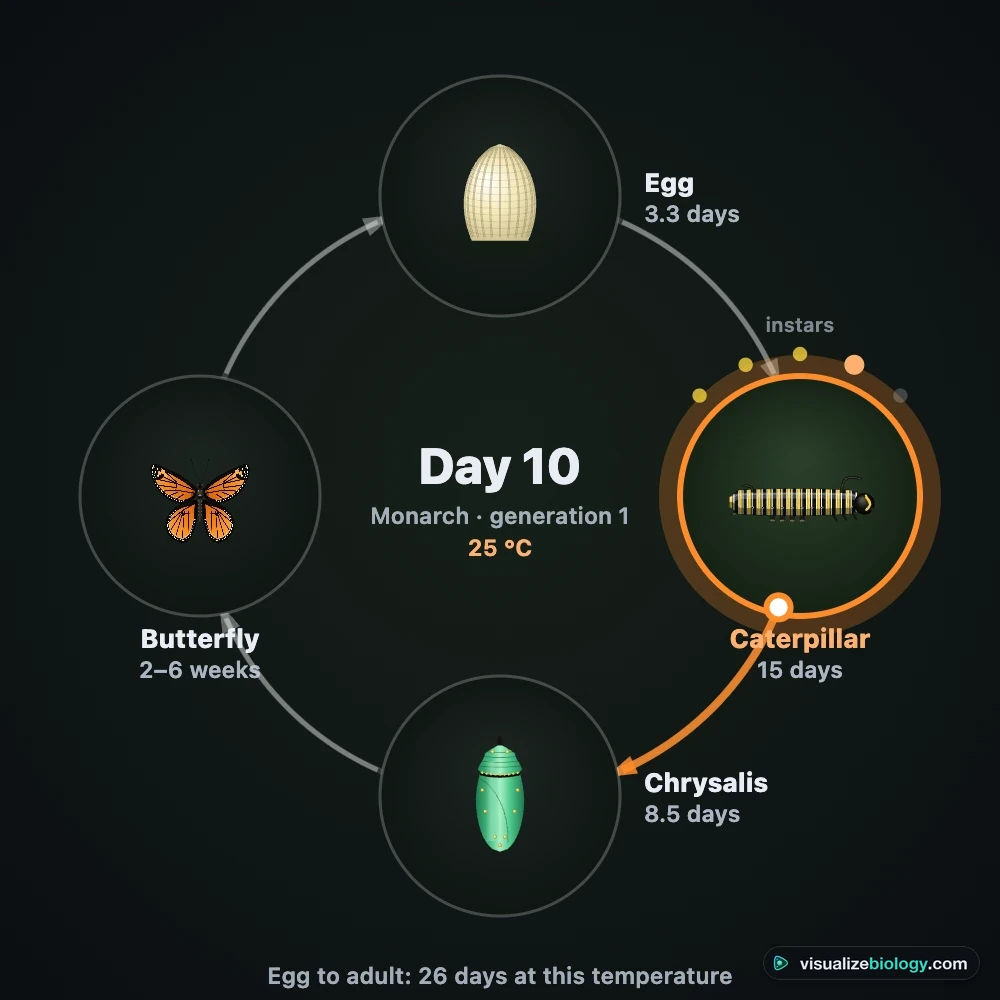
- The strip under the clock shows the nine steps: egg, five instars, the J-hang, the chrysalis and the butterfly. The clock counts days since the egg was laid.
- Use Jump to in the Life panel to go straight to a stage, or tap a stage on the Cycle wheel.
3 Camera, labels and parts
- Follow keeps the animal at a readable size: the 1 mm egg is magnified many times, and the scale bar shows real millimetres. Whole plant shows it life size with a magnifier.
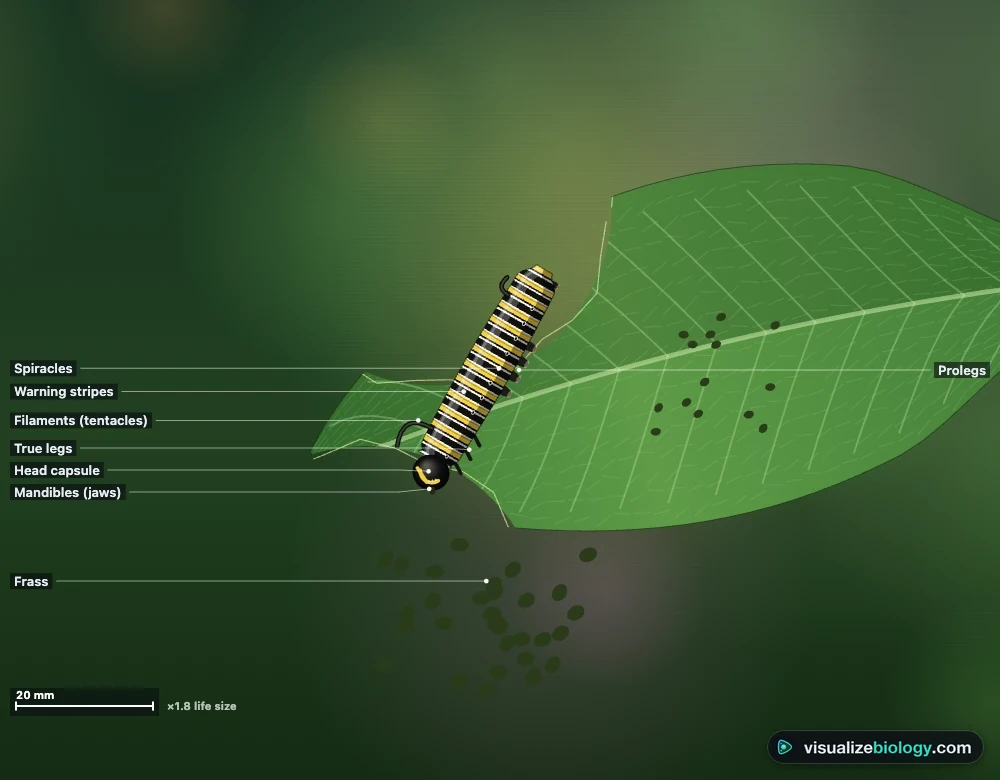
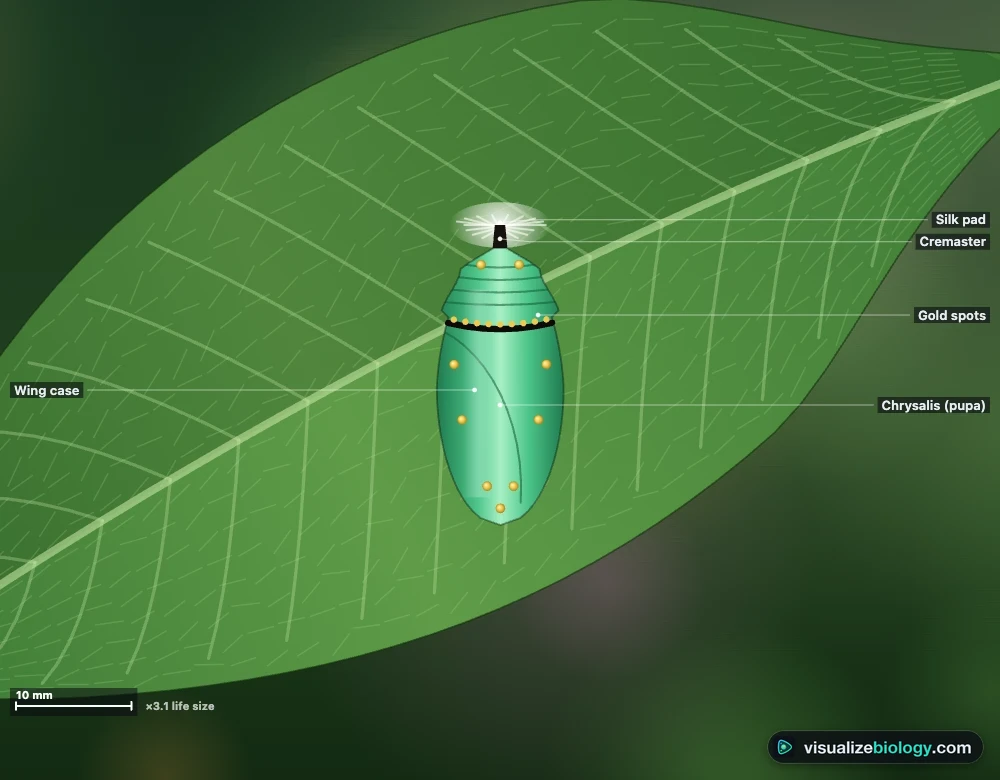
- Tap any part (head capsule, prolegs, spiracles, cremaster, wings, proboscis…) to name it and see its job. Labels can be switched off in View.
- In 3D drag to turn the garden; hold Ctrl or ⌘ and scroll (or pinch) to zoom. The camera keeps following the animal from the angle you choose.
4 Temperature, species and generations
In Weather, temperature sets the speed of development: a monarch takes about 26 days from egg to adult at 25 °C and about 42 days at 20 °C, and does not develop below about 11.5 °C. Above 30 °C it slows again. In Life choose the monarch or the painted lady, and the monarch's summer or migratory generation, which does not breed and lives up to 8 months.
5 Experiment mode and the lab report
Five practicals: name the stage, raise a caterpillar and measure it each day with a ruler, rear eggs at different temperatures, measure head capsules (Dyar's rule), and measure how much leaf each instar eats. Each shows its aim, what you need and a real-lab safety note; the method ticks off as you work, a conclusion question checks your result, and Create lab report builds a PDF.
6 Units and keyboard
- SI | US switches between °C and millimetres and °F and inches; masses stay in mg and g in both.
- Space plays or pauses, → jumps to the next stage, 1 and 2 choose Follow or Whole plant, N lays a new egg, S opens Status and Esc clears the selection. Right-click the garden or the close-up to save it as an image.
The butterfly life cycle, stage by stage
Every butterfly goes through four stages: egg, larva (caterpillar), pupa (chrysalis) and adult. This butterfly life cycle simulator follows one monarch, the butterfly most US classrooms raise, from a 1 mm egg on a milkweed leaf to a butterfly laying the next egg, in 2D or 3D. Every stage is animated, every part can be tapped and named, and the duration of each stage comes from real development data, so warm weather makes it go faster and cold weather slower.
- Species
- Monarch (on milkweed) and painted lady (on mallow and thistle)
- Stages
- Egg, five caterpillar instars and four molts, the J-hang, the chrysalis, eclosion and the adult
- Views
- 2D and 3D garden, life-cycle wheel, inside each stage, growth and timing graphs
- Modes
- Simulate, Experiment (5 practicals with a PDF report) and Quiz
- Price
- Free, with no account or download; works on Chromebooks, tablets and phones
The 4 stages of the butterfly life cycle
| Stage | How long (monarch, about 25 °C) | Key features |
|---|---|---|
| 1. Egg | 3–4 days | About 1.2 mm tall, cream, with fine ridges; laid singly under a milkweed leaf; the black head shows through before it hatches |
| 2. Larva (caterpillar) | About 2 weeks | The eating and growing stage; five instars and four molts; grows from about 2 mm to 45 mm and over 2000 times heavier |
| 3. Pupa (chrysalis) | 8–10 days | Jade green with gold spots, hanging from a silk pad; does not eat; the body is rebuilt inside |
| 4. Adult (butterfly) | 2–6 weeks (migrants up to 8 months) | Six legs, four scaly wings, clubbed antennae and a proboscis; feeds on nectar, mates and lays about 400 eggs |
How long does each stage last?
Insects are cold-blooded, so they develop faster when it is warm. Each stage needs a set amount of warmth, measured in degree-days: for a monarch about 45 degree-days above 11.5 °C for the egg, about 200 for the caterpillar and about 115 for the chrysalis (Zalucki, 1982). At 25 °C that gives about 26 days from egg to adult; at 20 °C about 42 days; and at 15 °C more than three months. Above about 30 °C development slows down again and many caterpillars die. Change the temperature in the simulator and the Timing chart shows every stage.
Caterpillar instars and molting
A caterpillar's skin can stretch a little, but its hard head capsule cannot grow at all, so it grows in steps. It stops eating, a new, looser skin forms underneath, and the old skin splits behind the head and is shed: a molt. The stage between two molts is an instar. A monarch has five instars, and its head capsule is about 1.5 times wider after each molt (Dyar's rule). Two hormones control this: ecdysone triggers each molt, and juvenile hormone decides what the molt makes. While juvenile hormone is high the molt makes a bigger caterpillar; in the fifth instar it disappears, so the next molt makes a pupa. The fifth instar eats about three quarters of all the food of the caterpillar's life.
What happens inside a chrysalis?
The full-grown caterpillar leaves its plant, spins a silk pad, hangs head-down in a J and sheds its skin one last time to reveal the chrysalis, hooked into the silk by its cremaster. Inside, enzymes break down most of the caterpillar's body (histolysis), while groups of cells set aside in the larva, the imaginal discs, grow into the wings, legs, antennae, eyes and proboscis of the adult. The day before it emerges the chrysalis turns clear. Then the adult splits the case (eclosion), hangs from it and pumps blood into its crumpled wings, which take a few hours to dry before its first flight.
Complete vs incomplete metamorphosis
| Complete metamorphosis | Incomplete metamorphosis | |
|---|---|---|
| Stages | Egg, larva, pupa, adult (4) | Egg, nymph, adult (3) |
| Young | A larva that looks nothing like the adult | A nymph that looks like a small adult without wings |
| Pupa | Yes | No |
| Examples | Butterflies, moths, beetles, flies, bees, ants | Grasshoppers, cockroaches, dragonflies, true bugs |
The monarch and the painted lady
Monarch caterpillars eat only milkweed and store its bitter cardenolides, so their stripes warn birds away. Several generations follow each other through a North American summer; the one that emerges in late summer does not breed, but migrates up to 4,000 km to the mountains of Mexico and lives up to 8 months. The painted lady, the butterfly of most classroom kits, has spiny caterpillars that eat mallow and thistle, a bronze chrysalis and a complete cycle of about three weeks at room temperature.
Practicals and course links
| Practical | What you find out | Course links |
|---|---|---|
| Name the stage | The features of each of the four stages | NGSS 3-LS1-1; NCERT 8 |
| Raise and measure a caterpillar | How fast a caterpillar grows, day by day | NGSS 3-LS1-1, MS-LS1-5 |
| Temperature and development time | Why warm weather speeds up the life cycle | NGSS MS-LS1-5; IGCSE |
| Head capsules and Dyar's rule | Why caterpillars grow in steps | High school biology; IB |
| How much does a caterpillar eat? | Which instar eats the most | NGSS MS-LS1-5 |
Who uses this butterfly life cycle simulator?
Elementary and middle school students learning about life cycles (NGSS 3-LS1-1), classes raising caterpillars who want to see what happens inside the chrysalis, high school students studying metamorphosis, molting hormones and degree-days, and teachers who want a free, no-login butterfly life cycle animation for a classroom screen or students' Chromebooks.
Frequently asked questions
What are the 4 stages of the butterfly life cycle?
Egg, larva (caterpillar), pupa (chrysalis) and adult (butterfly). The egg is laid on the host plant and hatches into a caterpillar, which eats and grows, molting four times. The full-grown caterpillar hangs from a silk pad and becomes a chrysalis, in which its body is rebuilt into an adult. The butterfly emerges, feeds on nectar, mates and lays eggs, so the cycle begins again. Because there is a pupa between a larva and an adult that look completely different, this is called complete metamorphosis.
How long does it take for a caterpillar to turn into a butterfly?
For a monarch in summer (about 25 °C), about four weeks from egg to adult: the egg hatches in 3 to 4 days, the caterpillar grows for about 2 weeks and the chrysalis lasts 8 to 10 days. The butterfly then lives 2 to 6 weeks. Development depends on temperature: at 20 °C the same cycle takes about 6 weeks, and below about 11 °C a monarch does not develop at all. The monarchs that hatch in late summer migrate and can live up to 8 months.
What happens inside a chrysalis?
Most of the caterpillar's body is broken down by its own enzymes into a soup of cells and nutrients, a process called histolysis. Small groups of cells that were set aside in the caterpillar, the imaginal discs, then grow into the adult's wings, legs, antennae, eyes and proboscis, using the fat the caterpillar stored. The day before the butterfly emerges, the chrysalis turns clear and the folded orange and black wings of a monarch show through.
Explore related simulators
Butterflies sip nectar and carry pollen from flower to flower: follow a grain of pollen to a seed in the Pollination Simulator. A caterpillar is a herbivore, a primary consumer: put it in a food web with Build the Food Chain. Frogs change shape as they grow too, from tadpole to frog: see the life cycle in the Virtual Frog Dissection. Look at butterfly scales and caterpillar hairs under the lens with the Virtual Microscope, and see where the leaves the caterpillar eats get their energy in the Photosynthesis Lab.
Sources: Zalucki (1982), Journal of the Australian Entomological Society 21, for monarch degree-days; Oberhauser and Kuda, A Field Guide to Monarch Caterpillars (Monarch Larva Monitoring Project), for instar sizes; OpenStax Biology 2e, chapters 27 and 29; Urry et al., Campbell Biology 12th edition, chapters 33 and 45; Dyar (1890), Psyche 5. Stage durations, sizes and the amount of food eaten follow these sources; individual butterflies vary, and the simulator is an educational model.
Updated