
Pollination Simulator: How Flowering Plants Make Seeds
An interactive plant reproduction animation, from flower to fruit: send a bee, a bird or the wind with pollen, follow every grain down its pollen tube, and watch double fertilization turn ovules into seeds. Worked examples: the hibiscus and the lily.
What's happening
Lab notebook
Every visit, every fertilization and every fruit is written here, with the time of day. Export a CSV, or turn the session into a PDF lab report.
| # | Flower | What | Result | Value |
|---|
Concept library
Click "New problem" to begin.
Click "Start quiz" for 5 questions on the parts of a flower, pollination, the pollen tube, double fertilization and seeds.
1 Overview
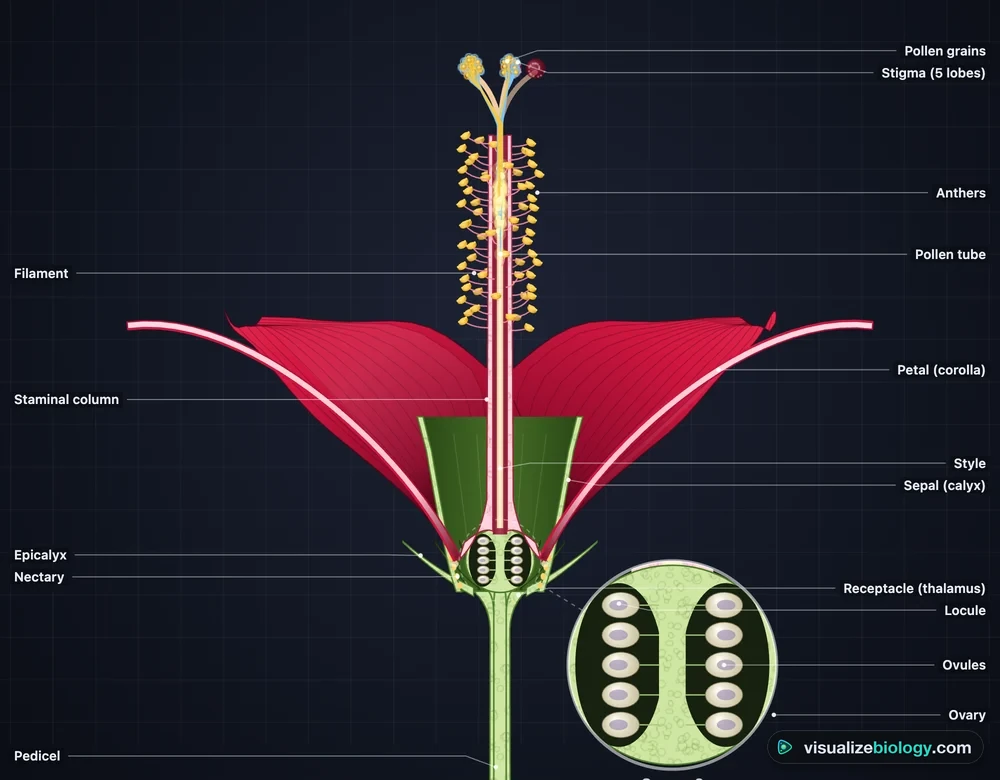
Simulate shows one hibiscus flower on the left, cut in half (Section), whole (Flower) or on its plant in a Garden, and close-ups on the right: a pollen grain, the stigma surface, the ovary in cross-section, one ovule and a graph. Everything follows one model of the flower's day, from the bud opening at dawn to the fruit a month later. Experiment has five practicals that end in a PDF lab report, and Quiz has a practice quiz with worked solutions and a 5-question quiz.
2 Pollinating the flower
- In the Pollinate panel choose where the pollen comes from: this flower (autogamy), another flower on the same plant (geitonogamy) or another plant (xenogamy, cross-pollination).
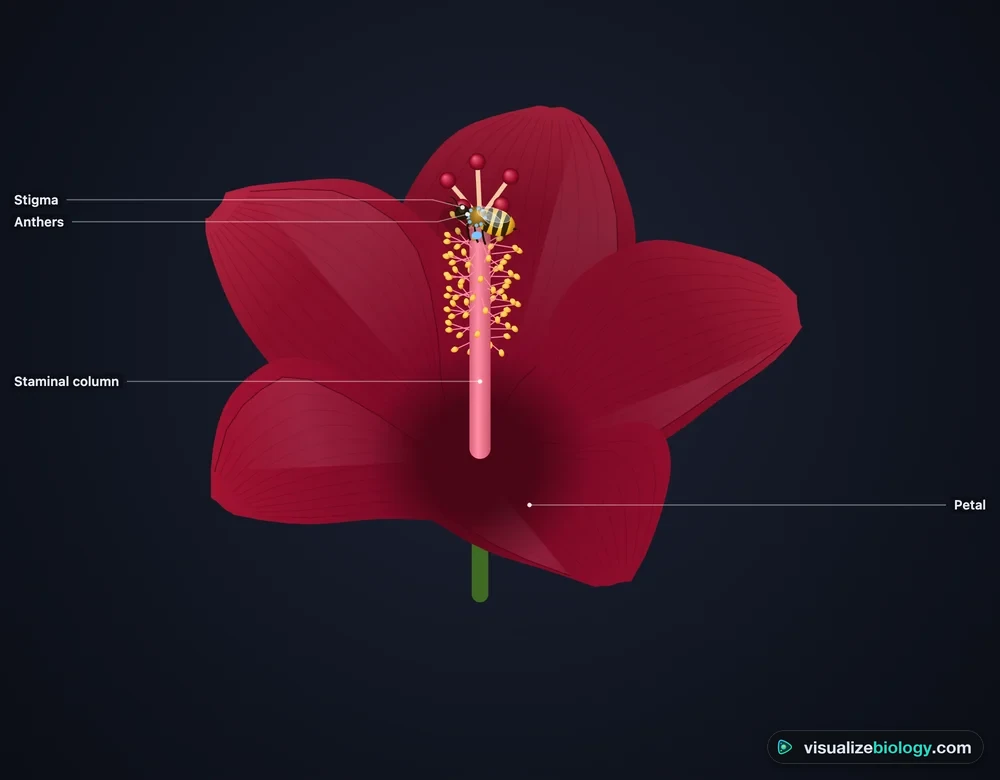
- Choose who carries it: a bee, a sunbird or hummingbird, a butterfly, the wind or a paintbrush (hand pollination). Then press Pollinate (key P). Visitors leave different amounts of pollen, and the wind hardly moves hibiscus pollen at all.
- Press ▶ to run the flower's day. With nothing on the stigma yet, ▶ first sends the chosen visitor, then plays everything that follows: germination, the pollen tubes, double fertilization and the fruit.
3 Reading the section and the close-ups
- Tap any part of the flower to name it and see its job; the labels can be switched off in View. Grains and tubes are drawn larger than life so you can see them.
- With Color pollen by source on, each grain and tube is ringed in the color of where its pollen came from (blue: another plant, orange: the same plant, gold: the same flower). A red cross marks a tube the plant stopped.
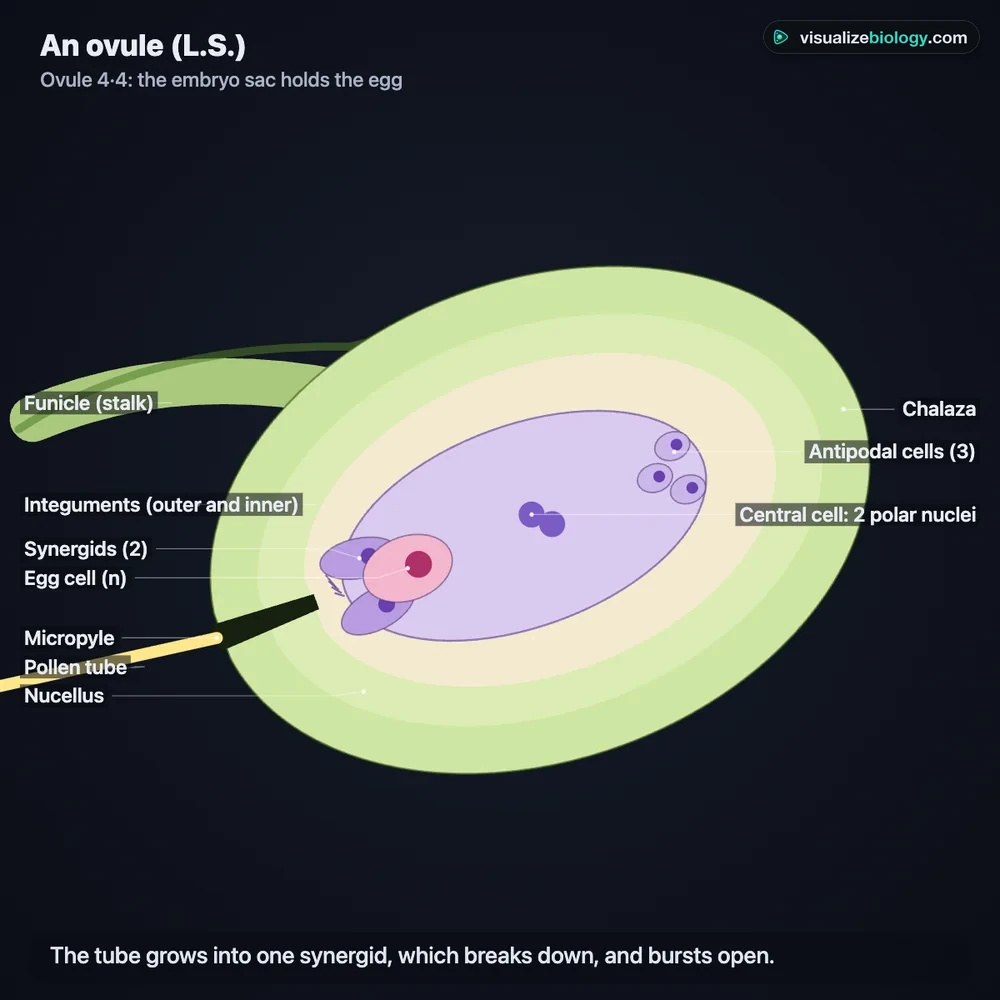
- Ovary shows all 25 ovules in five locules; tap one to open it in Ovule, where its embryo sac, the pollen tube and double fertilization are drawn from the model's times.
- Graph plots the length of every tube against the time of day, or the fate of every grain and ovule.
4 The flower and the weather
In Flower you can bag the flower (no visitors), emasculate it (remove the anthers, best done in the bud) and make the plant self-incompatible (its own pollen tubes stop in the style). New flower starts again with a bud at dawn. In Weather, temperature changes how fast pollen tubes grow (fastest near 27 °C, nothing below 10 °C) and how long pollen stays alive; dry air kills pollen faster and lowers germination.
5 Experiment mode and the lab report
Five practicals: name the parts of a hibiscus flower, pollen germination in sucrose on a slide (count the grains yourself), self- versus cross-pollination with emasculation and bagging, temperature and pollen tube growth, and pollen load and seed set. Each shows its aim, what you need and a real-lab safety note; the method ticks off as you work, a conclusion question checks your result, and Create lab report builds a PDF.
6 Speed, 3D and units
Teach speed gives every stage a few seconds: slow while grains germinate and gametes fuse, fast while tubes grow for hours and the fruit ripens for weeks. 10 min/s and 1 h/s run at a fixed rate. The 3D flower can be turned and cut open; it opens in 2D because the section is the textbook view. SI | US switches between °C and mm and °F and inches; pollen and ovules stay in µm in both.
7 Keyboard and gestures
- Space plays or pauses, → jumps to the next stage, P pollinates, 1–3 choose Section, Flower or Garden, N starts a new flower, S opens Status and Esc clears the selection.
- A plain scroll over the flower scrolls the page. Right-click the flower or the close-up to save it as an image.
How flowering plants make seeds: an interactive pollination simulator
Pollination is the transfer of pollen from an anther to a stigma, and it is the first step in the sexual reproduction of every flowering plant. Most pages explain it with a still diagram or a two-minute video. This pollination simulator lets students and teachers run the whole process themselves, from flower to fruit. You choose who carries the pollen and where it comes from, then watch each pollen grain land, germinate and grow a pollen tube down to an ovule. After double fertilization the ovule becomes a seed and the ovary becomes a fruit. It is free, needs no login and runs on Chromebooks, tablets and phones.
- Shows
- Pollination, pollen germination, the pollen tube, double fertilization, seed and fruit formation
- Pollinators
- Bee, sunbird or hummingbird, butterfly, wind and hand pollination with a brush
- Flowers
- Hibiscus (a dicot) and lily (a monocot), switched from the Flower menu
- Views
- A labeled flower section (the textbook diagram), the whole flower, a garden of two plants and a 3D flower
- Modes
- Simulate (an animation you control), Experiment (5 practicals with a PDF report) and Quiz
- Price
- Free, with no account or download
What is pollination?
Pollination moves pollen to a stigma of the same species. It is not yet fertilization. Pollen cannot swim to the egg, so once a grain lands on a receptive stigma it takes up water, germinates and grows a tube that carries its two male gametes down to an ovule. Many flowers are open for only a short time, so the pollen has to arrive then. A hibiscus flower lasts a single day; a lily about five.
Parts of a flower used in reproduction
A flower is a shoot built for sexual reproduction. The stamens (androecium) are the male parts: each anther makes pollen. The pistil or carpels (gynoecium) is the female part. Its stigma catches pollen, its style is the path the pollen tube grows along, and its ovary holds the ovules. The petals and sepals do not make gametes, but they attract pollinators and protect the bud. In a bisexual flower both sexes sit in the same flower, so the plant could pollinate itself.
Self-pollination vs cross-pollination
| Type | Pollen comes from | Genetically |
|---|---|---|
| Autogamy | The same flower | Self-pollination |
| Geitonogamy | Another flower on the same plant | Self-pollination (the same plant's genes), though it needs a pollinator |
| Xenogamy | A flower on another plant | Cross-pollination: new combinations of genes |
Plants have ways to favor cross-pollination. Some hold the stigmas away from their own anthers. Others are self-incompatible: they recognize their own pollen and stop its tubes in the style. Switch on self-incompatibility in the simulator and the plant's own pollen tubes stop with a red cross, while pollen from another plant goes on to fertilize the ovules.
Insect vs wind pollination
| Insect- or bird-pollinated | Wind-pollinated (maize, grasses) | |
|---|---|---|
| Petals | Large, bright, often with nectar guides | Small, green or absent |
| Scent and nectar | Yes | No |
| Pollen | Large, spiny or sticky, in modest amounts | Small, smooth, light, in huge amounts |
| Stigma | Sticky, inside or on the flower | Large and feathery, hanging outside |
Fertilization in plants: how the pollen tube grows
On a compatible stigma a grain germinates within about 20 minutes. A pollen tube grows out through one of its pores, led by the tube nucleus, while the generative cell divides into two male gametes. The tube grows down the style into the ovary and enters an ovule through the micropyle. Each ovule takes only one tube, so the fastest tubes win the ovules. Temperature controls the speed: in the simulator a hibiscus tube grows about 9 mm an hour at 27 °C, and below about 10 °C it does not grow at all. Lily tubes are slower, about 2.6 mm an hour at their best.
Double fertilization
Inside each ovule the embryo sac has seven cells and eight nuclei: the egg and two synergids at the micropyle, a large central cell with two polar nuclei, and three antipodal cells. The tube enters one synergid and bursts. One male gamete fuses with the egg (syngamy) to make the diploid zygote (2n), which grows into the embryo. The other fuses with the two polar nuclei (triple fusion) to make the triploid primary endosperm nucleus (3n), which becomes the endosperm that feeds the embryo.
From flower to fruit: how seeds and fruits form
After fertilization the zygote grows into an embryo, the endosperm feeds it, and the integuments harden into the seed coat: each fertilized ovule becomes a seed. The ovary wall grows into the fruit, and the petals fall. A flower with too few fertilized ovules is usually dropped. The number of seeds depends on how much pollen arrived, but it can never be more than the number of ovules.
Pollination vs fertilization
Pollination is pollen reaching the stigma. Fertilization is a male gamete fusing with the egg inside the ovule, hours later. Pollination does not always lead to fertilization. A grain may be dead, of another species, arrive when the stigma is not receptive, or be rejected by a self-incompatible plant. In the simulator you can see each of these outcomes, grain by grain.
Worked example: pollination in a hibiscus flower
The simulator uses the hibiscus (Hibiscus rosa-sinensis, the China rose) because every part is large and easy to see, and it is the flower many textbooks use, including NCERT. It opens at dawn, its anthers split a few hours later, and it lasts one day. In the late afternoon its style branches curl down onto the anthers, a back-up self-pollination if no visitor came.
Parts of a hibiscus flower
Hibiscus is bisexual and regular, with four whorls on a swollen receptacle. It also has an extra ring of bracteoles, the epicalyx, typical of the hibiscus family (Malvaceae). Its floral formula is ⊕ ⚥ Epi₅₋₈ K₍₅₎ C₅ A₍∞₎ G₍₅₎.
| Part | What it is | Its job |
|---|---|---|
| Epicalyx | 5 to 8 narrow green bracteoles | Extra protection below the calyx |
| Calyx (sepals) | 5 green sepals joined into a cup | Protects the bud; stays round the fruit |
| Corolla (petals) | 5 large red petals with a dark center | Attracts pollinators; a landing platform |
| Androecium (stamens) | Many stamens whose filaments are fused into a staminal column (monadelphous), with one-lobed anthers | Makes pollen, the male part |
| Gynoecium (pistil) | A superior ovary of 5 fused carpels, a long style inside the column and 5 knob-like stigmas | Receives pollen and holds the ovules, the female part |
Is hibiscus self-pollinated or cross-pollinated?
Both are possible, but mainly cross-pollinated. Its five stigmas are held above the anthers, which keeps most of the flower's own pollen off them. Bees, butterflies and nectar-feeding birds (sunbirds in Asia and Africa, hummingbirds in the Americas) carry pollen from flower to flower. Its pollen is large (about 140 µm), spiny and sticky, so the wind barely moves it. When the flower falls, the petals drop together with the staminal column, while the calyx stays round the young capsule.
Worked example 2: pollination in a lily flower
Choose Lily in the Flower menu at the top of the simulator and every view, practical and quiz question switches to a lily (Lilium, an Asiatic or tiger lily). The lily is the flower most schools use for a flower dissection, because its parts are large, few and easy to count. It is also a monocot, so it is a useful contrast to the hibiscus. A lily flower lasts about five days. Its anthers split on the first morning, and its stigma becomes wet and sticky a few hours later and stays ready for days. Its pollen tubes are slow: about 2.6 mm an hour at 25 °C, so they take a day or more to reach the ovules.
Parts of a lily flower
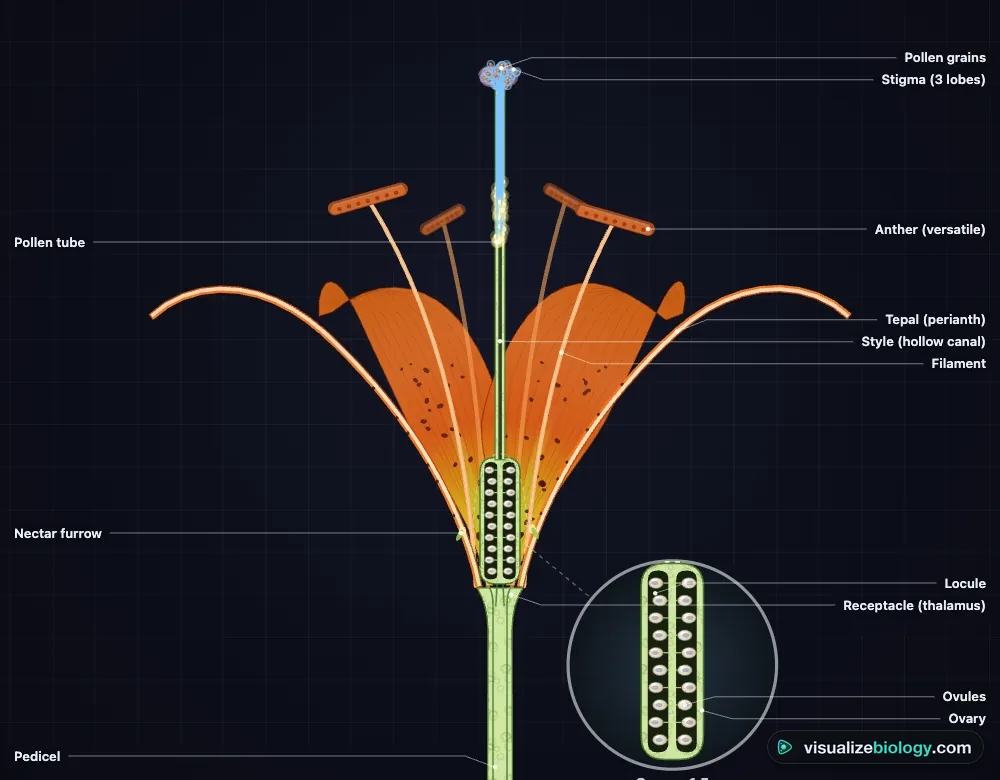
The lily is bisexual and regular, with its parts in threes. Its sepals and petals look alike, so they are called tepals and together form the perianth. Its floral formula is ⊕ ⚥ P₃₊₃ A₃₊₃ G₍₃₎.
| Part | What it is | Its job |
|---|---|---|
| Perianth (tepals) | 6 colored tepals in two whorls of 3, with dark spots and a green nectar furrow at the base | Protects the bud; attracts pollinators and guides them to the nectar |
| Androecium (stamens) | 6 free stamens on long filaments, with large versatile anthers hinged at their middle | Makes pollen, the male part; the anthers swing and dust a visitor |
| Gynoecium (pistil) | A superior ovary of 3 fused carpels with 3 locules, a long hollow style and a three-lobed wet stigma | Receives pollen and holds the ovules, the female part |
| Ovules | Many, in two rows in each locule on the central axis (axile placentation) | Each becomes a flat, papery seed after double fertilization |
Hibiscus vs lily: a dicot and a monocot flower
| Hibiscus (dicot) | Lily (monocot) | |
|---|---|---|
| Parts in | Fives (pentamerous) | Threes (trimerous) |
| Sepals and petals | A green calyx and a red corolla, plus an epicalyx | Six look-alike tepals (a perianth) |
| Stamens | Many, fused into a staminal column | Six, free, with swinging (versatile) anthers |
| Pistil | 5 carpels, 5 locules, 5 stigmas | 3 carpels, 3 locules, one 3-lobed stigma |
| Pollen | Round and spiny, many pores | Oval, net-patterned, one furrow |
| Flower lasts | One day | About five days |
| Seed | Embryo with two cotyledons | Embryo with one cotyledon |
Lily flower dissection
In the lab, students pull off the six tepals and lay them out (outer three, inner three), then remove the six stamens and look at the pollen under a hand lens. Then they cut the ovary across to see the three locules full of ovules, and draw and label each part. In the simulator, the Parts of a lily flower practical in Experiment mode asks you to find each part on the section and count the whorls. Lily pollen stains skin and clothes, so dissect over paper and wash your hands afterwards.
Practicals and course links
| Practical | What you find out | Course links |
|---|---|---|
| Parts of a flower (hibiscus) | Name every part on the section and write the floral formula | NCERT 12 ch. 1; IGCSE 16.3; NGSS 4-LS1-1 |
| Pollen germination on a slide | Which sucrose concentration grains germinate best in | NCERT 12 practical; Edexcel A-level Biology B CP4 |
| Self vs cross (emasculation and bagging) | Whether the plant needs pollen from another plant | NCERT 12 ch. 1 (artificial hybridization); IB D3.1 |
| Temperature and the pollen tube | How fast tubes grow at 15 to 35 °C | Edexcel International GCSE 3.4; NGSS MS-LS1-4 |
| Pollen load and seed set | Why seeds level off at the number of ovules | NGSS MS-LS1-4; IGCSE 16.3 |
Who uses this pollination simulator?
It is for middle and high school students learning plant reproduction for NGSS, GCSE, IGCSE, IB and NCERT/CBSE. In India the topic is "Sexual Reproduction in Flowering Plants" in class 12, and pollination is also taught in class 10. It is also for teachers who want a free, interactive animation of pollination and fertilization for the classroom screen, as an alternative to a paid virtual lab. The labeled section doubles as a flower diagram to revise from.
Frequently asked questions
What are the steps of pollination and fertilization in plants?
First, the anthers release pollen, and an insect, a bird, the wind or water carries it to a stigma (pollination). Next, a compatible pollen grain takes up water and germinates, and its pollen tube grows down the style into the ovary. The tube enters an ovule through the micropyle and releases two male gametes. One fuses with the egg to form the zygote and the other with the two polar nuclei to form the endosperm (double fertilization). Finally, the ovule develops into a seed and the ovary into a fruit.
What is the difference between pollination and fertilization?
Pollination is the transfer of pollen from an anther to a stigma, by an insect, a bird, the wind, water or a person. Fertilization comes later and happens inside the ovule: the pollen grain germinates, a pollen tube grows down the style into the ovary and enters an ovule, and a male gamete fuses with the egg. Pollination takes a moment, while the tube can need several hours to reach the ovules. Pollination does not always lead to fertilization: the grain may be dead, of the wrong species or rejected.
Why is it called double fertilization?
Because two fusions happen in the same ovule, each with one of the two male gametes the pollen tube delivers. One male gamete fuses with the egg cell (syngamy) to form the diploid zygote (2n), which grows into the embryo. The other fuses with the two polar nuclei of the central cell (triple fusion) to form the triploid primary endosperm nucleus (3n), which becomes the endosperm, the food store of the seed. Double fertilization is found only in flowering plants.
Explore related simulators
See how the egg and the male gametes get their single set of chromosomes in the Meiosis Simulator, and why cross-pollination mixes traits with the Interactive Punnett Square Calculator: Mendel crossed his peas by hand, exactly as in the emasculation practical here. Follow the sugar that feeds a flower and its growing fruit from the leaves in Xylem and Phloem, and see where that sugar is made in the Photosynthesis Lab. Look at real pollen grains under the lens with the Virtual Microscope. Raise one of the flower's visitors from egg to adult in the Butterfly Life Cycle Simulator.
Sources: NCERT Biology class 12, chapter 1 (Sexual Reproduction in Flowering Plants); OpenStax Biology 2e, chapter 32 (Plant Reproduction); Urry et al., Campbell Biology 12th edition, chapter 38; Bhojwani and Bhatnagar, The Embryology of Angiosperms; Yan and Hunt, Annals of Botany 84 (1999), for the temperature response. The flower's anatomy follows these sources; pollen numbers, germination, tube growth rates and timings are an educational model based on them.
Updated