
Xylem and Phloem
See inside a plant and a tree. Water them and watch the water climb up the xylem to the leaves, and the sugar the leaves make flow through the phloem to the flower, the fruit and the roots.
Experiment
HealthySunflower09:00
Your plant
Water taken up—
Water lost (vapour)—
Sap speed (xylem)—
Stomata open—
Sugar made—
Sugar carried (phloem)—
Water in the soil—
Plant—
Weather
Temperature
Air
Wind
Light
Season
Soil & water
Water in the soil—
Water in the plant—
Lab
View & time
What the plant is doing
Lab notebook
Your measurements, and the big moments (the plant wilting, being watered, a ring cut in the bark), are written here with the weather. Export a CSV, or turn the session into a PDF lab report.
| # | Plant | Conditions | Measurement | Result |
|---|
Concept library
Click "New question" to begin.
Click "Start quiz" for 5 questions on xylem, phloem, transpiration, roots and the experiments.
User Guide: Xylem and Phloem Simulator
1 Overview
Simulate shows a sunflower (🌻 Plant) or an apple tree (🍎 Tree) in a garden, with the soil cut away so you can see the roots. Press 💧 Water and watch the water go up, change the weather, and tap any part to look inside it. Experiment has five practicals that end in a PDF lab report, and Quiz has a practice quiz with answers and a 5-question quiz.
2 Seeing inside: the two kinds of tube
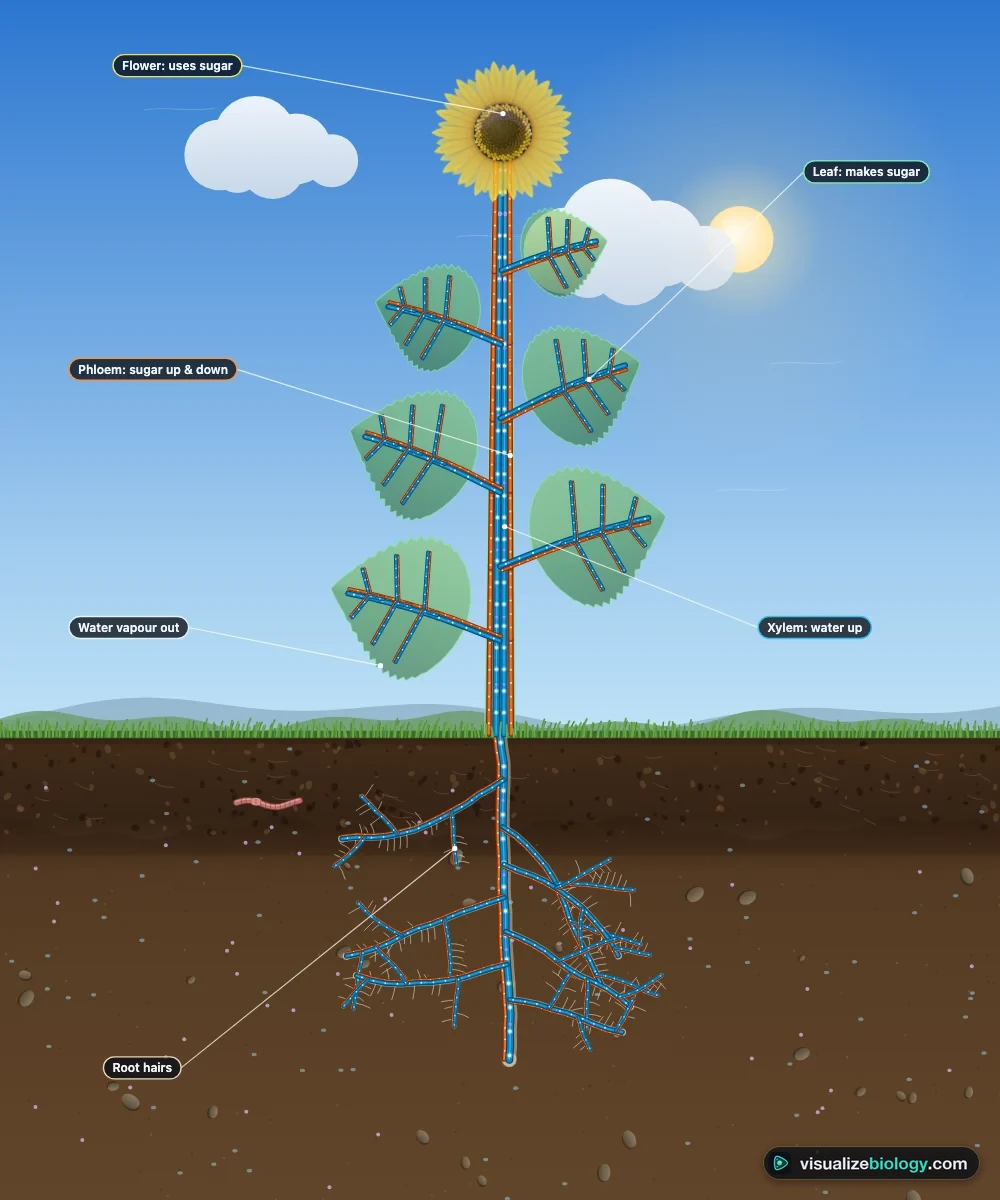
- With See inside on, the stem, trunk, roots and leaves become see-through. Blue tubes are xylem: the moving dashes are water going up, with purple specks of minerals. Orange tubes are phloem: the dashes are sugar, moving up to the flower or apples and down to the roots.
- The faster the dashes move, the faster the flow. White puffs leaving the leaves are water vapour (transpiration); blue dots creeping into the root hairs are water from the soil; gold sparkles show sugar arriving where it is used.
- Turn Labels on to name the parts.
3 Water, weather and wilting
- 💧 Water wets the soil (a watering can for the sunflower, rain for the tree). The Soil panel shows how much water is in the soil and in the plant.
- In the Weather panel, try hot, dry, windy and sunny weather: the plant loses water faster. Humid, still, cool or dark weather slows it down. At night the stomata close and the xylem nearly stops, but the phloem keeps going on the sugar stored in the day.
- If the soil dries out, the plant wilts: its leaves droop and its stomata close. Water it to bring it back, but a plant left dry for too long dies.
- 🌱 Plant food adds minerals; without them the leaves slowly turn yellow. Colour the water adds red dye that shows where the water goes.
4 Looking inside and comparing
Tap a part of the plant, or a chip under the close-up, to see it in section: a root hair taking in water and minerals, the root, the stem (or the trunk), and a leaf with its stomata. Xylem vs phloem puts the two tubes side by side and goes through the differences one at a time (tap the picture for the next one). Graph draws the water and sugar over the last 24 hours.
5 The journeys
Follow water takes a drop of water from the soil, into a root hair, up the xylem, into a leaf and out through a stoma. Follow sugar takes sugar from a leaf through the phloem to the flower (or the apples) and down to the roots. Use ‹ and › to step, ❚❚ to pause and Done to finish.
6 The tree: seasons and ringing the bark
The apple tree has seasons: in summer the leaves send sugar to the apples and the roots; in spring the roots send their stored sugar up to the new buds; in winter the bare tree rests. Choose 🔪 Ring bark and tap the trunk to cut away a ring of bark, then press ⏩ A week later a few times: the bark swells above the ring and the roots slowly starve, while the leaves stay green for weeks. The sunflower has an 🐞 Aphid tool: an aphid drinks sugary sap straight from the phloem.
7 Experiment mode and the lab report
Five practicals: celery (or a white flower) in coloured water, a bag over a plant, a potometer, ringing a branch, and spotting xylem and phloem in sections. Each shows its aim, what you need and a safety note; the method ticks off as you work, a conclusion question checks your result, and Create lab report builds a PDF with your plant, results and calculations.
8 Quiz and units
The practice quiz covers xylem, phloem, telling them apart, transpiration, roots, trees and the experiments, each with a worked answer. Take the quiz gives five mixed questions and a star rating. SI | US switches lengths, volumes and temperatures between metric (cm, mL, °C) and US units (inches, fluid ounces, °F).
9 Keyboard and gestures
- Space pauses or runs the clock, W waters, N switches day and night, F shows the whole plant, S opens Status, Esc stops a journey, and ← and → step through a journey.
- A plain scroll over the garden scrolls the page; hold Ctrl or ⌘ (or click the garden first) to zoom with the wheel. On a phone, one finger scrolls the page.
- Right-click the garden or the close-up to save it as a picture or copy the readings.
Xylem and phloem: how plants move water and food
A plant has no heart, yet water travels from its roots to its highest leaf and sugar travels from its leaves to its roots, fruit and flowers. It does this with two kinds of tube that run through every root, stem and leaf: xylem, which carries water and minerals up, and phloem, which carries food. Together they make up the plant's transport system. This simulator lets you see inside a sunflower and an apple tree and watch both at work.
- Subjects
- A sunflower (about 1.2 m tall) and an apple tree with seasons
- It shows
- Water and minerals up the xylem, sugar both ways in the phloem, transpiration, root hairs, stomata, wilting
- Close-ups
- Root hair, root, stem, leaf and trunk in section; xylem vs phloem side by side
- Modes
- Simulate (with guided journeys), Experiment (5 practicals) and Quiz
- Price
- Free, no account or download; works on Chromebooks, tablets and phones
What does xylem do?
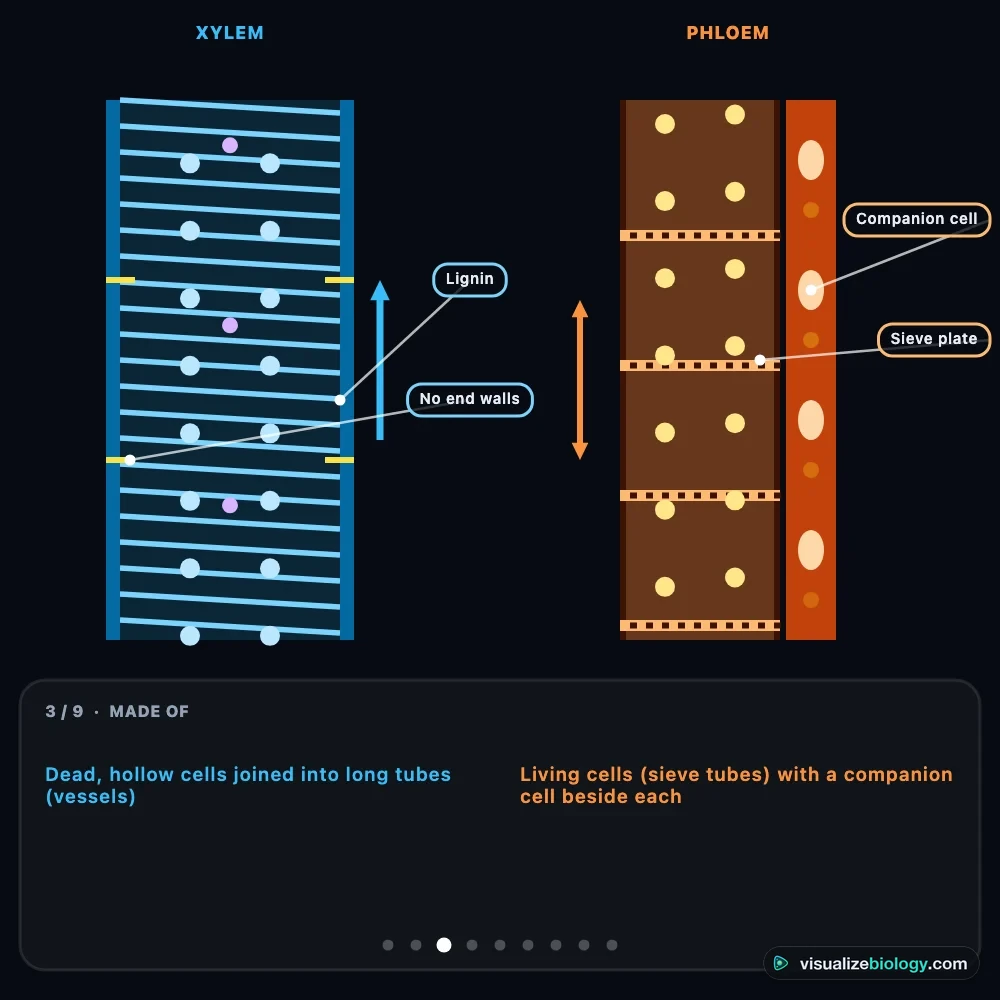
Xylem carries water and dissolved minerals (such as nitrate and magnesium) from the roots to the stem and leaves. Its tubes, called vessels, are made of dead cells joined end to end with their end walls gone, so each vessel is one long, open pipe. Rings and spirals of lignin make the walls strong, so they do not collapse, and lignin is also what makes wood hard. Water moves only upwards in the xylem.
What does phloem do?
Phloem carries food, mainly the sugar sucrose made in the leaves by photosynthesis, to every part of the plant that needs it. This is called translocation. Its tubes are living sieve tube cells with sieve plates (end walls full of holes) between them, and each has a companion cell beside it that supplies the energy to load the sugar. Phloem flows from a source, where sugar is made or released, to a sink, where it is used or stored, so it can flow up and down: up to flowers, fruit and young leaves, down to the roots. In spring the roots of a tree become the source and the sap flows up to the opening buds.
Xylem vs phloem: how to tell them apart
| Feature | Xylem | Phloem |
|---|---|---|
| Carries | Water and minerals | Sugar (sucrose) and other food |
| Direction | Up only | Up and down |
| Cells | Dead, hollow vessels | Living sieve tubes with companion cells |
| End walls | None | Sieve plates |
| Walls | Thick, with lignin | Thin, no lignin |
| Moved by | Transpiration pull (no energy used) | Pressure from loading sugar (uses energy) |
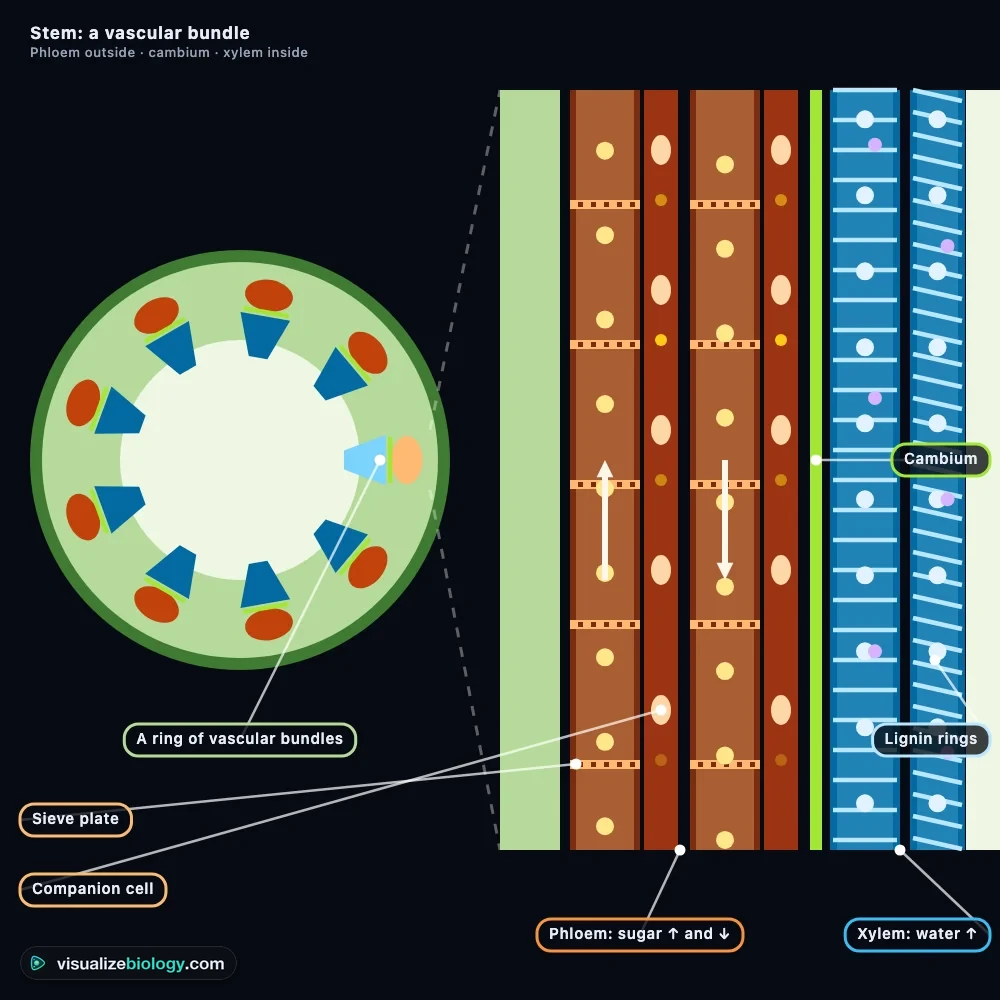
| In a stem | Inside of each vascular bundle | Outside of each vascular bundle |
| In a tree | The wood | The inner bark |
Transpiration: why water goes up
Water evaporates from the cells inside each leaf and escapes as vapour through tiny pores, the stomata, on the underside. This loss is transpiration. Water molecules cling to each other, so as water leaves the top, the whole thread of water in the xylem is pulled up behind it, like a drink up a straw. This transpiration pull needs no energy from the plant and lifts water to the top of trees over 100 m tall. More than 97 % of the water a plant takes in is lost this way; less than 1 % is used in photosynthesis. Transpiration is faster when it is warm, dry, windy and bright, and slower when it is cool, humid, still or dark, because at night the guard cells close the stomata. A sunflower in summer sun can lose a glass of water in a few hours; a big apple tree loses tens of litres a day.
Roots, root hairs and minerals
Each root is covered near its tip with thousands of root hairs, thin outgrowths of single cells that give a huge surface for taking in water. Water enters them by osmosis, crosses the root and reaches the xylem in the middle. Minerals are often less concentrated in the soil than in the root, so they are pumped in by active transport, which uses energy from respiration. In a root the xylem forms a star in the centre with the phloem between its arms; in a stem the vascular bundles form a ring, phloem on the outside and xylem on the inside; in a leaf they are the veins.
Experiments you can do
| Practical | What it shows | Course links |
|---|---|---|
| Celery or a white flower in coloured water | Water travels up the xylem; the dye shows in dots (the bundles) | NGSS 4-LS1-1, MS-LS1-3; NCERT Class 7 |
| A bag over a plant | Leaves give off water vapour (transpiration) | Primary science; NCERT Class 10 |
| Potometer | How temperature, wind, light and humidity change the rate of transpiration | AQA GCSE 4.2.3.2 |
| Ringing a branch | Sugar travels in the phloem, in the bark | GCSE, IGCSE, NCERT Class 11 |
| Spot the xylem and phloem | Where the tubes are in a root, a stem and a leaf | GCSE 4.2.3.1; HS-LS1-2 |
Who uses this simulator?
Children and school students use it to see what cannot be seen in a real plant: water climbing, sugar flowing, and the difference between the two tubes. Teachers project it to ask "what will happen if…" before pressing the button (stop watering, turn on the wind, ring the bark), and set the practicals as homework when there is no time for the real celery. It is an educational model built from published plant physiology; it needs no login and runs on school Chromebooks.
Frequently asked questions
What is the difference between xylem and phloem?
Xylem carries water and dissolved minerals from the roots up to the leaves. It is made of dead, hollow cells joined end to end into tubes, with no end walls and thick walls strengthened by lignin, and water moves only upwards, pulled by transpiration. Phloem carries food, mainly sugar (sucrose), from the leaves to the parts of the plant that need it, both up and down. It is made of living sieve tube cells with sieve plates between them and a companion cell beside each, and moving the sugar uses energy. In a stem the phloem is on the outside of each vascular bundle and the xylem on the inside; in a tree the wood is xylem and the inner bark is phloem.
How does water get to the top of a tall tree?
It is pulled up. Water evaporates from the cells inside the leaves and escapes as vapour through the stomata (transpiration). Water molecules stick to each other (cohesion) and to the xylem walls (adhesion), so as water leaves the top, the whole column in the xylem is pulled up behind it, like a drink up a straw. This transpiration pull works without the plant using any energy and can lift water over 100 m in the tallest redwoods. Root pressure gives a small extra push from below. Warm, dry, windy and sunny weather makes transpiration, and so the flow, faster.
What happens if you remove a ring of bark from a tree?
Removing a ring of bark (ringing or girdling) removes the phloem, which is the inner layer of the bark. The leaves still get water, because the xylem is the wood and it is not cut, so the tree looks healthy for a while. But sugar made in the leaves can no longer travel down past the ring: it piles up just above it, so the bark there swells, while the roots below slowly use up their stored food and starve. After months or a couple of years the roots die, and then the whole tree dies. Ringing just one branch makes the fruit on that branch bigger, because its sugar cannot leave.
Explore related simulators
See how leaves make the sugar the phloem carries in the Photosynthesis Lab, watch water move by osmosis into potato cells in the Osmosis Lab, and open up a plant cell, its wall and its vacuole, in the Virtual Living Cell. Look at real stem and leaf sections down the Virtual Microscope, compare a plant's transport with the blood pumped round your body in the Heart Simulator, and put the plant at the bottom of a food chain. Find out where the nitrate that rides up the xylem comes from in the Nitrogen Cycle Simulator. Follow the sugar the phloem carries to a flower as it turns into nectar, pollen and seeds in the Pollination Simulator.
Sources: OpenStax Biology 2e, chapter 30.5 (Transport of Water and Solutes in Plants); Urry et al., Campbell Biology 12th edition, chapter 36; Taiz, Zeiger et al., Plant Physiology and Development 6th edition, chapters 4–6 and 11; Nobel, Physicochemical and Environmental Plant Physiology; AQA GCSE Biology 8461 specification, section 4.2.3. Rates of water and sugar flow are an educational model based on these sources, sped up so they can be watched.
Updated