
Interactive Nitrogen Cycle Simulator
Watch nitrogen move through a living field: from the air into root nodules, crops and cows, through the soil's bacteria and back to the air. Add fertilizer, waterlog the soil or make it rain, and see what reaches the pond.
Experiment
Growing well🌽 CornDay 0
Your field
Ammonium in the soil—
Nitrate in the soil—
Nitrogen in the crop—
Fixation—
Leaching—
Denitrification—
Oxygen in the pond—
Field—
Field
Crop
Crop growth—
Nitrogen it gets (of what it needs)—
Soil & weather
Temperature
Soil water
Soil pH
Each process has its own bacteria, and each kind of bacteria likes different conditions. Change one thing at a time and watch which arrows grow or shrink.
Lab
View & time
What is happening in the field
Lab notebook
Your measurements and the big moments (fertilizer, storms, harvests and their yields, a crop running short of nitrogen, an algal bloom) are written here with the conditions. Export a CSV, or turn the session into a PDF lab report.
| # | Sample | Conditions | Measurement | Result |
|---|
Concept library
Click "New question" to begin.
Click "Start quiz" for 5 questions on nitrogen fixation, the steps of the cycle, plants and animals, people and the cycle, and the experiments.
User Guide: Nitrogen Cycle Simulator
1 Overview
Simulate shows one field with its soil cut away, the air above it, a fertilizer factory on the left and the pond the field drains into on the right. Time runs at one day a second: the crop grows and nitrogen moves between the air, the soil, the crop, the animals and the water. Experiment has five practicals that end in a PDF lab report, and Quiz has a practice quiz with worked answers and a 5-question quiz.
2 Reading the field
- Each arrow is one process of the nitrogen cycle. The thicker the arrow and the faster its beads move, the more nitrogen is moving along it today. A faint arrow means the process has (almost) stopped.
- The colour of an arrow is the molecule it carries: pale blue N₂, purple ammonium NH₄⁺, orange nitrite NO₂⁻, cyan nitrate NO₃⁻, green protein (organic nitrogen). The key is in the top-right corner.
- The dots in the soil are ions: purple ammonium, cyan nitrate. Their number follows the amount in the soil. Watch them appear after fertilizer, turn from purple to cyan (nitrification), move to the roots (assimilation), sink after rain (leaching) or bubble away as gas (denitrification).
- Bubbles in the soil hold the bacteria: decomposers, Nitrosomonas, Nitrobacter and denitrifying bacteria deep down. Legumes have pink root nodules.
- Turn off See into the soil to see the field as it really looks, and Process names to test yourself.
3 The crop, the soil and the weather
- Field panel: grow corn (not a legume), soybeans or clover (legumes, with nodules). On clover, turn on Cows grazing. The meters show how far the crop has grown and how much of the nitrogen it needs it is getting; short of nitrogen, its older leaves turn yellow.
- Soil panel: temperature, soil water (dry, moist or waterlogged) and soil pH. Waterlogged soil has no oxygen, so nitrification stops and denitrification starts. Acid soil stops nitrifiers and nodules. Cold slows everything.
- Action bar: Add fertilizer (60 kg N/ha of ammonium nitrate, for non-legumes), Thunderstorm (rain and lightning), Harvest (shows the yield, then sows the crop chosen in the Field panel), and Spread manure in the Field panel. Changing the crop mid-season ploughs the old one in.
4 Close-ups, the cycle diagram and graphs
Tap any part of the field (an arrow, a bacteria bubble, the factory, the cow, the pond…) or a chip under the close-up to see that process up close: inside a root nodule, lightning, the Haber–Bosch process, roots and leaves, animals, decomposers, nitrifying bacteria, denitrifying bacteria and eutrophication in a pond. Cycle diagram shows the classic textbook cycle with today's flows (tap an arrow to name it). Graph plots the soil and the crop, the pond, and the season's nitrogen budget: what came in and what left.
5 The journeys
Follow an N atom takes one nitrogen atom from the air into a clover nodule, a leaf, a cow, the soil, two kinds of bacteria and back to the air. Follow fertilizer goes from the factory to the field, down with the rain to the pond, into an algal bloom and a dead zone. Use ‹ and › to step, ❚❚ to pause and Done to finish. Your own field is put back as it was afterwards.
6 Experiment mode and the lab report
Five practicals: legumes and wheat in nitrogen-free sand (count and cut the nodules), cycling a new aquarium with test strips, fertilizer and algae in jars of pond water, airy vs waterlogged soil cores, and labelling the nitrogen cycle. Each shows its aim, what you need and a safety note; the method ticks off as you work, a conclusion question checks your result, and Create lab report builds a PDF with your results and calculations.
7 Quiz and units
The practice quiz covers nitrogen fixation, the steps of the cycle, plants, animals and decomposers, people and the cycle, and calculations, each with a worked answer. Take the quiz gives five mixed questions and a star rating. SI | US switches nitrogen per area between kg N/ha and lb N/acre, yields between t/ha and bushels per acre, and temperatures between °C and °F. Water concentrations stay in mg/L, as on every test strip.
8 Keyboard and gestures
- Space pauses or runs the clock, F adds fertilizer, R makes a thunderstorm, H harvests, Z shows the whole field, S opens Status, Esc stops a journey, and ← and → step through a journey.
- A plain scroll over the field scrolls the page; hold Ctrl or ⌘ (or click the field first) to zoom with the wheel. On a phone, one finger scrolls the page.
- Right-click the field or the close-up to save it as a picture or copy the readings.
The nitrogen cycle, animated in a living field
Every protein, every strand of DNA and every chlorophyll molecule contains nitrogen. The air is 78 % nitrogen, yet plants and animals cannot use a single molecule of it, because the two atoms of nitrogen gas (N₂) are held by a triple bond that only a few bacteria, lightning and factories can break. The nitrogen cycle is the path nitrogen takes from the air into living things, through the soil and back again. This simulator runs the whole cycle in one field and lets you change the conditions that control each step.
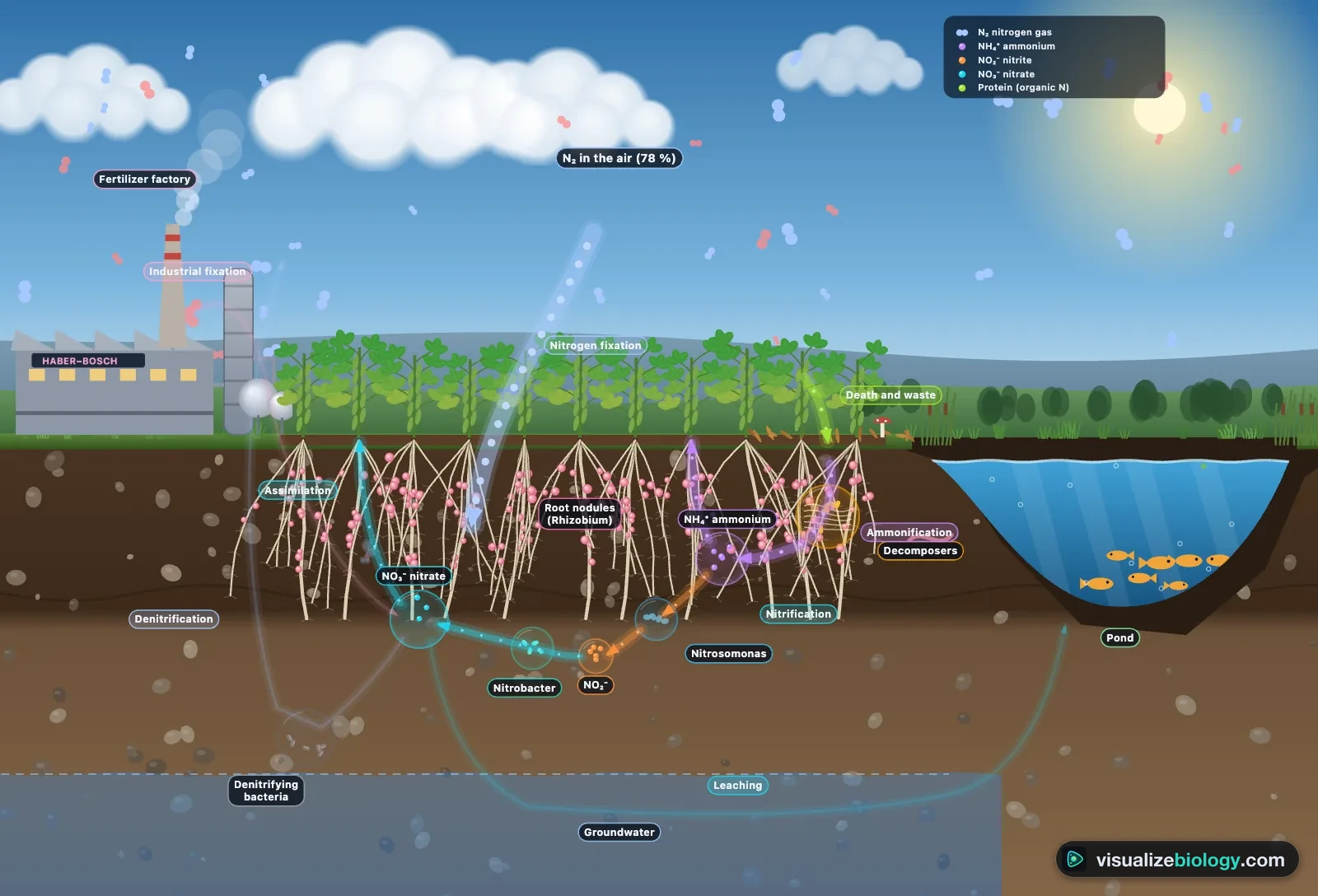
- It shows
- Fixation, assimilation, eating, ammonification, nitrification, denitrification, leaching, lightning and Haber–Bosch
- You control
- The crop (corn, soybeans, clover with cows), temperature, soil water, soil pH, fertilizer, manure, storms, harvest
- Close-ups
- Root nodule, lightning, Haber–Bosch, roots and leaves, animals, decomposers, nitrifiers, denitrifiers, a pond
- Modes
- Simulate (with two guided journeys), Experiment (5 practicals) and Quiz
- Price
- Free, no account or download; works on Chromebooks, tablets and phones
The 5 steps of the nitrogen cycle
- Nitrogen fixation. Bacteria turn N₂ from the air into ammonium (NH₄⁺): Rhizobium in the root nodules of legumes, free-living Azotobacter and cyanobacteria. Lightning and the Haber–Bosch process fix nitrogen too.
- Assimilation. Plants take up nitrate and ammonium through their roots and build them into amino acids, proteins and DNA. Animals get their nitrogen by eating plants or other animals.
- Ammonification. When plants and animals die, and from dung and urine, decomposers (bacteria and fungi) break the proteins and urea down and release the nitrogen as ammonium.
- Nitrification. Nitrosomonas turns ammonium into nitrite (NO₂⁻), and Nitrobacter turns nitrite into nitrate (NO₃⁻). Both need oxygen, warmth and a soil pH above about 6.
- Denitrification. In waterlogged soil with no oxygen, bacteria such as Pseudomonas use nitrate instead of oxygen and turn it back into N₂ (and some N₂O), which returns to the air.
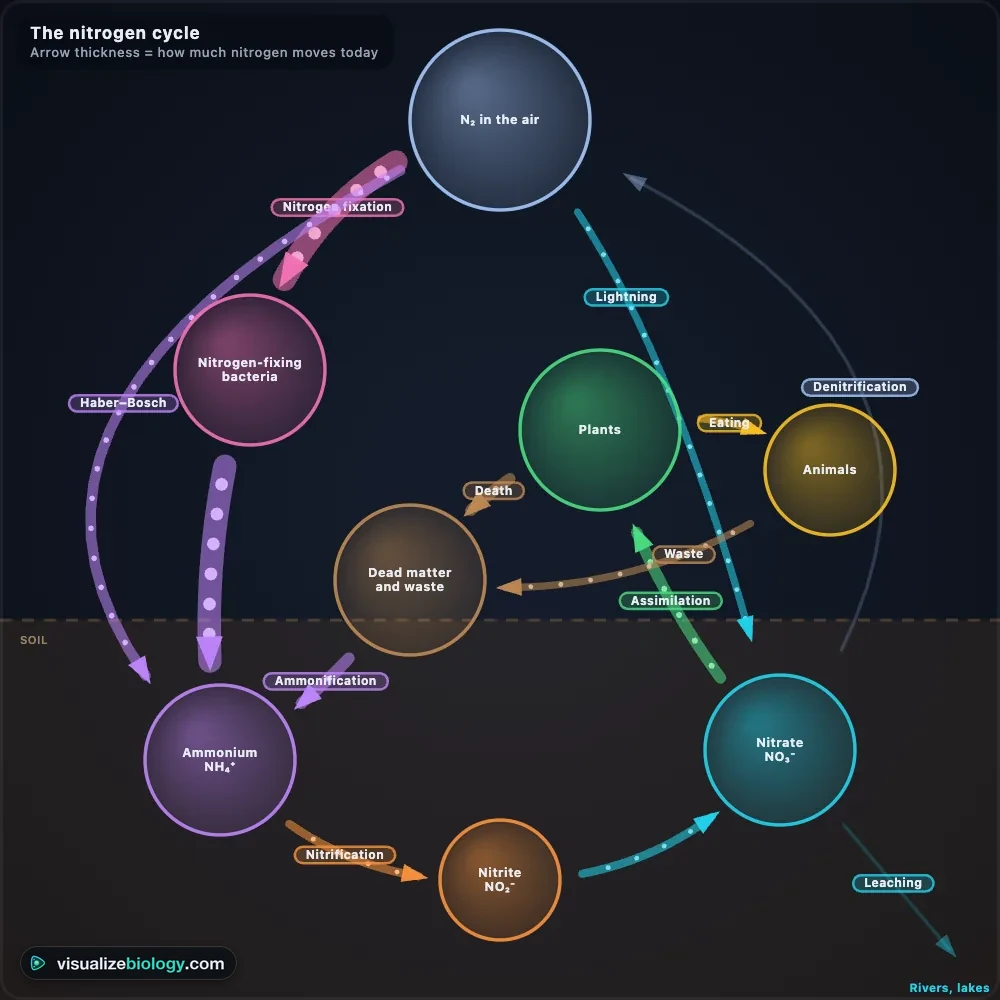
How do plants get nitrogen from the air?
Most plants never touch the nitrogen in the air: they take up nitrate and ammonium dissolved in soil water, pumping them into their root hairs by active transport. Legumes such as beans, peas, soybeans and clover have a partner. Rhizobium bacteria infect their roots and form nodules, where the enzyme nitrogenase turns N₂ into ammonia: N₂ + 8H⁺ + 8e⁻ + 16 ATP → 2NH₃ + H₂. Oxygen destroys nitrogenase, so the nodule makes leghemoglobin, which binds oxygen and makes an active nodule pink inside. The plant pays the bacteria with sugar, so both benefit: mutualism. A soybean crop can fix 100 to 250 kg of nitrogen per hectare in a season, which is why farmers rotate corn with soybeans.
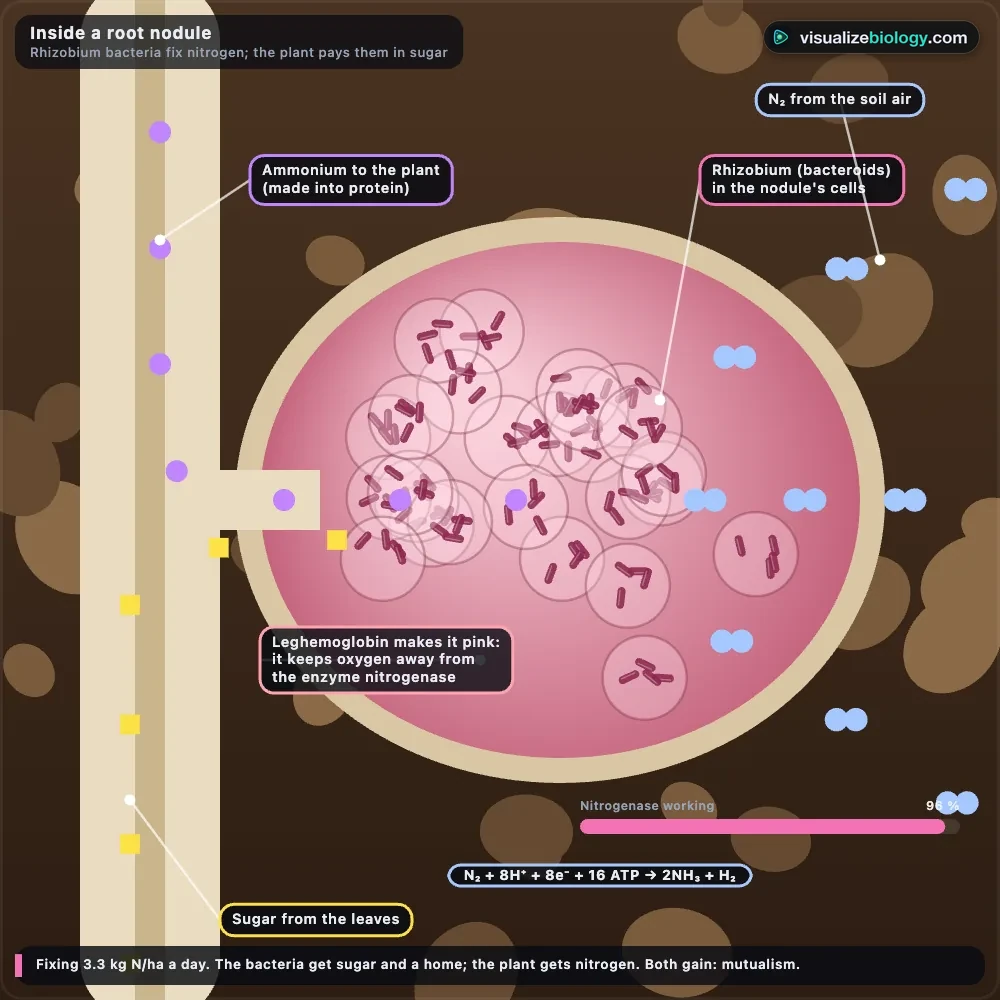
Nitrification vs denitrification
| Feature | Nitrification | Denitrification |
|---|---|---|
| Change | NH₄⁺ → NO₂⁻ → NO₃⁻ | NO₃⁻ → NO₂⁻ → NO → N₂O → N₂ |
| Bacteria | Nitrosomonas, then Nitrobacter | Pseudomonas and others |
| Oxygen | Needs oxygen (airy soil) | Only without oxygen (waterlogged soil) |
| Result | Makes nitrate that plants take up | Returns nitrogen to the air |
| Good for crops? | Yes | No: the crop loses its nitrate |
| Farmers help it by | Draining, ploughing, liming acid soil | (They try to prevent it) |
Fertilizer, runoff and dead zones
Since about 1913 the Haber–Bosch process has fixed nitrogen in factories (N₂ + 3H₂ ⇌ 2NH₃ at about 450 °C and 200 atmospheres). It now fixes about 120 million tonnes a year, more than all natural fixation on land, and grows the food for about half the people on Earth. But nitrate dissolves easily and is not held by the soil, so heavy rain after fertilizing washes it into groundwater, rivers and lakes (leaching). There it feeds an algal bloom; when the algae die, decomposing bacteria use up the dissolved oxygen and fish suffocate: eutrophication and a dead zone. The Gulf of Mexico's dead zone covered 11 400 km² (4 402 square miles) in 2025. Wet, fertilized soils also release nitrous oxide, a greenhouse gas about 273 times stronger than carbon dioxide.
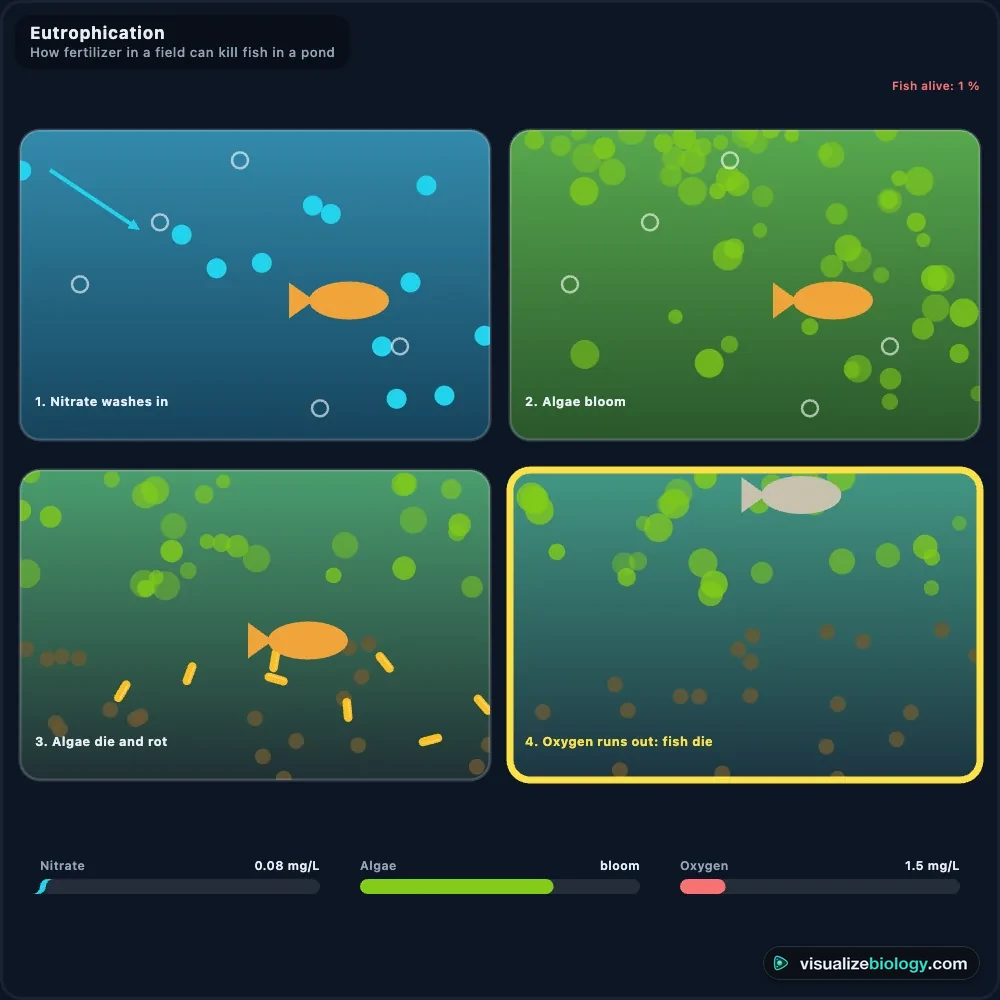
Experiments you can do
| Practical | What it shows | Course links |
|---|---|---|
| Legumes in nitrogen-free sand | Rhizobium nodules fix nitrogen; nitrate fertilizer switches nodules off | AP Bio 8.2; IGCSE; NCERT 11 |
| Cycling a new aquarium | Ammonia, then nitrite, then nitrate: nitrification by two kinds of bacteria | APES 1.5; NGSS MS-LS2-3 |
| Fertilizer and algae in jars | More nitrate, bigger bloom, less oxygen: eutrophication | APES 8.5; NGSS HS-ESS3-6 |
| Airy vs waterlogged soil | Denitrification needs no oxygen; nitrate is lost as gas | APES 1.5; IGCSE; A-level 3.5.4 |
| Label the nitrogen cycle | The processes and where they happen | All courses |
Who uses this simulator?
Middle and high school students use it to see what the textbook diagram cannot show: which way nitrogen moves, how fast, and why it changes when a field floods or a farmer fertilizes before a storm. AP Environmental Science and AP Biology teachers project it to ask "what will happen if…" before pressing the button, and set the practicals as homework when there is no time for a six-week bean experiment. It is an educational model built from published soil science; it needs no login and runs on school Chromebooks.
Frequently asked questions
What are the 5 steps of the nitrogen cycle?
1. Nitrogen fixation: bacteria (Rhizobium in the root nodules of legumes, Azotobacter, cyanobacteria), lightning and fertilizer factories turn nitrogen gas (N₂) from the air into ammonium or nitrate. 2. Assimilation: plants take up nitrate and ammonium through their roots and build proteins and DNA; animals get their nitrogen by eating plants. 3. Ammonification: when plants and animals die, and from dung and urine, decomposers release the nitrogen as ammonium (NH₄⁺). 4. Nitrification: Nitrosomonas bacteria turn ammonium into nitrite (NO₂⁻) and Nitrobacter turns nitrite into nitrate (NO₃⁻), using oxygen. 5. Denitrification: in waterlogged soil with no oxygen, bacteria such as Pseudomonas turn nitrate back into N₂ gas, which returns to the air.
How do plants get nitrogen from the air?
They cannot take it from the air themselves: the two atoms of N₂ are held by a triple bond that plants cannot break. Plants take up nitrogen from the soil as nitrate and ammonium. Legumes such as beans, peas, soybeans and clover get nitrogen from the air indirectly: Rhizobium bacteria live in nodules on their roots and use the enzyme nitrogenase, and a lot of ATP, to turn N₂ into ammonium. The plant gives the bacteria sugar in return, so both benefit (mutualism). Other plants rely on decomposers, nitrifying bacteria, lightning and fertilizer to put nitrate into the soil.
What is the difference between nitrification and denitrification?
Nitrification makes nitrate: Nitrosomonas turns ammonium into nitrite and Nitrobacter turns nitrite into nitrate. It needs oxygen, so it happens in airy, well-drained soil, and the nitrate is what most plants take up. Denitrification removes nitrate: where the soil is waterlogged and there is no oxygen, bacteria such as Pseudomonas use nitrate instead of oxygen and turn it into nitrogen gas (and some nitrous oxide), which escapes to the air. Nitrification keeps nitrogen in the soil for plants; denitrification returns it to the atmosphere.
Explore related simulators
See the nitrifying and decomposing bacteria as cells in the Virtual Bacteria Simulator, follow the energy that flows the other way through the same field in Build the Food Chain, and watch nitrate and water climb from the roots to the leaves in the Xylem and Phloem Simulator. See how leaves short of nitrogen make less chlorophyll in the Photosynthesis Lab, and turn the nitrogen in a gene's bases into a protein with the Codon Chart.
Sources: OpenStax Biology 2e, section 46.3 (Biogeochemical Cycles); Urry et al., Campbell Biology 12th edition, chapters 37 and 55; Robertson and Groffman, Nitrogen transformations, in Soil Microbiology, Ecology and Biochemistry, 4th edition; Fowler et al. (2013), The global nitrogen cycle in the twenty-first century, Phil. Trans. R. Soc. B 368; NOAA (2025) hypoxic zone measurement; College Board AP Environmental Science Course and Exam Description, Topic 1.5. Rates of fixation, nitrification, denitrification and leaching are an educational model based on these sources, sped up so they can be watched.
Updated