
Virtual Cockroach Dissection: Morphology and Anatomy of Cockroach
Snip off the wings, pin a cockroach under water, cut along its sides and lift off its back to reach the 13-chambered heart, the gut, the Malpighian tubules and the nerve cord. Pull its mouthparts onto a slide, then watch every organ system work in a see-through cockroach.
What you're looking at
Lab notebook
Every step of your dissection, each cut's accuracy, each organ lifted out, each mouthpart mounted and every count is written here. Export a CSV, or turn the session into a PDF lab report.
| # | Specimen | What | Result | Value |
|---|
Concept library
Click "New problem" to begin.
Click "Start quiz" for 5 questions on the cockroach's morphology, mouthparts, organs, digestion and excretion, circulation and breathing, reproduction, nerves and calculations.
1 Overview
Simulate puts a cockroach on a dissecting tray, on the left, in four views: External (its morphology, from above and below), Mouthparts (the head from the front, with a slide), Dissection (snip, pin, cut, lift the terga and the organs) and Systems (see-through, with one organ system working). On the right, How it works plays animated close-ups (heart, breathing, digestion, nerves, reproduction, compound eye, life cycle, leg nerve) and Graph plots heart rate, breathing and leg spikes. Organ opens a page for any organ you tap. Experiment has five practicals that end in a PDF lab report, and Quiz has a practice quiz with worked solutions and a 5-question quiz.
2 External features and mouthparts
- Tap any part to read what it is, its job and an exam fact in What you're looking at; hover (on a computer) for its name. ▶ plays a guided tour.
- Tap a tegmen to spread the wings; ↻ Flip over shows the underside, where you sex the cockroach by its anal styles or brood pouch.
- In the Specimen panel choose the species (American, oriental or Madagascar hissing cockroach) and the sex.
- In Mouthparts, lift the parts off with the 🤏 forceps, front to back; they are laid out on the slide.
3 Doing the dissection
- With ✂️ Scissors, tap the yellow ring at the base of each wing to snip it off (tegmina first).
- With 📍 Pins, tap the four yellow rings on the legs. The tray floods with water.
- With the scissors, press on the yellow dot and drag along each yellow line: both sides, then across the neck. Keep off the middle of the back: the heart lies there.
- Tap the back with 🤏 Forceps to lift off the terga; they land inside up with the heart on them.
- Tap organs with the forceps to lift them into the dish, top layer first, or use the Organs panel. 🔍 Hand lens magnifies; 📏 Ruler measures.
▶ Watch it done performs and explains the whole dissection; the main button does one step for you.
4 Systems, close-ups and organ pages
Tap any organ (in Systems, the dissection or the mouthparts) to open its Organ page on the right: a labelled drawing, every part an exam asks for, what it does, why it matters to the cockroach, NCERT/NEET points and a comparison with humans. In Systems, pick a system in the Systems panel (or ⏭ Next system). With Show it working on, food, air, haemolymph, uric acid and nerve impulses move. The temperature slider and Resting · After a run change the heart rate and breathing.
5 Experiment mode and the lab report
Five practicals: external features and sexing, mouthparts (remove and mount), the full dissection (graded), breathing rate vs temperature, and the leg nerve (touch, spikes and temperature). Each shows its aim, what you need and a real-lab safety note; the method ticks off as you work, a conclusion question checks your result, and Create lab report builds a PDF. The controls for each practical are in the Lab panel.
6 Units, keyboard and gestures
- SI | US switches between millimetres and degrees Celsius and inches and degrees Fahrenheit.
- Space plays or pauses, T does the view's next step, 1–4 choose the views, S opens Status, B counts a pump in the breathing practical and Esc clears the selection.
- A plain scroll over the tray scrolls the page. Right-click the tray or the close-up to save it as an image.
Virtual cockroach dissection: the cockroach's morphology and anatomy, step by step
The cockroach is the classic insect for learning how an arthropod is built: a hard exoskeleton in segments, jointed legs, two pairs of wings, biting mouthparts, an open circulation with a tube-shaped heart, tracheae instead of lungs, Malpighian tubules instead of kidneys and a nerve cord along the belly. Few students get to dissect one today, so this virtual cockroach dissection lets you do every step yourself on screen, with each organ drawn where it really lies in Periplaneta americana, and then shows each organ system working.
- Specimen
- American cockroach (Periplaneta americana, NCERT), oriental cockroach or Madagascar hissing cockroach; male or female
- You do
- Snip the wings, pin, cut along the sides, lift the terga and the organs with forceps, mount the mouthparts, measure with a ruler
- Shows
- External features, mouthparts, 70+ parts and organs, 23 organ pages, 7 organ systems at work
- Modes
- Simulate, Experiment (5 practicals with a PDF report) and Quiz
- Price
- Free, with no account or download; works on Chromebooks, tablets and phones
Cockroach dissection steps
- External features. Look at the cockroach dorsal side up, then ventral side up, and decide its sex.
- Mouthparts. Pull them off with fine forceps from the front (labrum, mandibles, maxillae, labium, hypopharynx) and mount them on a slide.
- Wings and pins. Snip off the tegmina and hind wings, pin the cockroach dorsal side up through its legs on a wax tray and cover it with water.
- Side cuts. Cut along both sides through the soft pleura from the tail end to the neck, then across behind the head. Never cut down the middle: the heart lies under the mid-dorsal line.
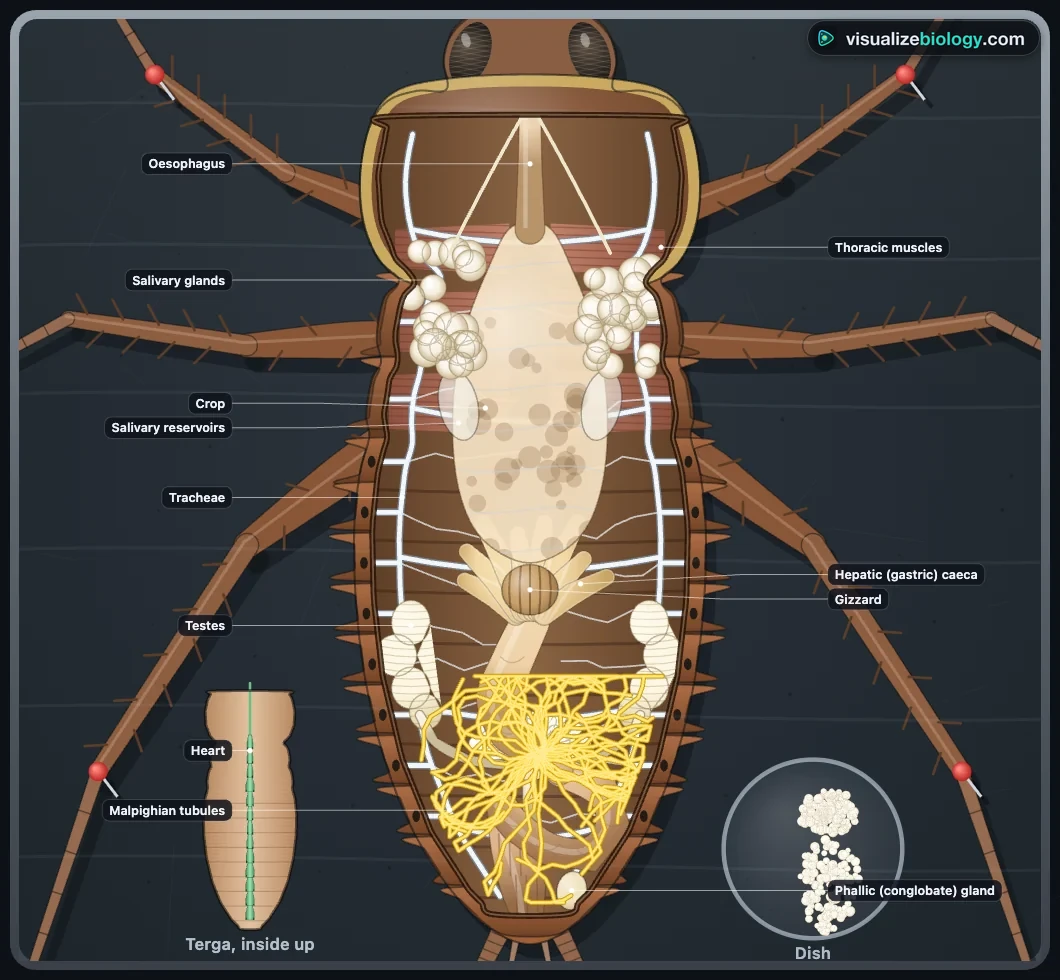
- Lift the terga. Lift the dorsal plates off in one piece; the 13-chambered heart comes away on their inner side.
- Organs in place. Identify them, then remove the fat body, salivary glands, reproductive organs and the alimentary canal to see the ventral nerve cord.
Morphology of cockroach: external features
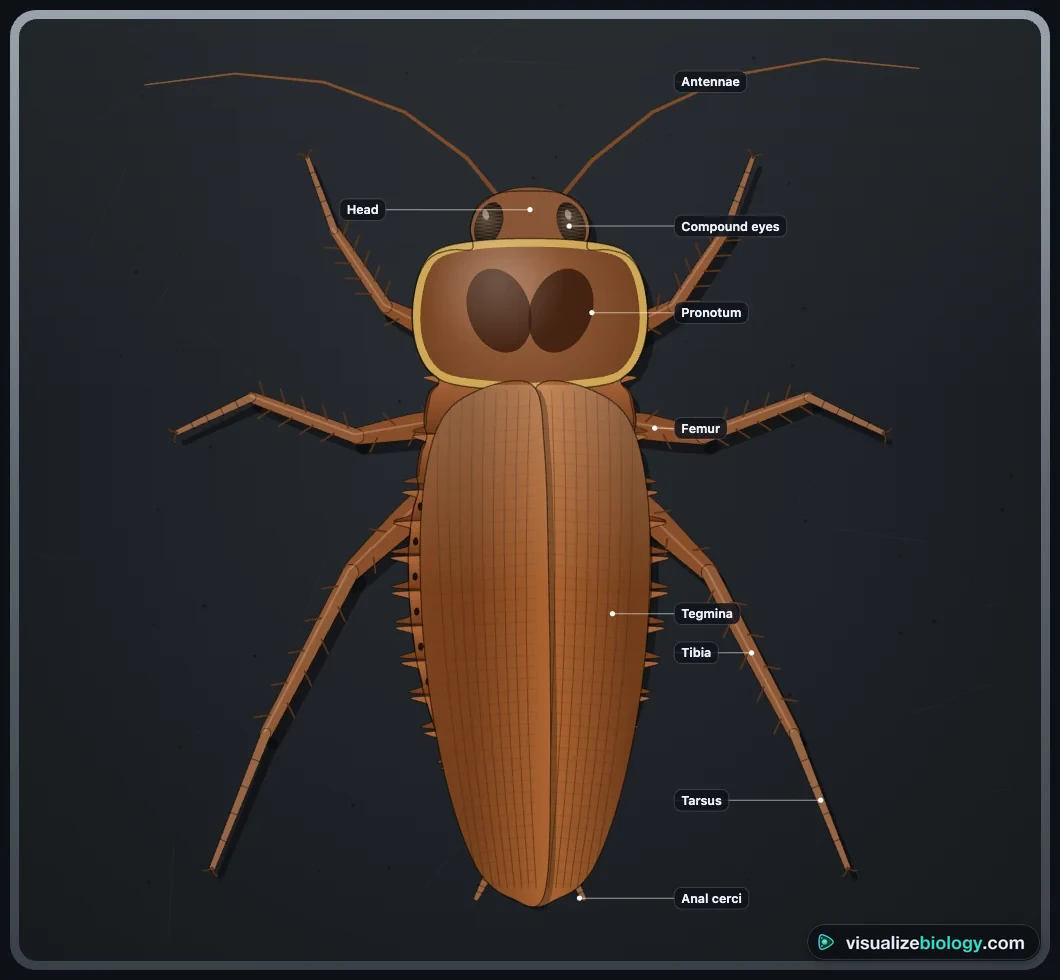
Periplaneta americana is 34–53 mm long and reddish brown. Its body has a head of six fused segments, a thorax of three (prothorax, mesothorax, metathorax) and an abdomen of ten, all covered by a hard chitinous exoskeleton of sclerites: tergites above and sternites below, joined by the flexible arthrodial membrane. The head carries a pair of compound eyes and long thread-like antennae. Each thoracic segment has a pair of walking legs; the leathery tegmina arise from the mesothorax and the membranous hind wings, used in flight, from the metathorax. Ten pairs of spiracles open along the sides, and a pair of jointed anal cerci sits on the 10th segment.
Mouth parts of cockroach
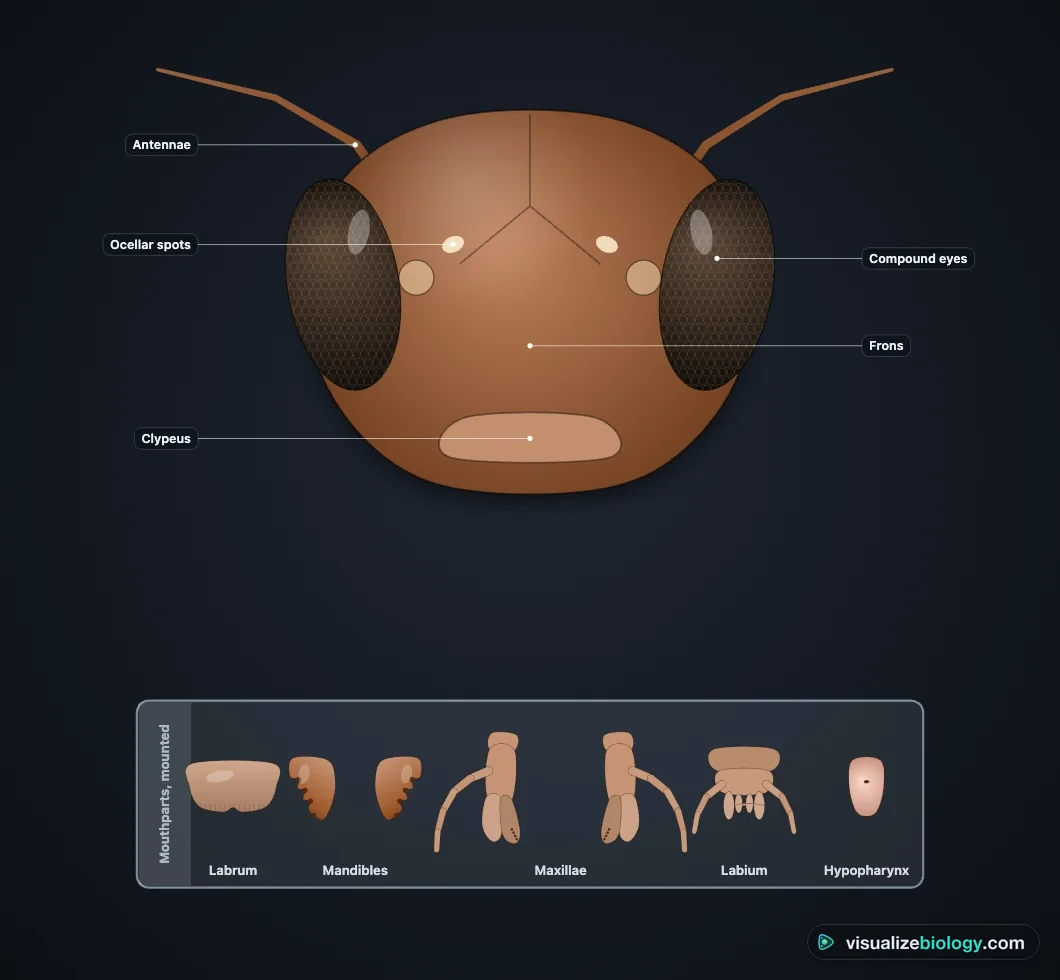
The mouthparts are of the biting and chewing type: the labrum (upper lip), a pair of toothed mandibles, a pair of maxillae (cardo, stipes, lacinia, galea and a 5-jointed palp) and the labium (lower lip) with 3-jointed palps. The hypopharynx, a median flexible lobe inside them, acts as the tongue.
Anatomy of cockroach: organs and their functions
| Organ | Where you find it | Function |
|---|---|---|
| Heart (13 chambers) | Under the mid-dorsal line, on the terga | Pumps colourless haemolymph forward in an open circulation |
| Crop | Thorax and front of the abdomen | Stores food |
| Gizzard | Behind the crop | Six chitinous teeth grind the food |
| Hepatic caeca (6–8) | Foregut/midgut junction | Secrete digestive juice |
| Midgut | Middle of the abdomen | Digests and absorbs food |
| Malpighian tubules (100–150) | Midgut/hindgut junction | Excrete nitrogen as uric acid (uricotelic) |
| Ileum, colon, rectum | Hind end of the abdomen | Absorb water; form dry faecal pellets |
| Salivary glands | Thorax, beside the crop | Make saliva with amylase |
| Fat body | Fills the haemocoel | Stores food and uric acid |
| Tracheae and spiracles | Everywhere; 10 pairs of openings | Carry air to the cells; gases exchange at the tracheoles |
| Ventral nerve cord | On the floor of the body | 3 thoracic and 6 abdominal ganglia |
Circulatory and respiratory system of cockroach
The circulation is open: blood vessels open into the haemocoel, where the organs bathe in haemolymph, a colourless plasma with haemocytes. The heart is a long tube of 13 funnel-shaped chambers, each with a pair of ostia, held to the terga by alary muscles. Breathing does not use the blood: air enters through 10 pairs of spiracles, travels along the tracheae and reaches the cells through fine tracheoles, where oxygen diffuses straight in. The abdomen pumps to ventilate them, faster when the cockroach is warm, which you can measure in the breathing practical.
Male vs female cockroach
| Male | Female | |
|---|---|---|
| Outside | A pair of anal styles on the 9th sternum | No styles; boat-shaped 7th sternum forming the brood pouch |
| Gonads | Testes in abdominal segments 4–6 | Two ovaries of 8 ovarioles each in segments 2–6 |
| Glands and ducts | Vasa deferentia, seminal vesicles, mushroom gland (segments 6–7), ejaculatory duct, phallomeres | Oviducts, vagina, a pair of spermathecae (segment 6), collaterial glands that make the ootheca |
Fertilised eggs are packed 14–16 at a time into an ootheca; a female makes 9–10 of them. Development is paurometabolous: the nymphs look like small wingless adults and moult about 13 times.
Cockroach for NCERT Class 11 and NEET
The cockroach was the insect of NCERT Class 11 chapter 7, Structural Organisation in Animals, until the 2023 rationalised edition, and it is still taught by many state boards and asked in NEET question banks. The facts examiners return to are all here: the head of six fused segments, 10 pairs of spiracles, the 13-chambered heart and open circulation, the gizzard's six teeth, the 6–8 hepatic caeca and 100–150 Malpighian tubules, uricotelic excretion, about 2000 ommatidia and mosaic vision, 3 thoracic and 6 abdominal ganglia, a headless cockroach living for a week, testes in segments 4–6 and the mushroom gland in 6–7, ovaries in 2–6, and 9–10 oothecae of 14–16 eggs.
Practicals and course links
| Practical | What you find out | Course links |
|---|---|---|
| External features and sexing | The cockroach's morphology, male or female | NCERT 11 ch. 7; high school biology |
| Mouthparts: remove and mount | Biting and chewing mouthparts, in order | NCERT 11 practical; insect anatomy |
| The full dissection | How the organs are arranged, in layers | NGSS HS-LS1-2; AP Biology |
| Breathing rate and temperature | Q10 for ventilation in an ectotherm | AQA A-level 3.3.2 (gas exchange in insects); AP Biology |
| Leg nerve: touch and temperature | Spikes, rate coding and temperature | NGSS MS-LS1-8; AP Biology; the SpikerBox cockroach-leg lab |
Who uses this virtual cockroach dissection?
NCERT Class 11 and state-board students and NEET candidates learning the morphology and anatomy of the cockroach, high school and A-level students studying insect anatomy and gas exchange, AP and college students doing the cockroach-leg neuroscience lab, and teachers who want a free, no-login dissection on a classroom screen or students' Chromebooks.
Frequently asked questions
How do you tell a male cockroach from a female?
Look at the tip of the abdomen from below. A male has a pair of short, thread-like anal styles on the 9th sternum; a female has none. In a female the 7th sternum is boat-shaped and, with the 8th and 9th sterna, forms the brood (genital) pouch. Both sexes have a pair of jointed anal cerci on the 10th segment. In the American cockroach the male's wings also reach beyond the tip of the abdomen. Inside, a male has testes in abdominal segments 4–6 and a mushroom gland in segments 6–7; a female has two ovaries of eight ovarioles each in segments 2–6.
Why is the circulatory system of a cockroach called open?
Its blood vessels are poorly developed and open into the body cavity, the haemocoel, so the organs are bathed directly in haemolymph instead of being supplied by capillaries. A long tubular heart of 13 chambers on the mid-dorsal line pumps colourless haemolymph forward into the head; it flows back through the haemocoel and re-enters the heart through pairs of ostia. The haemolymph carries food and wastes but not oxygen, which reaches the cells through the tracheae.
What are the mouth parts of a cockroach?
A cockroach has biting and chewing mouthparts: a labrum (upper lip), a pair of toothed mandibles, a pair of maxillae (each with a cardo, stipes, lacinia, galea and a 5-jointed maxillary palp) and a labium (lower lip, with 3-jointed labial palps). A median flexible lobe, the hypopharynx, lies inside them and acts as the tongue; the salivary duct opens on it.
What are the steps of a cockroach dissection?
Kill and wash the cockroach, then study its external features and remove its mouthparts. Snip off the wings, pin it dorsal side up through its legs in a wax tray and cover it with water. Cut along both sides of the body through the soft pleura from the tail end to the neck, and across behind the head, then lift off the terga carefully: the heart comes away attached to them. Identify the white fat body and the organs below it, then remove the fat body and the alimentary canal to see the reproductive organs and the ventral nerve cord.
Explore related simulators
Compare an insect with a vertebrate in the Virtual Frog Dissection, the cockroach's open circulation with our four-chambered heart in the Heart & Cardiac Cycle Simulator, and its tracheae with our lungs in the Respiratory System Simulator. See how its Malpighian tubules differ from our nephrons in the Kidney Simulator, and look at insect cells and tissues down the Virtual Microscope.
Sources: NCERT Biology Class 11 (2006–2022 editions), chapter 7, Cockroach; OpenStax Biology 2e, chapter 28.5 (Arthropods); Bell, Roth and Nalepa, Cockroaches: Ecology, Behavior, and Natural History (2007); Miller, Advances in Insect Physiology 3 (1966), for insect ventilation; Marzullo and Gage, PLoS ONE 7 (2012), for the cockroach-leg spike lab. Heart and breathing rates, spike counts and development times are typical values for an educational model; real cockroaches vary with species, size, age and temperature.
Updated