
Seed Germination Virtual Lab: Watch a Seed Germinate in 3D
Sow a bean, maize, barley or lettuce seed against the glass of a root viewer and watch it take up water, push out its radicle and grow into a seedling. Change water, oxygen, temperature and light, cut the seed open, and run seven germination experiments.
What's happening
Lab notebook
Imbibition, germination, emergence, greening and every condition you change are written here with the time. Export a CSV, or turn the session into a PDF lab report.
| # | Seed | What | Result | Value |
|---|
Concept library
Click "New problem" to begin.
Click "Start quiz" for 5 questions on the stages of germination, what seeds need, seed structure, food reserves and a calculation.
1 Overview
Simulate shows a seed sown against the glass of a root viewer on the left, in 2D or 3D, and close-ups on the right: Inside the seed, the Enzymes that digest its food, Graph and what it Needs. One model drives everything, from the dry seed to a seedling three weeks later. Experiment has seven practicals that end in a PDF lab report, and Quiz has a practice quiz with worked solutions and a 5-question quiz.
2 Watching a seed germinate
- Press ▶ (or Space) to play. At Teach speed each step gets a few seconds on screen; 1 h/s, 6 h/s and 1 day/s run at a fixed rate. › jumps to the next step.
- The strip under the clock shows the steps: dry seed, imbibition, activation, radicle emergence, root growth, shoot growth, above ground and seedling.
- Jump to in the Seed panel goes straight to a step; New seed sows a fresh dry seed.
3 Cameras, labels and the cut seed
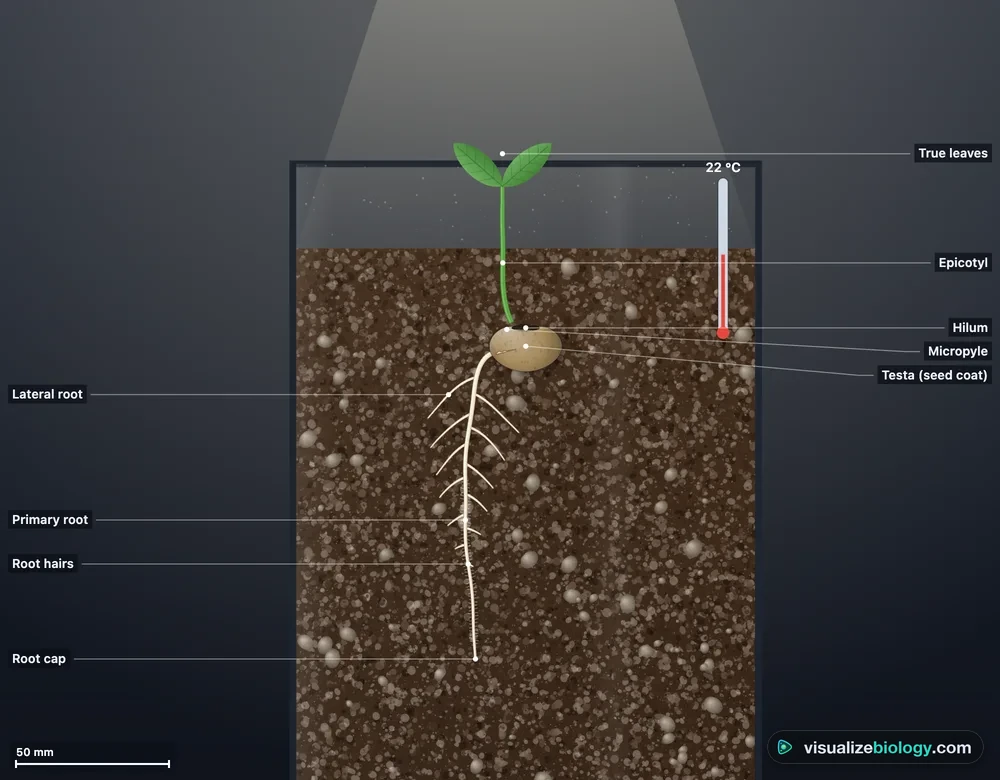
- Seed follows the seed and seedling, magnified (a lettuce seed is only 4 mm long); Pot shows the whole root viewer with its lamp and thermometer; Dish of 25 shows 25 seeds on wet filter paper germinating one by one.
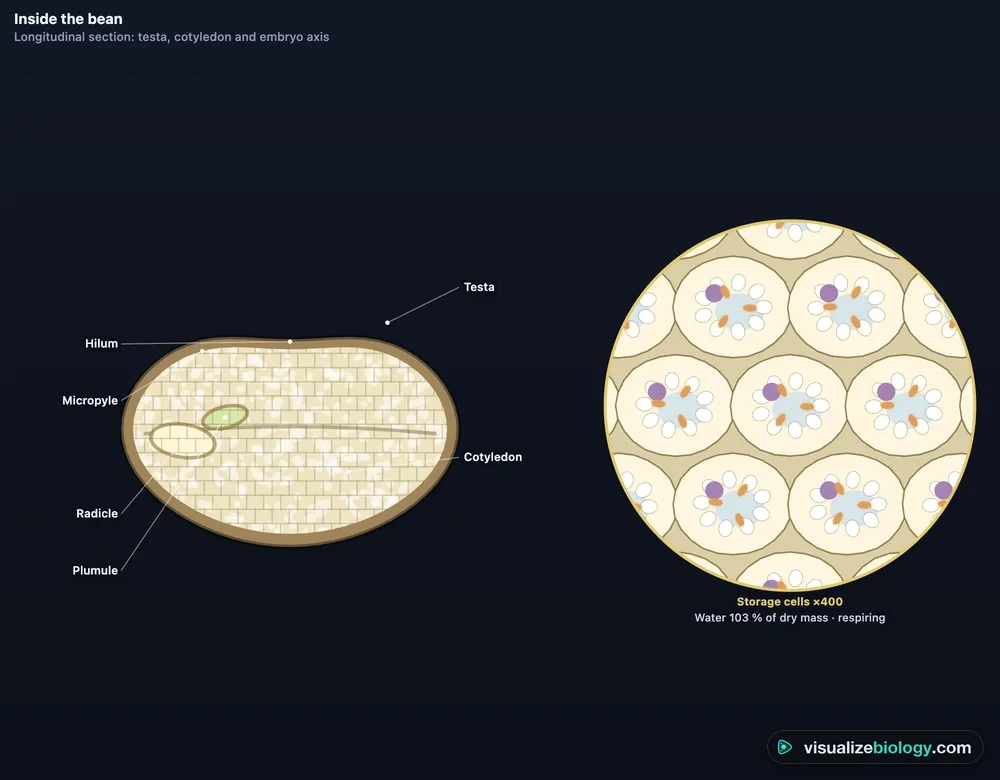
- Tap any part (testa, micropyle, radicle, root hairs, hook, coleoptile…) to name it and see its job. Cut the seed open in View shows its inside; the Inside close-up has an iodine stain for starch.
- In 3D drag to turn the root viewer; hold Ctrl or ⌘ and scroll (or pinch) to zoom.
4 Conditions
In Conditions set the water (dry, moist, waterlogged or salty), the temperature, the oxygen and the light. If the seed cannot germinate, a red tag on the bench says why, and the Needs close-up shows which need is missing. Boiled (dead) seeds in the Seed panel are the control: they swell but never germinate.
5 Experiment mode and the lab report
Seven practicals: dissect a seed, what seeds need (five tubes), temperature and germination rate, water potential (PEG solutions), red and far-red light on lettuce seeds, barley amylase and gibberellin on starch agar, and heat from germinating seeds in vacuum flasks. Each shows its aim, what you need and a real-lab safety note; the method ticks off as you work, a conclusion question checks your result, and Create lab report builds a PDF.
6 Units and keyboard
- SI | US switches between °C and millimetres and °F and inches; masses and water potentials (MPa) stay the same.
- Space plays or pauses, → jumps to the next step, 1, 2 and 3 choose Seed, Pot or Dish, C cuts the seed open, N sows a new seed, S opens Status and Esc clears the selection. Right-click the bench or the close-up to save it as an image.
A seed germination virtual lab you can run in your browser
This seed germination virtual lab is a simulator of a real seed. You sow it against the glass of a root viewer and watch it, in 2D or 3D, take up water, push out its radicle and grow into a green seedling. You choose the seed (broad bean, mung bean, maize, barley or lettuce) and the conditions: water, oxygen, temperature and light. The model behind it is the hydrothermal-time model that seed scientists use, so it decides when the seed germinates and how many seeds in a dish of 25 germinate. A cold, dry, waterlogged or salty seed behaves like a real one.
- Seeds
- Broad bean, mung bean, maize, barley and lettuce: dicot and monocot, epigeal and hypogeal
- Conditions
- Water, oxygen, temperature from 4 to 40 °C, and dark, white, red or far-red light
- Views
- 2D and 3D root viewer, a dish of 25 seeds, the seed cut open, enzymes, graphs
- Modes
- Simulate, Experiment (7 practicals with a PDF report) and Quiz
- Price
- Free, with no account or download; works on Chromebooks, tablets and phones
Conditions for seed germination
A seed needs three things to germinate: water, oxygen and a suitable temperature. Water switches on its enzymes and lets it digest and move its stored food. Oxygen is needed for the aerobic respiration that powers growth, which is why seeds in waterlogged soil fail. Temperature sets how fast the enzymes work. Each kind of seed has a base temperature below which nothing happens, an optimum where germination is fastest, and a ceiling above which it fails. Most seeds germinate in the dark. Small seeds such as lettuce are different: they need light to germinate. Try the classic five tubes (dry, moist, no oxygen, fridge, dark) in the "What does a seed need?" practical.
The stages of seed germination
| Stage | What happens | In the simulator |
|---|---|---|
| 1. Imbibition | The dry seed (about 10 % water) soaks up water through its micropyle and testa and swells. This is physical, so dead seeds swell too. | The seed swells and its coat wrinkles; water molecules stream in |
| 2. Activation | Water uptake levels off. Membranes and mitochondria are repaired, enzymes are activated and respiration rises. In cereals the embryo releases gibberellin. | The cell magnifier glows with respiring mitochondria |
| 3. Radicle emergence | The radicle pushes through the seed coat. This is the moment of germination. | The testa splits and the root grows down |
| 4. Seedling growth | The root grows down with root hairs, the shoot grows up in a hook or coleoptile, then turns green in the light. | The hook opens and the leaves green |
Parts of a seed: dicot and monocot
Cut a soaked broad bean in half and you see a dicot seed: the testa (seed coat), with the hilum scar and the micropyle pore, around two thick cotyledons that store starch and protein, and between them the embryo: a radicle (embryonic root) and a plumule (embryonic shoot). A maize or barley grain is a monocot and really a fruit. Its starchy endosperm is wrapped in an aleurone layer. The single cotyledon, the scutellum, lies against it, and the embryo has a coleoptile over its shoot and a coleorhiza over its root.
Epigeal vs hypogeal germination
| Epigeal | Hypogeal | |
|---|---|---|
| Cotyledons | Lifted above the soil; turn green and photosynthesise | Stay underground and empty as their food is used |
| What grows up | The hypocotyl, arched into a hook | The epicotyl (dicots) or coleoptile (grasses) |
| Examples | Mung bean, French bean, lettuce, sunflower | Broad bean, pea, maize, barley, wheat |
Gibberellin and amylase: how the seed uses its food
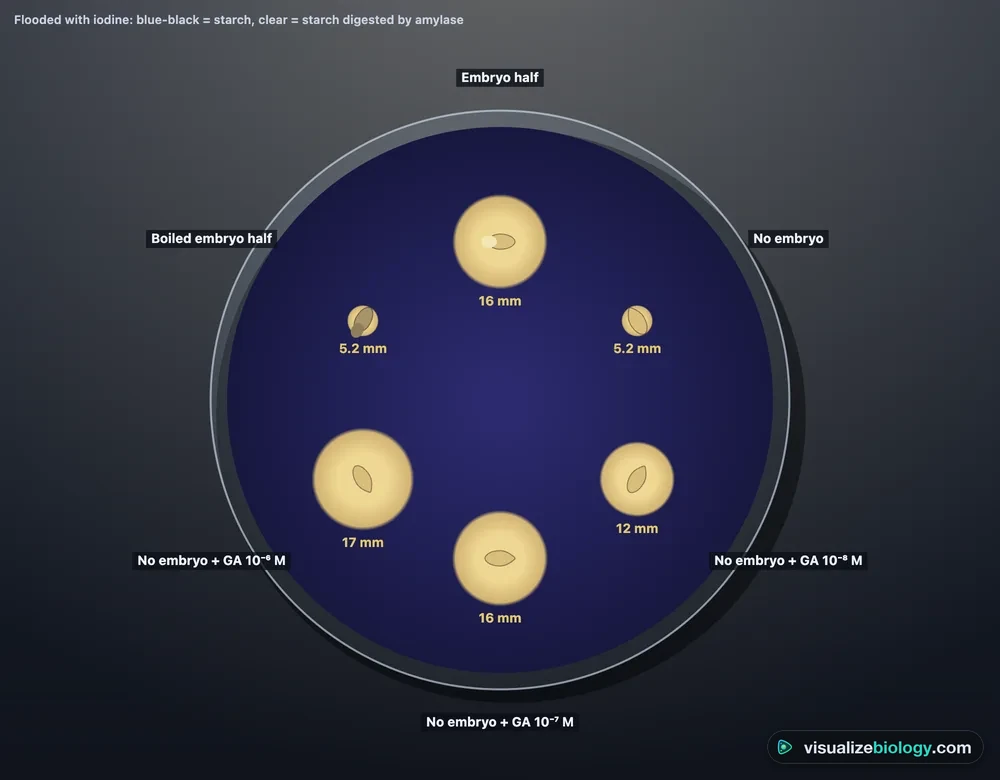
A seedling lives on stored food until its leaves photosynthesise. In a barley grain the embryo sends the hormone gibberellin (GA) to the aleurone layer. The aleurone answers by secreting α-amylase, which digests endosperm starch to maltose for the embryo. Put half-grains on starch agar, flood the plate with iodine, and a clear zone shows where starch was digested. An embryo half clears a zone, a half without its embryo does not, and adding GA to that half brings the zone back. Because respiration burns some of the stored food, a seedling's dry mass falls at first and only rises once photosynthesis takes over.
Light, phytochrome and lettuce seeds
Lettuce seeds of the variety Grand Rapids germinate after a flash of red light (660 nm) and not after far-red light (730 nm). Red light switches the pigment phytochrome to its active form, Pfr, and far-red light switches it back. Give a sequence of flashes and only the last one counts (Borthwick and colleagues, 1952). This tells a small seed that it is near the surface and not under a canopy of leaves, which let far-red light through. Lettuce also stops germinating above about 28 °C.
Practicals and course links
| Practical | What you find out | Course links |
|---|---|---|
| Dissect a seed | The parts of a dicot seed and a monocot grain | IGCSE 16; NCERT 11; NGSS MS-LS1-4 |
| What does a seed need? | Water, oxygen and warmth; light is not needed | GCSE; IGCSE 16.4; NGSS MS-LS1-5 |
| Temperature and germination rate | The optimum temperature and rate = 1 / t50 | GCSE, AP, A-level |
| Water potential (PEG) | Why seeds fail in dry and salty soil | AP Bio; A-level |
| Red and far-red light | Phytochrome and the last-flash rule | AP Bio 8.1; A-level; NCERT 11 |
| Barley amylase and GA | The embryo signals the aleurone with gibberellin | A-level; IB; NCERT 11 |
| Heat from germinating seeds | Respiration releases energy | GCSE; AP Bio Unit 3 |
Who uses this seed germination simulator?
Middle school students learning how plants grow (NGSS MS-LS1-5), GCSE and IGCSE students revising the conditions for germination, A-level, AP and IB students studying gibberellin, amylase and phytochrome, and teachers who want a free, no-login seed germination simulation for a classroom screen, a homework or a lab that would otherwise take a week to grow.
Frequently asked questions
What are the 3 conditions needed for seed germination?
Water, oxygen and a suitable temperature. Water activates the seed's enzymes and lets it digest and move its stored food; oxygen is needed for the aerobic respiration that supplies energy for growth; and the temperature must be warm enough for enzymes to work but not so hot that they are damaged. Most seeds do not need light, although some small seeds, such as lettuce, need red light to germinate.
What are the stages of seed germination?
First, imbibition: the dry seed takes up water quickly and swells. Second, activation: water uptake levels off while membranes and mitochondria are repaired, enzymes are switched on and respiration rises; in cereals the embryo releases gibberellin, which makes the aleurone layer secrete amylase. Third, the radicle grows through the seed coat, which completes germination. Then the seedling grows: the root grows down with root hairs, the shoot grows up and turns green in the light.
What is the difference between epigeal and hypogeal germination?
In epigeal germination the hypocotyl grows and lifts the cotyledons above the soil, where they turn green and photosynthesise, as in mung beans, French beans, lettuce and sunflowers. In hypogeal germination the cotyledons stay underground and the epicotyl (in dicots) or the coleoptile (in grasses) carries the shoot up, as in broad beans, peas, maize and barley.
Explore related simulators
A seed starts as an ovule: follow pollen to a fertilized ovule in the Pollination Simulator. Once the seedling is green it feeds itself: test light, CO₂ and temperature in the Photosynthesis Lab. Root hairs take up the water that travels up the stem: see it in the Xylem and Phloem Simulator. Imbibition and water potential are osmosis in action: compare potato tissue in the Osmosis Lab. Amylase is an enzyme like any other: measure its Km, optimum temperature and pH in the Enzyme Kinetics Virtual Lab.
Sources: Bradford (2002), Weed Science 50, and Alvarado and Bradford (2002), Plant, Cell & Environment 25, for the hydrothermal-time model; Bewley et al., Seeds: Physiology of Development, Germination and Dormancy, 3rd edition (2013); Borthwick et al. (1952), PNAS 38, for red and far-red light; Jones and Varner (1967), Planta 72, for the aleurone amylase bioassay; OpenStax Biology 2e, chapters 30 and 32; Urry et al., Campbell Biology 12th edition, chapters 38 and 39. Timings, sizes and amounts follow these sources; real seeds vary, and the simulator is an educational model.
Updated