
Water Filtration and Treatment Simulator: From River to Tap
Choose the water, the weather and the treatment steps, then watch mud, germs, salt and chemicals being settled, filtered and killed on the way to the tap. Check your water against the US and EU limits, in 2D or 3D.
Experiment
0 hSafe🏞️ River
At the tap
Turbidity—
E. coli—
Infection risk a year—
Free chlorine—
Dissolved salts—
Energy—
Output—
Verdict—
Source & weather
Weather
Season
Farming
Treatment steps, in order
Settings
Lab
View, time & limits
Limits
Is the water safe?
Lab notebook
Your measurements and the big moments (a storm, a filter backwash, carbon running out, a membrane fouling, water that fails a limit) are written here with the conditions. Export a CSV, or turn the session into a PDF lab report.
| # | Sample | Conditions | Measurement | Result |
|---|
Concept library
Click "New question" to begin.
Click "Start quiz" for 5 questions on the stages of water treatment, filters, disinfection, sewage, desalination and the labs.
User Guide: Water Filtration Simulator
1 Overview
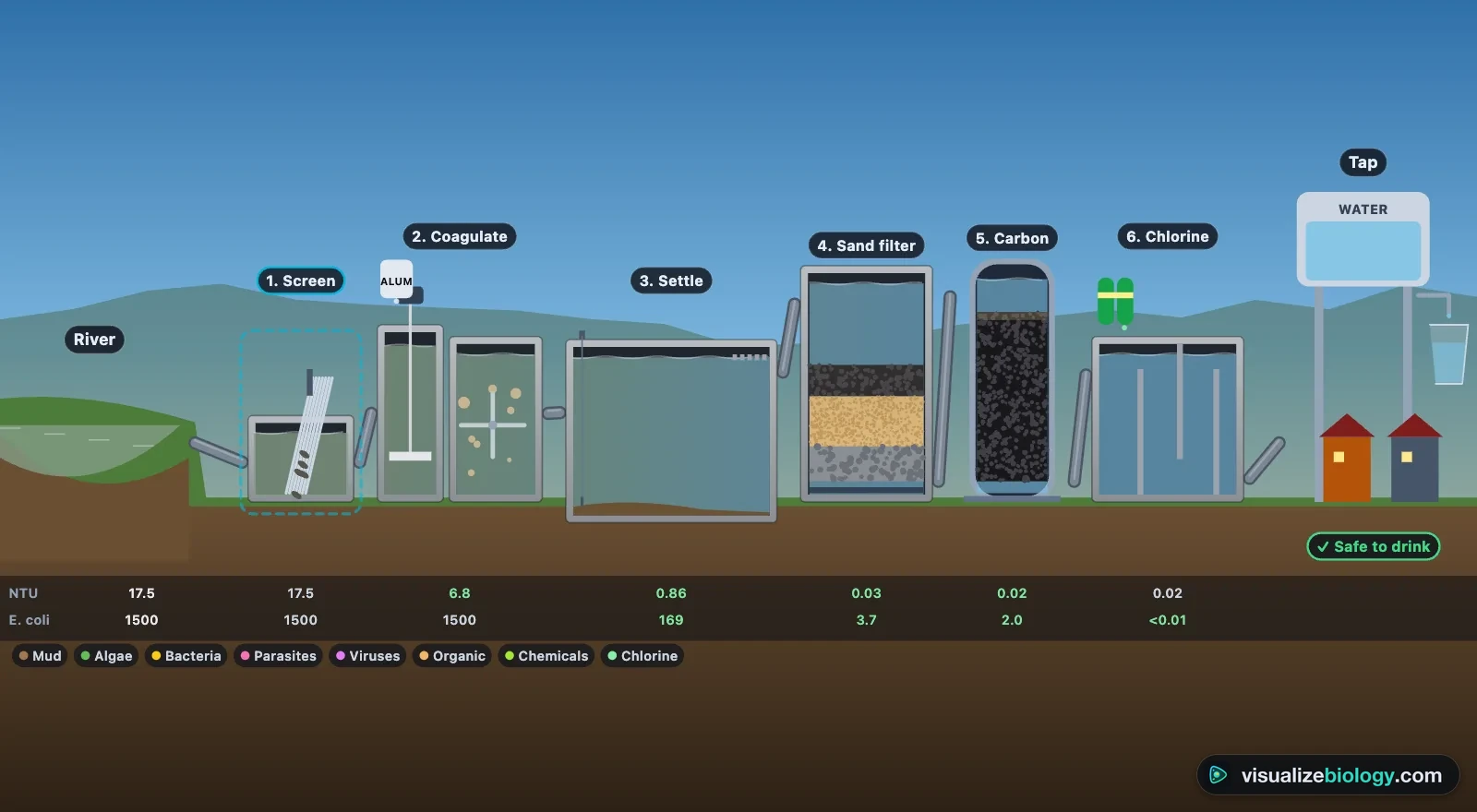
Simulate shows a water treatment plant in cut-away: the water source on the left, every treatment step as its real apparatus in the middle, and the tap (or, for sewage, the river) on the right. Coloured particles stand for what is in the water: mud, algae, bacteria, parasites (Giardia and Cryptosporidium), viruses, organic matter, chemicals and salt. Each particle meets each step and survives with the same odds as the real water in the model; when it does not, you see it removed the way that step removes it: it sinks into the sludge, sticks in the sand, is stopped at a membrane, or is killed (it turns grey and fades). Experiment has seven practicals with a lab report; Quiz has a practice quiz and a 5-question quiz.
2 Systems, sources and the weather
- The System menu loads a ready-made plant: a city water works on a river, a reservoir works with ozone, a small-town well, a desalination plant, a sewage works, a village household, a home with a lead pipe, or an empty plant to build yourself.
- The Source panel changes where the water comes from without changing the steps, and sets the weather (a storm muddies the river and overflows the sewers for a day or two), the season (cold water settles more slowly and kills germs more slowly; summer brings algae) and how much fertilizer the farms upstream use. Chemical spill sends a pulse of pesticide down the river.
3 Building the treatment
The Steps panel lists the steps in the order the water meets them. Move a step up or down, switch it off (the water bypasses it) or remove it, and add new ones from the palette: screens, grit removal, coagulation, settling, rapid and slow sand filters, activated carbon, membranes (micro-, ultra-, nanofiltration, reverse osmosis), ion exchange, activated sludge, reed beds, chlorine, ozone, UV, distillation, boiling, solar disinfection, ceramic, cloth and jug filters, and portable filters (a filter straw, a squeeze filter, a hand pump with a carbon core, a carbon-block bottle, a charcoal bottle and a UV pen). Tap a step on the plant (or its row) to open its Settings: the coagulant dose, the surface loading of a settling tank, filtration rates, carbon contact time, membrane type and pressure, chlorine dose, contact time and baffles, UV dose and more, with the maintenance buttons (backwash, replace the carbon, clean the membrane, scrape the slow sand filter).
4 Inside, sizes, quality and graphs
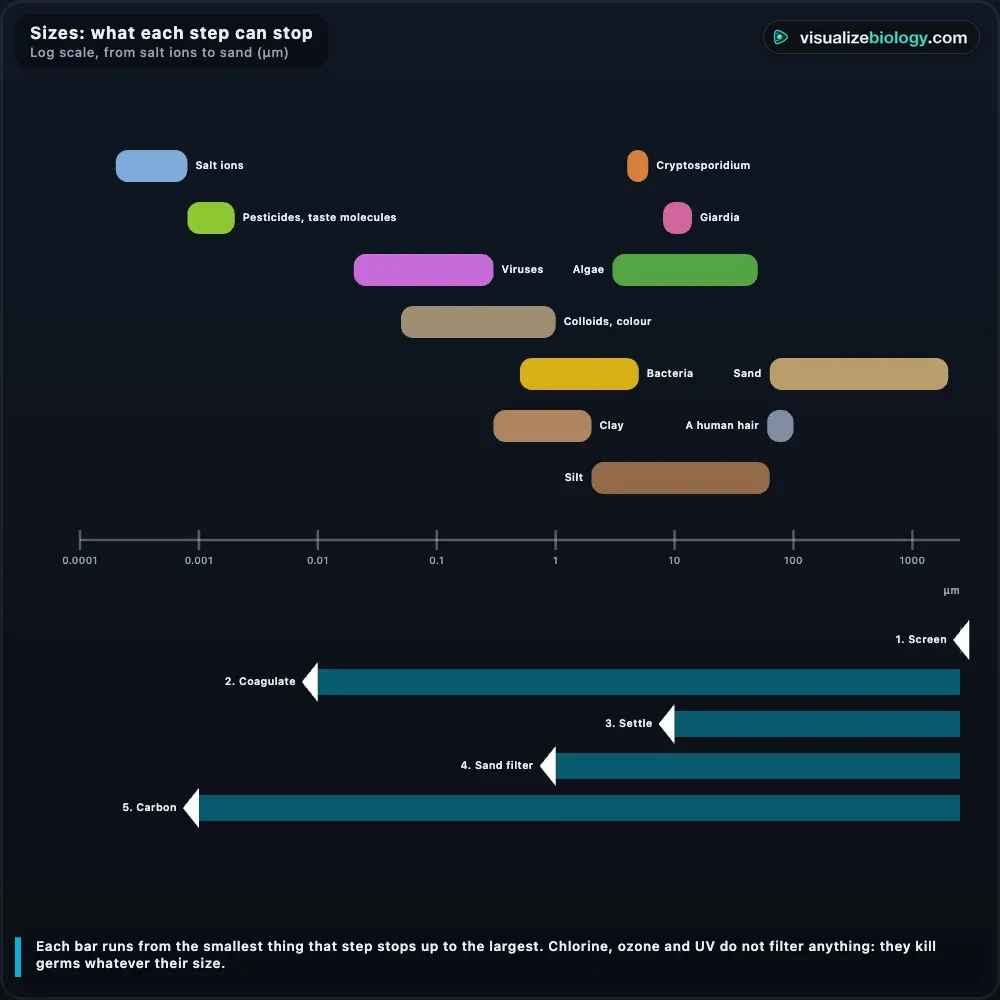
Inside shows what the selected step does at the scale of particles and molecules (choose the step from the chips). Sizes is the filtration size chart from salt ions to sand, with the smallest thing each of your steps can stop. Quality follows one quantity (turbidity, E. coli, Cryptosporidium, viruses, organic carbon, salt, nitrate, lead, arsenic, pesticide, taste, trihalomethanes, chlorine, BOD…) through the plant against the US, EU or WHO limit. Graph records the plant over time: turbidity in and out, sand filter head loss, chlorine at the tap, carbon left, the river after rain. The card Is the water safe? checks every limit and the yearly risk of infection.
5 2D, 3D and the catchment
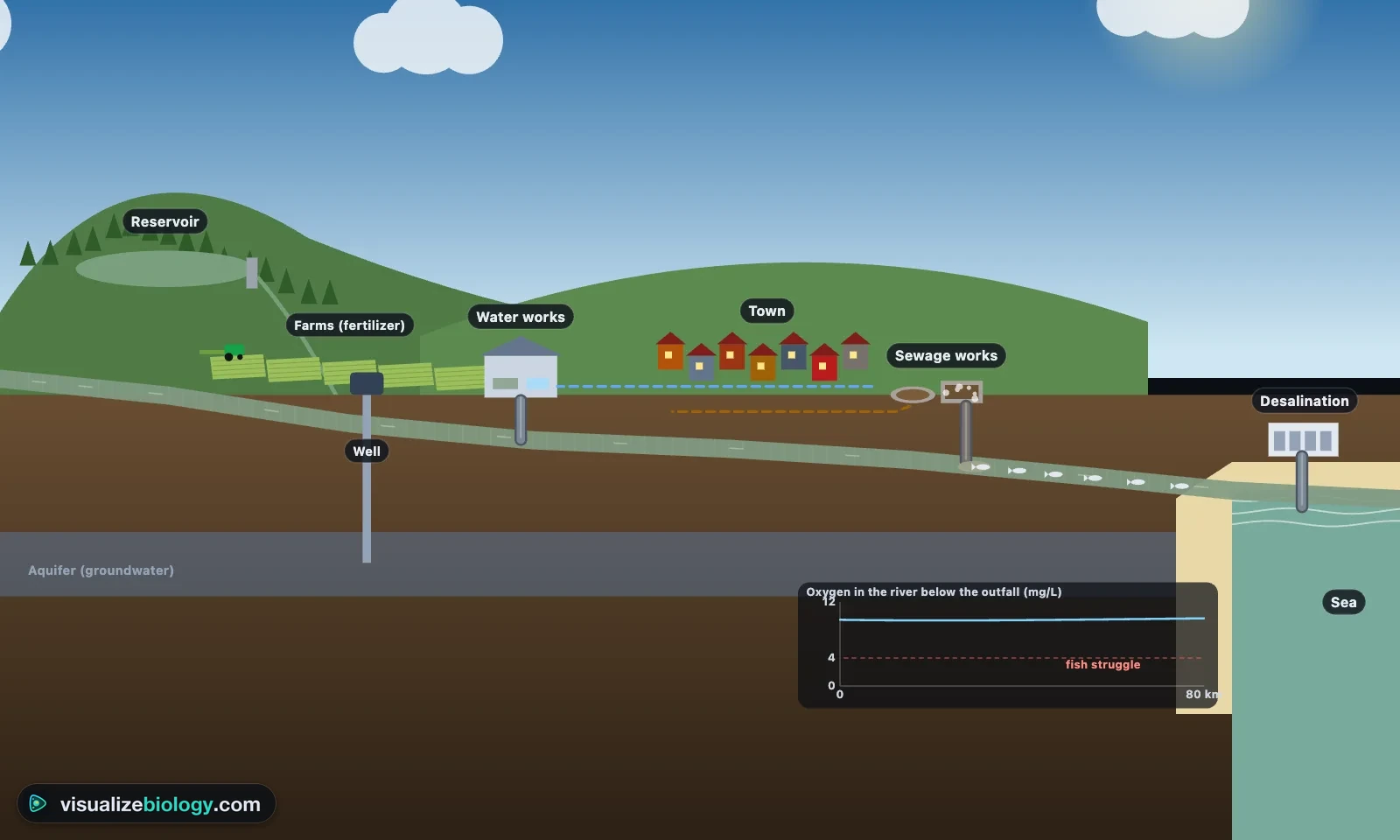
The 2D | 3D switch shows the plant as a cut-away drawing or as a 3D model you can turn (drag to turn, Ctrl/⌘ + scroll or pinch to zoom, click a step to select it). Catchment shows the whole journey: rain on the hills and farms, the reservoir, the river, the water works, the town, the sewers and the sewage works, the oxygen in the river below it, a well into the aquifer and a desalination plant on the coast. Click a place to load its plant.
6 Experiment mode and the lab report
Eight practicals: design a bottle filter (an engineering design challenge), analyse and purify a water sample (the AQA required practical), find the best coagulant dose with a jar test, disinfect water with chlorine or UV, push seawater through a reverse osmosis membrane, sample the river below a sewage works, make pond water safe at home, and choose a portable filter for a stream, a pond and an old tap. Each shows its aim, what you need and a safety note; a checklist ticks off each step; then answer the conclusion question and make a PDF lab report from your notebook.
7 Quiz and units
The practice quiz covers the stages of treatment, filters and membranes, germs and disinfection, sewage and rivers, desalination and safe water at home, and calculations, each with a worked answer. Take the quiz gives five mixed questions and a star rating. SI | US switches flows, pressures, lengths and temperatures between metric (m³/day, bar, m, °C) and US units (MGD, psi, ft, °F); water quality stays in mg/L, µg/L, NTU and counts per 100 mL, as on every lab report.
8 Keyboard and gestures
- Space runs or pauses the clock, 1 and 2 switch between the plant and the catchment, R makes a storm, B backwashes the sand filter, L shows or hides labels, Z shows it all, S opens Status, Esc stops a tour.
- A plain scroll always scrolls the page. To zoom, hold Ctrl or ⌘ while scrolling (or pinch), or click the picture first. Drag to pan when zoomed in. On a phone, one finger scrolls the page.
- Right-click the picture to save an image, copy the readings or reset the plant.
The water treatment process, step by step
Water from a river, a lake or the ground is never just water. It carries mud, algae and organic matter, germs from people and animals upstream, and dissolved chemicals: nitrate from farms, pesticides, natural arsenic, lead from old pipes, and in the sea about 35 grams of salt in every litre. Turning it into drinking water means removing each of these by the method that suits it: physical methods (screening, settling, filtering through sand or membranes), chemical methods (coagulation, adsorption on carbon, disinfection with chlorine or ozone) and biological ones (the living skin of a slow sand filter, the bacteria of a sewage works). This simulator lets you build the treatment yourself and see what each step removes.
- Sources
- River, reservoir, deep well, farm well, seawater, town sewage, village pond, an old house tap
- Steps
- 28, from screens and coagulation to reverse osmosis, chlorine and UV, plus home filter vessels (sand, iron removal, activated carbon) and portable filters (straws, squeeze and pump filters, carbon blocks, charcoal bottles, UV pens)
- Checks
- US EPA, EU Drinking Water Directive and WHO limits; the yearly risk of infection
- Modes
- Simulate (2D or 3D, with guided tours), Experiment (8 practicals) and Quiz
- Price
- Free, no account or download; works on Chromebooks, tablets and phones
The stages of water treatment
- Screening. Bars at the intake catch leaves, litter and fish.
- Coagulation and flocculation. Clay particles and germs carry negative charges that keep them apart. A coagulant (alum or ferric chloride) cancels the charges, and slow paddles let the particles stick into fluffy flocs.
- Sedimentation. In a wide, calm tank the flocs sink as sludge. A particle is removed if it sinks faster than the water rises out of the tank (Stokes' law and Hazen's rule).
- Filtration. The water trickles through a bed of sand, where fine particles stick to the grains. Activated carbon then adsorbs taste, odour and pesticides.
- Disinfection. Chlorine, ozone or UV light kills the germs that are left. A little chlorine stays in the water to protect it all the way to the tap.
How a water filter works: what each one can stop
| Filter | How it works | Stops | Lets through |
|---|---|---|---|
| Screen, cloth | Straining | Litter, sand, plankton | Clay, germs, chemicals |
| Rapid sand filter | Particles stick to grains (depth filtration) | Flocs, silt, cysts | Dissolved matter; free viruses |
| Slow sand filter | A living skin of microbes | Bacteria, cysts, many viruses | Salt, nitrate, chemicals |
| Activated carbon | Adsorption | Taste, odour, pesticides, chlorine | Germs, salt, nitrate |
| Microfiltration (0.1 µm) | Pores | Bacteria, cysts | Viruses, everything dissolved |
| Ultrafiltration (0.01 µm) | Pores | Viruses too | Everything dissolved |
| Reverse osmosis | Pressure above the osmotic pressure | Salt, nitrate, metals, almost everything | Water (and a little salt) |
Chlorine, ozone and UV
Disinfection depends on CT, the concentration of disinfectant times the contact time. Under US rules, 3-log (99.9 %) removal of Giardia at 10 °C and pH 7 needs a CT of about 112 mg·min/L of free chlorine, which is why contact tanks are long and baffled. Chlorine works best below pH 7.5, more slowly in cold water, and hardly at all on Cryptosporidium, whose thick wall makes it nearly immune; UV light at only 12 mJ/cm² kills 99.9 % of it. Cloudy water shields germs from all three, so turbidity must be brought below 1 NTU first. Chlorine meeting organic matter also makes trihalomethanes, limited to 80 µg/L in the US and 100 µg/L in the EU.
The sewage treatment process
A sewage works cleans used water before it goes back to a river. Preliminary treatment screens out rags and grit; primary treatment settles about half of the solids as sludge; secondary treatment bubbles air through the sewage so that bacteria in activated sludge eat the dissolved organic matter (BOD) and turn ammonia into nitrate; tertiary treatment removes nitrogen and phosphate and may disinfect with UV. The sludge is digested without oxygen to make biogas. Without treatment, bacteria decomposing the sewage use up the oxygen in the river and fish die downstream: in the simulator's catchment you can watch that oxygen sag.
Desalination by reverse osmosis
Osmosis moves water from fresh water into salty water through a membrane. Seawater, with about 35 g/L of salt, has an osmotic pressure of about 27 bar (390 psi), so pushing at 55–70 bar forces water the other way, out of the salt. About 45 % of the seawater comes out fresh and the rest returns to the sea as brine. With energy recovery, it takes about 2–4 kWh per cubic metre. The other route, distillation, boils the water and condenses the steam.
Home water filter vessels: what is inside the blue tanks
Many homes on a well, in India, the US and Europe alike, have one or two tall blue fibreglass (FRP) pressure vessels, about 25 cm across and 1.4 m tall, with a multiport valve on top. Water enters the valve, sprays out of a top distributor, trickles down through layers of media, is collected by a slotted distributor at the bottom and rises up the central riser tube back to the valve and the house. The top third of the vessel is left empty (freeboard) so that the bed can lift during a backwash.
| Vessel | Layers, top to bottom | What happens inside |
|---|---|---|
| Multimedia (sand) filter | Anthracite, fine sand, coarse sand, gravel | Particles stick to the grains; rust and silt are caught |
| Iron removal filter | Birm or manganese greensand, calcite, gravel | Calcite raises the pH of acidic well water; dissolved iron (Fe²⁺) meets oxygen on the media and becomes rust flakes, Fe(OH)₃, trapped in the bed |
| Activated carbon filter | Granular activated carbon, gravel | Chlorine, smell, colour and pesticides are adsorbed onto the carbon |
The valve has five positions: Filter (service), Backwash (water goes down the riser and up through the bed to the drain, washing out the trapped dirt), Rinse (a few minutes down to drain to settle the bed), Bypass and Closed. Iron filters on a typical well need a backwash every few days. These vessels do not disinfect: water from an open well still needs UV or chlorine to be safe to drink.
Portable water filters and activated charcoal
Hikers, travellers and families after a disaster use small filters that work like a water works in miniature. What they can stop depends on their pores, and activated charcoal is not a germ filter at all.
| Device | How it works | Stops | Lets through |
|---|---|---|---|
| Filter straw, squeeze or gravity filter | Hollow fibres, 0.1–0.2 µm | Bacteria, Giardia, Cryptosporidium, mud | Viruses, dissolved chemicals |
| Purifier straw or bottle | Ultrafiltration fibres, 0.02 µm, plus carbon | Viruses too; chlorine and taste | Salt, nitrate |
| Hand pump filter | 0.2 µm element, then an activated carbon core | Bacteria, cysts; taste and some chemicals | Most viruses |
| Carbon-block bottle | Pressed activated carbon, pores about 0.5–1 µm | Chlorine, lead, pesticides, taste; cysts | Many bacteria, all viruses |
| Charcoal bottle (loose granules) | Adsorption only | Taste, odour, chlorine | Germs of every kind |
| UV pen | UV light stirred in clear water for about 90 s | Inactivates bacteria, viruses and cysts | Germs shaded by mud; chemicals |
In a wilderness stream in North America or Europe, a 0.1–0.2 µm filter is usually enough. Where people live upstream, add something for viruses (UV, chlorine or boiling), and filter cloudy water before UV. A carbon block is the right choice for tap water from an old lead pipe, not for a stream.
Drinking water limits in the US and Europe
| Substance | US EPA | EU 2020/2184 | WHO |
|---|---|---|---|
| E. coli | 0 per 100 mL | 0 per 100 mL | 0 per 100 mL |
| Turbidity (filtered water) | ≤ 0.3 NTU in 95 % of samples, never above 1 | Indicator: no abnormal change | Below 1 NTU for disinfection |
| Nitrate | 10 mg/L as N (44 mg/L as NO₃⁻) | 50 mg/L | 50 mg/L |
| Lead | Action level 15 µg/L, 10 µg/L from 2027 | 10 µg/L, 5 µg/L from 2036 | 10 µg/L |
| Arsenic | 10 µg/L | 10 µg/L | 10 µg/L |
| Pesticide (each) | Atrazine 3 µg/L | 0.1 µg/L | Atrazine 100 µg/L |
| Trihalomethanes | 80 µg/L | 100 µg/L | By compound |
Experiments you can do
| Practical | What it shows | Course links |
|---|---|---|
| Design a bottle filter | Coarse to fine layers, trade-offs of clarity, speed and cost; a clear filter is not a safe one | NGSS MS-ETS1-1 to -4, MS-ESS3-3 |
| Analyse and purify a water sample | pH, dissolved solids by evaporation, distillation | AQA RP8 (Combined RP13); Edexcel; IGCSE 0620 10.1 |
| Jar test | The best coagulant dose; too much is as bad as too little | AP Environmental Science; water engineering |
| Chlorine and UV | CT, turbidity shielding, Cryptosporidium | APES 8.15; A-level and college |
| Reverse osmosis | No fresh water below the osmotic pressure | GCSE desalination; AP Chemistry; IB |
| The river below a sewage works | BOD, oxygen sag and river animals | APES 8.11; AQA 4.10.1.3; IB ESS 4.4 |
| Choose a portable filter | Pore size against germ size; charcoal adsorbs but does not filter germs | NGSS MS-ETS1; MS-ESS3-3 |
| Safe water in an emergency | Boiling, SODIS, chlorine tablets, ceramic and cloth filters | NGSS MS-ESS3-3; global health |
Who uses this simulator?
Middle and high school students use it to see what a textbook diagram of a water works cannot show: what each stage removes and what gets through, why the order matters, and what happens when a storm muddies the river. GCSE and IGCSE chemistry students use it for potable water, desalination and the water purification practical; AP Environmental Science and IB ESS students for sewage treatment and pathogens; engineering and environmental science students for jar tests, CT and reverse osmosis. Teachers project it to ask "what will happen if…" before pressing play. It is an educational model: real water treatment is designed and monitored by qualified engineers, and nothing here is advice about your own water.
Frequently asked questions
What are the stages of water treatment?
A typical drinking water works treats river or lake water in five stages. 1. Screening: bars catch leaves, litter and fish. 2. Coagulation and flocculation: a coagulant such as alum makes tiny clay particles and germs stick together into flocs. 3. Sedimentation: in a large calm tank the flocs sink to the bottom as sludge. 4. Filtration: the water trickles through beds of sand (and often activated carbon, which removes taste, odour and pesticides). 5. Disinfection: chlorine, ozone or UV light kills the germs that are left, and a little chlorine stays in the water to protect it in the pipes. Groundwater often needs less treatment, and seawater needs desalination by reverse osmosis or distillation.
How does a water filter work?
Filters remove what is in water in different ways. Straining stops anything bigger than the gaps, like a sieve. Depth filtration in sand catches particles much smaller than the gaps, because they touch the grains and stick. Biological filters (slow sand filters) have a living layer of bacteria and protozoa that eat germs. Activated carbon adsorbs dissolved molecules that cause taste, odour and pesticides onto its huge internal surface. Membranes stop particles by size: microfiltration stops bacteria, ultrafiltration stops viruses, and reverse osmosis even stops dissolved salt when the water is pushed through at high pressure. No filter on its own makes dirty water safe: a homemade sand and charcoal filter makes water look clearer but leaves germs, so the water must still be disinfected.
Does boiling water make it safe to drink?
Boiling kills germs: bacteria, viruses and parasites such as Giardia and Cryptosporidium all die within a minute at a rolling boil (the CDC advises 1 minute, or 3 minutes above about 2 000 m or 6 500 ft, where water boils at a lower temperature). But boiling does not remove mud, salt, nitrate, lead, arsenic or pesticides; it even concentrates them a little as water evaporates. So boiling makes water safe from germs, but not from chemicals.
Explore related simulators
See why reverse osmosis needs pressure in the Osmosis Lab, follow the nitrate from fertilizer to an algal bloom in the Nitrogen Cycle Simulator, meet the bacteria that cause and clean up pollution in the Virtual Bacteria Simulator, and see the viruses that UV and chlorine must kill in the Virus Virtual Lab.
Sources: Crittenden et al., MWH's Water Treatment: Principles and Design, 3rd edition; US EPA National Primary Drinking Water Regulations and Surface Water Treatment Rule CT tables; Directive (EU) 2020/2184, Annex I; Council Directive 91/271/EEC (urban waste water); WHO Guidelines for Drinking-water Quality, 4th edition; Haas, Rose and Gerba, Quantitative Microbial Risk Assessment; AQA GCSE Chemistry practical handbook; CDC boil-water guidance.
Updated