
Virtual Owl Pellet Dissection: Find the Bones, Name the Prey, Build the Food Web
Unwrap a real-size owl pellet, tease the fur apart and lift out every bone. Sort them on the bone chart, use the teeth to tell a vole from a shrew, rebuild a skeleton and turn what the owl ate into a food web.
This pellet
Lab notebook
The pellet's size and mass, the bones you find and sort, and every animal you identify are written here. Export a CSV, or turn the session into a PDF lab report.
| # | Pellet | What | Result | Value |
|---|
Concept library
Click "New problem" to begin.
Click "Start quiz" for 5 questions on owl pellets, bones, prey, data and food webs.
1 Overview
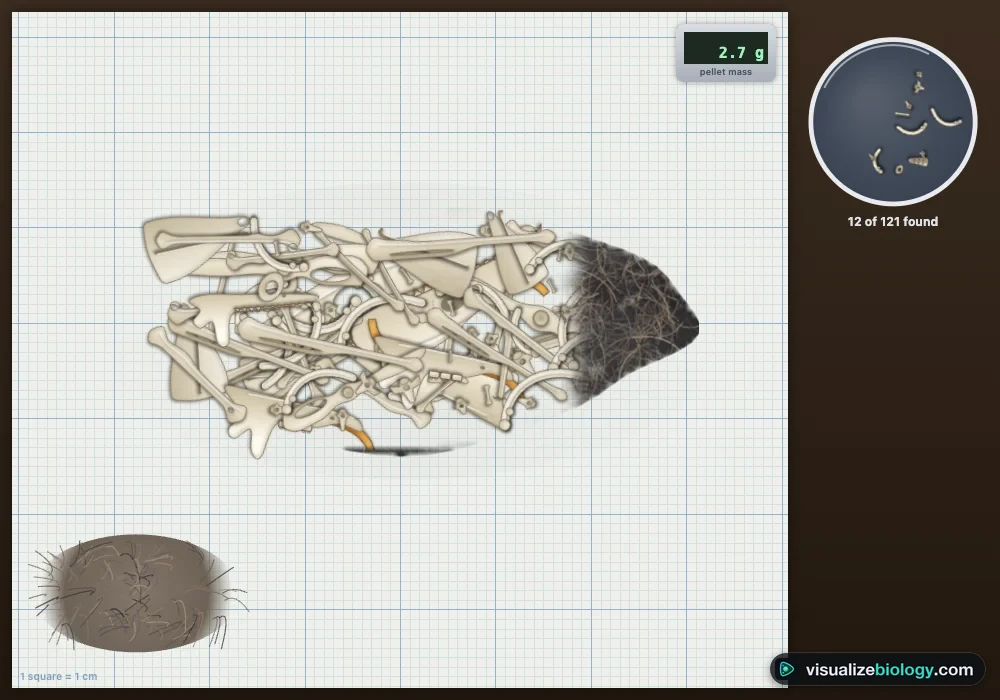
Simulate gives you a new owl pellet on gridded paper. The bench has four views: Pellet (unwrap, measure, weigh and tease it apart), Sort (the bone sorting chart), Rebuild (a skeleton sheet) and Web (the food web of what the owl ate). On the right, the close-ups show the bone you picked, the identification Key, how an Owl makes a pellet, and a Graph of the diet.
2 Dissecting the pellet
- Click the foil to unwrap the pellet. Click the scale to weigh it; turn on the Ruler or count the 1 cm squares to measure it.
- Drag the probe across the pellet to tease the fur away. Soak it first and the fur comes away faster.
- When a bone is free it glows (with Hints on): click it to lift it out to the dish. The brush sweeps out loose small bones such as vertebrae and ribs.
3 Sorting, keying and rebuilding
- Sort: drag a bone (or tap it, then tap a row) onto the right row of the chart. A wrong row sends it back with a clue. After three vertebrae, ribs or toe bones, you can count the rest as a pile.
- Key: pick a skull or a lower jaw, open the Key tab and answer the questions about its teeth and size. The magnifier shows the feature each question is about.
- Rebuild: choose an animal, then drag its bones onto the skeleton outline.
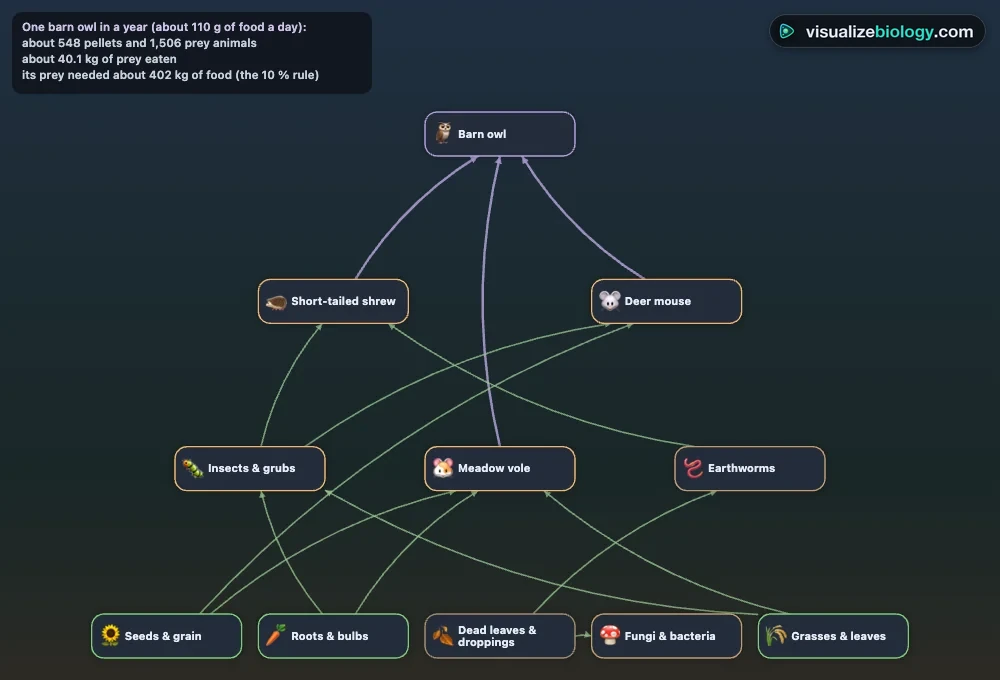
- Web: the prey you identified, what they eat and the owl, with the owl's yearly food. You can also draw the arrows yourself.
4 Experiment mode and the lab report
Seven practicals: dissect and measure a pellet, sort the bones, identify the prey and count them, rebuild a vole, graph class diet data, draw the food web, and find which owl made three mystery pellets. Each ticks off its method as you work and ends with a conclusion question; "Lab report (PDF)" turns your notebook into a report.
5 Units and keyboard
- SI | US shows sizes in millimetres or inches and masses in grams or ounces.
- 1 Pellet, 2 Sort, 3 Rebuild, 4 Web, P probe, B brush, R ruler, H hints, N new pellet, Esc clears the selection.
A virtual owl pellet dissection for the whole class
Pulling an owl pellet apart is one of the most loved labs in elementary and middle school science: a grey lump of fur turns into skulls, jaws and tiny leg bones that tell you exactly what an owl ate. This virtual owl pellet dissection keeps that moment of discovery and adds what a real pellet can't: a new pellet every time, from five different owls, bones drawn to their real size, a key that magnifies the teeth you need to look at, class data from twenty pellets, and a food web built from the animals you found. It works for students who are absent, who have allergies, or whose school has no budget for kits.
- Owls
- Barn owl (Midwest and East, or California), long-eared owl, eastern screech owl, great horned owl
- Prey
- Voles, mice, rats, pocket gophers, rabbits, shrews, moles, sparrows and June beetles
- Standards
- NGSS 4-LS1-1, 5-LS2-1, MS-LS2-2 and MS-LS2-3
- Modes
- Simulate, Experiment (7 practicals with a PDF report) and Quiz
- Price
- Free, with no account or download; works on Chromebooks, tablets and phones
What is an owl pellet?
An owl swallows a vole or a mouse whole, head first. Owls have no crop, so the meal goes straight to the first part of the stomach, the proventriculus, where acid and enzymes digest the muscles and organs. Owl stomach juice is less acidic than a hawk's (about pH 2.4 against 1.6), so bones survive. The muscular gizzard then presses the fur, bones and teeth into a tight wad, and 6 to 10 hours after the meal the owl coughs it up: an owl pellet. A barn owl makes one or two a day, about 5 cm long, and holds the remains of 2 to 4 animals in each.
Owl pellet dissection steps
- Unwrap the pellet on paper. Measure its length and width and weigh it.
- Soak it in water for a minute if it is hard (optional).
- Tease the fur apart with a probe or toothpick; don't pull bones, free them.
- Lift out each bone with forceps and lay it on a bone sorting chart.
- Find the skulls and lower jaws and identify each animal with a key.
- Count the prey and record your results for the class.
Real pellets for schools are heat-sterilized. Still wear gloves or wash your hands afterwards, and never dissect a pellet found outdoors unless it has been baked or frozen first.
The owl pellet bone chart
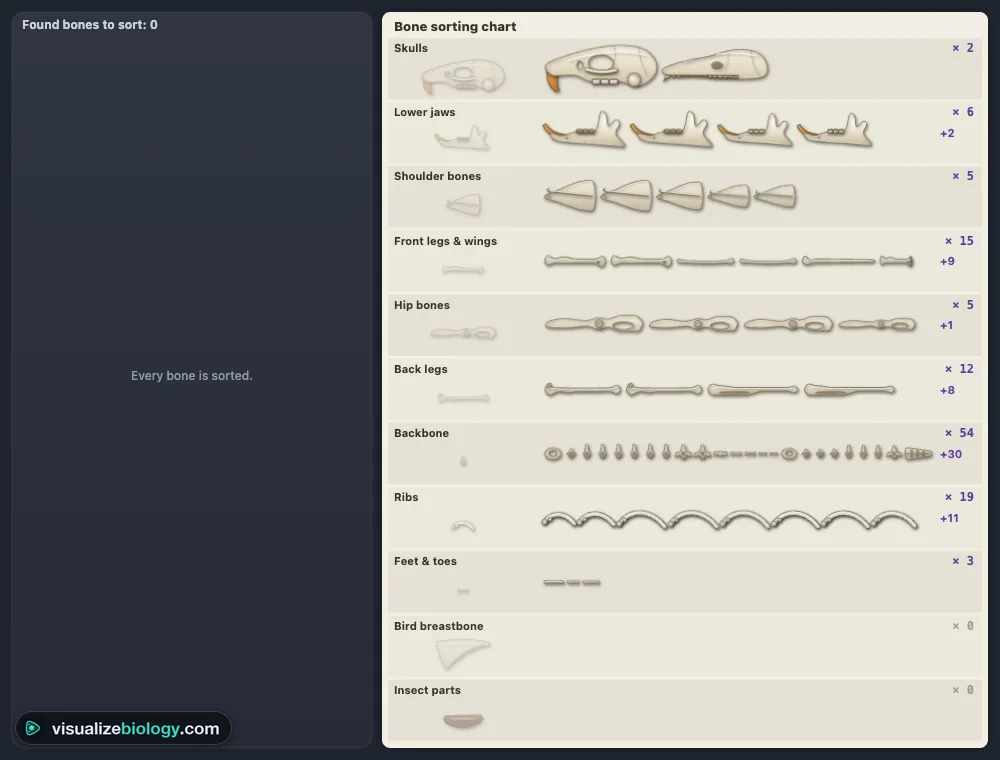
| Row | Bones | How to spot them |
|---|---|---|
| Skulls and jaws | Cranium, mandible | The biggest bones; teeth or a beak |
| Shoulder | Scapula; in birds the coracoid and wishbone | A thin triangle with a ridge |
| Front legs and wings | Humerus, radius, ulna | The ulna has a hook at the elbow |
| Hips | Pelvis | A round socket and a big oval hole |
| Back legs | Femur, tibia | The femur has a ball at one end |
| Backbone and ribs | Vertebrae, ribs | Knobbly rings; thin curved hooks |
How to identify the prey: vole, mouse, shrew or mole?
The skull and lower jaws hold the answer, because teeth show what an animal eats. Rodents gnaw: one pair of big orange front teeth, a wide gap, then grinding cheek teeth. Shrews and moles hunt insects and earthworms: a continuous row of sharp, pointed teeth.
| Prey | Teeth | Skull length |
|---|---|---|
| Vole | Gap; flat cheek teeth with zig-zag loops | 25–30 mm |
| Mouse | Gap; cheek teeth with rounded bumps | 20–26 mm |
| Rat | Like a mouse but bigger | 35 mm or more |
| Shrew | No gap; red-tipped teeth | 15–24 mm |
| Mole | No gap; white teeth, long narrow skull | 33–37 mm |
| Bird | No teeth: a beak | about 30 mm with the beak |
To count the prey, use the bones every animal has exactly one or two of: the number of skulls, or the number of left jaws, whichever is bigger. Scientists call this the minimum number of individuals.
The owl pellet food web
Every animal in a pellet links the owl to the plants and insects that animal ate. Voles and pocket gophers eat grasses and roots, mice eat seeds and insects, shrews and moles eat earthworms and insects. Arrows in a food web point from the food to the eater, the way the energy flows. A barn owl eats about 110 g of food a day, or roughly 40 kg a year. Because only about a tenth of the energy passes from one level to the next, its prey had to eat around 400 kg of food to make that much owl food.
Which owl made the pellet?
| Owl | Pellet | Usual prey |
|---|---|---|
| Barn owl | 4.5–7 cm, dark and glossy, whole bones | Voles, mice, shrews; pocket gophers in California |
| Long-eared owl | 3–5 cm, grey | Almost only voles |
| Eastern screech owl | 2–3.5 cm | Beetles, mice, small birds |
| Great horned owl | 7–10 cm, broken bones | Rabbits, rats, voles |
Practicals and course links
| Practical | What you find out | Course links |
|---|---|---|
| Dissect and measure a pellet | Size, mass, bones found | 4-LS1-1 |
| Sort the bone chart | The bones of a skeleton | 4-LS1-1 |
| Identify the prey | Using a dichotomous key; counting prey | MS-LS2-2 |
| Rebuild a vole | How the bones fit together | 4-LS1-1 |
| Class diet data | Percentages and bar graphs | MS-LS2-2 |
| Draw the food web | Energy flow; the 10 % rule | 5-LS2-1, MS-LS2-3 |
| Which owl made it? | Evidence and diet differences | MS-LS2-2 |
Frequently asked questions
What is an owl pellet?
An owl pellet is a wad of fur, feathers, bones, teeth and insect shells that an owl coughs up. Owls swallow small prey whole. The soft parts are digested, but the fur and bones are pressed together in the gizzard and brought back up through the beak 6 to 10 hours after the meal. It is not droppings and has no smell when dry.
What bones are in an owl pellet?
Mostly the bones of voles, mice and shrews: skulls, lower jaws, shoulder blades, humerus, radius and ulna, hip bones, femur and tibia, vertebrae and ribs, plus a few toe bones. Pellets can also hold bird bones (a keel-shaped breastbone, a wishbone) and the hard wing cases of beetles. A barn owl pellet usually holds the remains of 2 to 4 animals.
How do you tell a vole, a mouse, a shrew and a mole apart in an owl pellet?
Look at the teeth. Rodents (voles, mice and rats) have one pair of big orange front teeth and a wide gap before the cheek teeth: a vole's cheek teeth are flat with zig-zag loops, a mouse's have rounded bumps. Shrews and moles have a continuous row of pointed teeth with no gap; a shrew's teeth are tipped dark red, a mole's are white on a long, narrow skull. Birds have a beak and no teeth.
Is it safe to dissect an owl pellet?
Pellets sold to schools are heat-sterilized, so they are safe to handle with care. Still wear gloves or wash your hands afterwards, work on paper you can throw away, and never use pellets picked up outdoors unless they have been baked or frozen first, because they can carry Salmonella. A virtual dissection has no allergens and can be repeated with a new pellet any time.
Explore related simulators
Take the animals you found into Build the Food Chain, where the barn owl's meadow web runs as a living ecosystem and you can see what happens when the voles disappear. Sort the owl and its prey into classes in the Animal Kingdom Classification game, and compare a vole's femur with yours in the Interactive 3D Skeleton. For populations that boom and crash like vole numbers, try the Population Growth Simulator.
Sources: Marti, C. D. (1974), Feeding ecology of four sympatric owls, The Condor 76: 45–61; Duke, G. E. and others (1975), Gastric digestion in some raptors, Comparative Biochemistry and Physiology 50A: 649–656; pellet studies of barn and long-eared owls in Pennsylvania (Northeastern Naturalist); Cornell Lab of Ornithology K-12 bone identification guide; OpenStax Biology 2e, chapter 46. An educational model: the diets are typical mixes, and real pellets vary with the owl, the place and the season.
Updated