
Hormone Quest: The Interactive Endocrine System Lab
Click a gland to see its hormones travel to their targets, then run the body: eat a meal and watch insulin and glucagon steer blood glucose, push the thyroid loop with negative feedback, trigger fight or flight and grow a child through puberty.
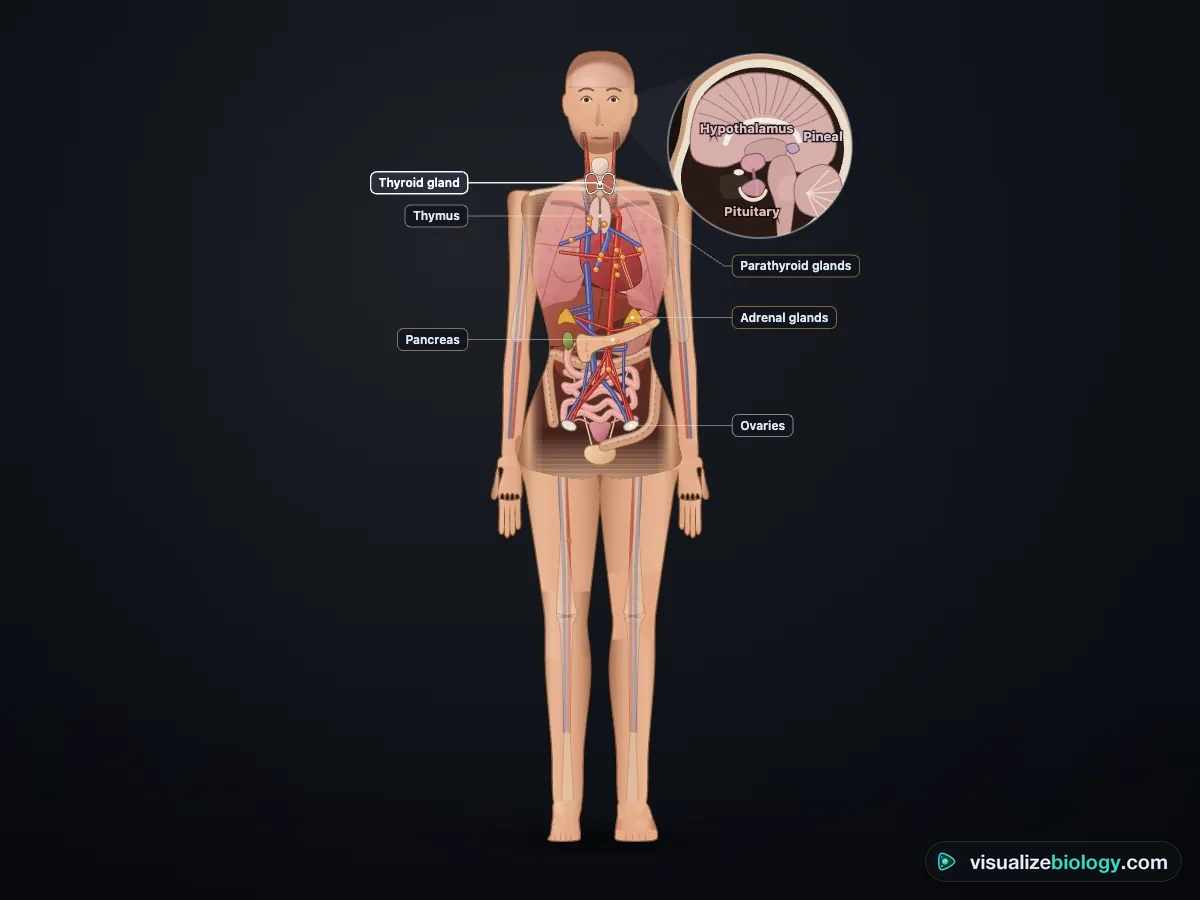
The hormones travel from their gland through the veins to the heart and out through the arteries to their target organs, as every hormone does. Glands glow brighter the more hormone they release.
What's happening
Lab notebook
Every reading you take and every event you trigger is written here with the time and the result. Export a CSV, or turn the session into a PDF lab report.
| # | Time | What | Measurement | Result |
|---|
Concept library
Click "New problem" to begin.
Click "Start quiz" for 5 questions on the glands, blood glucose, feedback, stress hormones, growth and endocrine disorders.
1 Overview
Simulate is six quests along the top of the lab: Glands, Glucose, Feedback, Fight or flight, Growth and Detective. Each has the body on the left, the quest's own view on the right, controls in the dock below, and a What's happening card that explains the body as it runs, with a checklist of discoveries. Experiment has six labs that end in a PDF lab report, and Quiz has a practice quiz with worked solutions and a 5-question quiz.
2 The body and the glands
- Tap or click a gland (or its label) to see what it is, its hormones, their target organs, what each does and what too much or too little causes. The hypothalamus, pituitary and pineal are inside the head magnifier.
- Hormones are drawn as glowing dots that travel from the gland through the veins to the heart and out through the arteries to their targets, which light up. Tap a hormone's name in the gland card to send only that hormone.
- ♀ | ♂ in the top bar switches between ovaries and testes; Labels and Hormones on the body hide the names and the dots.
3 Glucose quest
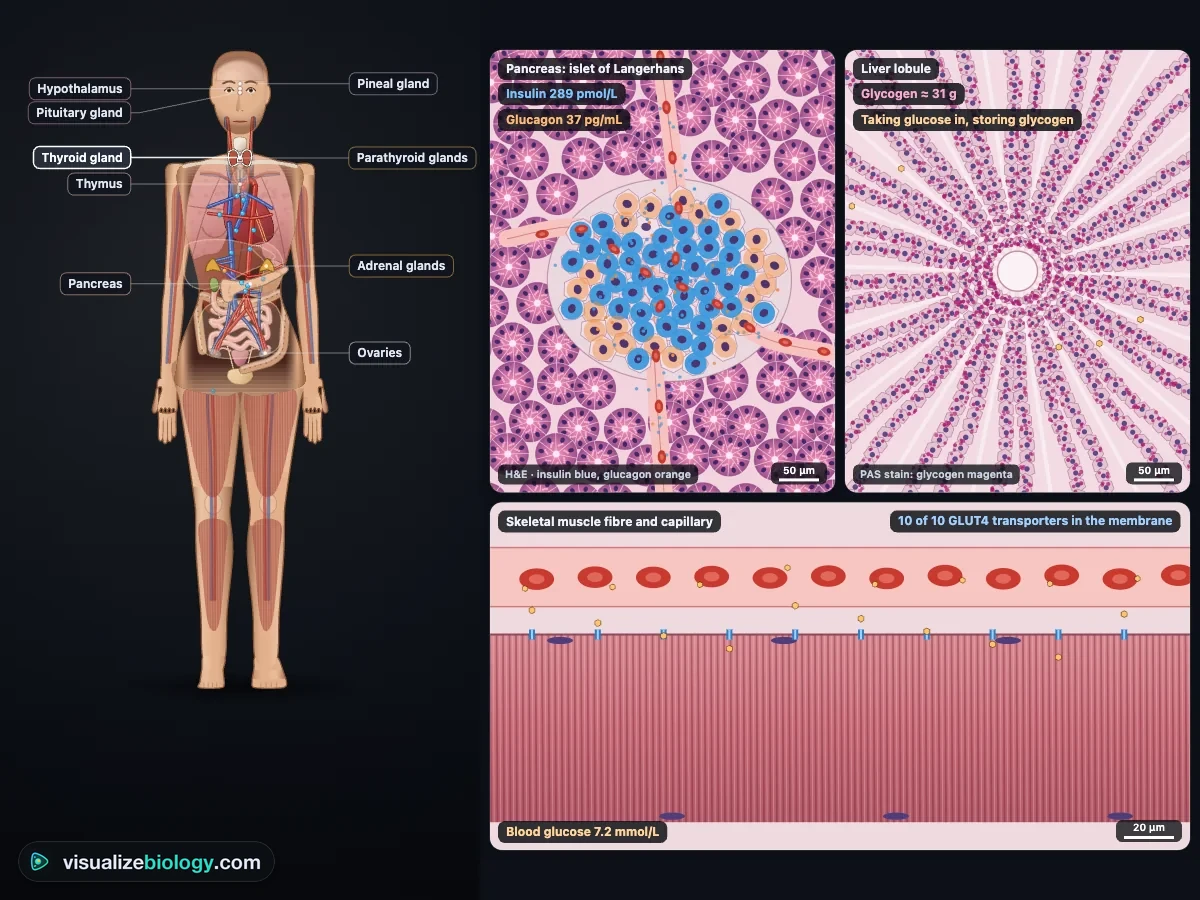
Choose a food and press Eat, then watch glucose rise, insulin follow and glucagon fall on the Monitor, and the islet, liver and muscle cells at work in Cells. Measure pricks a finger with a glucose meter and writes the reading in the notebook. Try Exercise, an insulin or glucagon injection, and a night without food, and switch the person to prediabetes, type 1 or type 2 diabetes. The clock runs at 1, 5 or 20 minutes a second.
4 Feedback quest
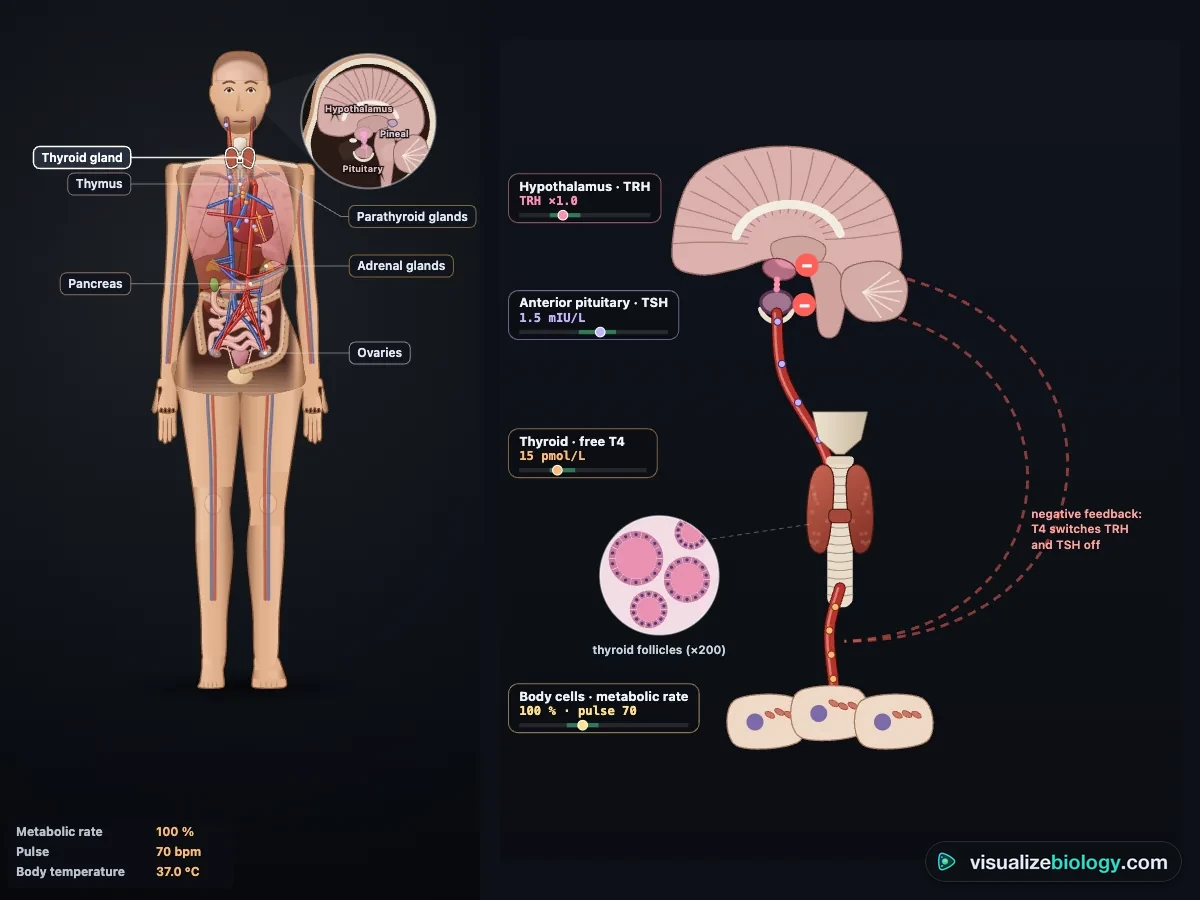
The Loop shows TRH, TSH and T4 with the negative feedback arrows; the Graph shows TSH (on a log scale) and free T4 over days, and every steady state on a TSH vs T4 plot. Hold T4 at a level you choose and watch TSH answer, give thyroxine tablets, or switch on Hashimoto's thyroiditis, Graves' disease, iodine deficiency (watch the goitre grow) or pituitary failure. The clock runs at 6 hours, 1 day or 1 week a second.
5 Fight-or-flight quest
Pick a stressor (a bear, a near miss in traffic, a speech or an exam) and watch the Monitor: heart rate, blood pressure, breathing, adrenaline and glucose, second by second. Body shows what fight or flight does to each organ. Calm down slows breathing. Switch on Cortisol (advanced) for the slower HPA axis, its daily rhythm and weeks of long-term stress.
6 Growth quest and the detective
Growth grows a child from 2 to 20 years on a CDC growth chart, with the body growing beside it. Change growth hormone (deficient, normal, excess, treatment), thyroid hormone and the timing of puberty, and see the growth spurt and the growth plates closing. Detective gives you virtual patients: read their story, order tests and choose the diagnosis. Results come from the same models as the other quests.
7 Experiment, quiz and units
Six labs: glucose tolerance test, insulin and glucagon fed vs fasted, negative feedback (TSH vs T4), fight or flight and heart rate, plotting a growth chart, and three detective cases. Each shows its aim, what you need and a real-lab note; the method ticks off as you work, a conclusion question checks your result, and Create lab report builds a PDF. The SI (mmol/L) | US (mg/dL) switch changes glucose, insulin, T4, cortisol, heights and temperatures to US clinical units. Every number here is an educational model, not medical advice.
8 Keyboard and gestures
- 1 to 6 open the quests, Space plays or pauses the clock, S opens Status and Esc clears the selected gland.
- A plain scroll over the body or a graph scrolls the page.
- Right-click the body or the view to save it as an image or copy the readings.
The endocrine system: glands, hormones and feedback
The endocrine system is the body's chemical messaging system. Its glands release hormones straight into the blood, which carries them to every organ; only the target cells that have the right receptor respond. Nerves send fast, short signals along wires; hormones are slower but last longer and reach the whole body at once. This endocrine system simulator lets you click every gland, follow its hormones to their targets and run the body to see what they do.
- Glands
- Hypothalamus, pituitary, pineal, thyroid, parathyroids, thymus, adrenals, pancreas, ovaries and testes
- Quests
- Glands, blood glucose, negative feedback, fight or flight, growth and puberty, endocrine detective
- Disorders
- Type 1 and type 2 diabetes, hypothyroidism, hyperthyroidism, GH deficiency, acromegaly, Cushing's, Addison's
- Modes
- Simulate (six quests), Experiment (6 labs with a PDF report) and Quiz
- Price
- Free, with no account or download; works on Chromebooks, tablets and phones
Endocrine glands and their hormones
| Gland | Main hormones | What they do |
|---|---|---|
| Hypothalamus | TRH, CRH, GnRH, GHRH; ADH and oxytocin | Controls the pituitary; links the nervous and endocrine systems |
| Pituitary | Growth hormone, TSH, ACTH, FSH, LH, prolactin | The "master gland": controls the thyroid, adrenals and gonads; growth |
| Pineal | Melatonin | Sleep and the body clock |
| Thyroid | Thyroxine (T4), T3, calcitonin | Metabolic rate, growth and brain development |
| Parathyroids | Parathyroid hormone (PTH) | Raises blood calcium |
| Adrenal glands | Adrenaline, cortisol, aldosterone | Fight or flight; long-term stress; salt and water |
| Pancreas (islets) | Insulin, glucagon | Lower and raise blood glucose |
| Ovaries / testes | Estrogen, progesterone / testosterone | Puberty, reproduction, the growth spurt |
How insulin and glucagon control blood glucose
After a meal, glucose from digested food enters the blood. The β-cells of the islets of Langerhans in the pancreas sense the rise and release insulin, which opens glucose doors (GLUT4) in muscle and fat cells and makes the liver store glucose as glycogen. Between meals and in exercise, glucose falls and the α-cells release glucagon, which makes the liver break glycogen down and release glucose. Each corrects the other's overshoot, so fasting blood glucose stays at about 4 to 5.5 mmol/L (70 to 100 mg/dL). In the simulator, a 75 g glucose drink lifts a healthy person's glucose to about 9 mmol/L at 30 to 40 minutes and back to normal within 2 hours.
Negative feedback: the thyroid loop
Most hormones are controlled by negative feedback, where the result switches its own cause off. The hypothalamus releases TRH, the pituitary answers with TSH, and TSH makes the thyroid release thyroxine (T4). T4 then acts back on the hypothalamus and pituitary and turns TRH and TSH down. The loop is very sensitive: halve the T4 and TSH rises about tenfold. That is why a high TSH is the first sign of an underactive thyroid, and an almost zero TSH the sign of an overactive one.
Adrenaline and cortisol: fight or flight
In danger, sympathetic nerves and adrenaline from the adrenal medulla act within seconds: the heart beats faster and harder, airways widen, pupils dilate, the liver releases glucose and blood is sent to the muscles instead of the gut. Adrenaline is cleared in a few minutes, so the body settles once the danger has gone. Cortisol from the adrenal cortex is slower: it peaks 20 to 40 minutes after a stress, keeps glucose up and follows a daily rhythm, highest in the morning. Months of high cortisol from long-term stress raise blood pressure and glucose and weaken the immune system.
Growth hormone and puberty
Growth hormone from the pituitary, released in pulses in deep sleep, makes the liver release IGF-1, which lengthens bones at their growth plates. Thyroid hormone is needed too. At puberty, GnRH from the hypothalamus switches on LH and FSH, the ovaries and testes release estrogen and testosterone, and a growth spurt follows (about 8 cm a year in girls at age 11 to 12 and 9 to 10 cm in boys at 13 to 14). Estrogen then closes the growth plates, and growth stops.
Type 1 vs type 2 diabetes and other endocrine disorders
| Disorder | What goes wrong | Key test results |
|---|---|---|
| Type 1 diabetes | β-cells destroyed: no insulin | High glucose, ketones, very low C-peptide |
| Type 2 diabetes | Cells resist insulin; β-cells tire | Fasting glucose ≥ 7.0 mmol/L (126 mg/dL), HbA1c ≥ 6.5 % |
| Hypothyroidism | Too little T4 (often Hashimoto's) | High TSH, low free T4 |
| Hyperthyroidism | Too much T4 (often Graves') | TSH near zero, high free T4 |
| GH deficiency / gigantism | Too little / too much growth hormone | Low / high IGF-1, slow / fast growth |
Experiments and course links
| Lab | What you find out | Course links |
|---|---|---|
| Glucose tolerance test | How a body handles 75 g of glucose; normal, prediabetes or diabetes | GCSE 4.5.3.2; IGCSE 14.4; NGSS HS-LS1-3 |
| Insulin and glucagon: fed vs fasted | Which hormone is high when | AP Biology 4.5; A-level 3.6.4.2 |
| Negative feedback: TSH vs T4 | The thyroid loop from your own data | GCSE 4.5.3.4; IB D3.3 |
| Fight or flight and heart rate | How fast adrenaline acts and wears off | GCSE 4.5.3.4; NCERT 11 |
| Plot a growth chart | Growth hormone deficiency and treatment | NGSS HS-LS1-2; A&P |
| Endocrine detective | Diagnosing from symptoms and hormone tests | AP Biology 4.5; IB C3.1 |
Who uses this simulator?
Students use it to learn each gland and hormone, to see negative feedback happen instead of memorizing it, and to practise diabetes and thyroid questions with worked solutions. Teachers project a meal and pause as insulin rises, hold T4 low and ask the class to predict TSH, or run the detective as a whole-class case. It is an educational model built on textbook physiology; it needs no login, runs on school Chromebooks, and nothing here is medical advice.
Frequently asked questions
What are the main endocrine glands and their hormones?
The hypothalamus (releasing hormones such as TRH, CRH and GnRH, plus ADH and oxytocin) controls the pituitary gland, which makes growth hormone, TSH, ACTH, FSH, LH and prolactin. The pineal gland makes melatonin; the thyroid makes thyroxine (T4) and T3; the parathyroids make parathyroid hormone; the thymus makes thymosin; the adrenal glands make adrenaline and cortisol; the pancreas makes insulin and glucagon; the ovaries make estrogen and progesterone, and the testes make testosterone.
How do insulin and glucagon regulate blood sugar?
After a meal, blood glucose rises and the beta cells of the pancreas release insulin. Insulin makes muscle and fat cells take up glucose and makes the liver and muscles store it as glycogen, so blood glucose falls back to normal. Between meals and during exercise, blood glucose falls and the alpha cells release glucagon, which makes the liver break glycogen down and release glucose. The two hormones act in opposite directions to keep fasting blood glucose at about 4 to 5.5 mmol/L (70 to 100 mg/dL).
What is negative feedback in the endocrine system?
Negative feedback is when the result of a process switches the process off. In the thyroid loop, the hypothalamus releases TRH, which makes the pituitary release TSH, which makes the thyroid release thyroxine (T4). Thyroxine then acts back on the hypothalamus and pituitary to reduce TRH and TSH. So if T4 is high, TSH falls, and if T4 is low, TSH rises, which keeps T4 near a set level. This is why doctors test TSH: a high TSH usually means an underactive thyroid.
Explore related simulators
See the hypothalamus and pituitary inside a whole brain, lobe by lobe, in the Interactive 3D Brain Model. Follow the meal behind the glucose curve from the mouth to the small intestine, and the pancreas that makes digestive enzymes as well as insulin, in the Human Digestive System Simulator. Take the blood pressure that adrenaline raises, with a cuff and a stethoscope, in the Manual Blood Pressure Apparatus Simulator. Watch ADH and aldosterone keep the body's water and salt in balance in the Kidney Simulator. See why adrenaline makes the heart race in the Heart & Cardiac Cycle Simulator, and how breathing speeds up in fight or flight in the Respiratory System Simulator. Look inside the cells that hormones act on, from the insulin gene to the rough ER, in the Virtual Living Cell.
Sources: OpenStax Biology 2e, chapter 37 (The Endocrine System); OpenStax Anatomy and Physiology 2e, chapter 17; Bergman et al., Am J Physiol 236 (1979) (minimal model of glucose and insulin); Spencer et al., J Clin Endocrinol Metab 70 (1990) (the log-linear TSH–T4 relation); American Diabetes Association, Standards of Care in Diabetes (diagnostic criteria); Nathan et al., Diabetes Care 31 (2008) (HbA1c and average glucose); CDC 2000 growth charts (stature-for-age); College Board, AP Biology Course and Exam Description, Unit 4. Hormone levels, rates and patients are an educational model based on these sources, and nothing here is medical advice.
Updated