
Clinical Thermometer Simulator: Every Type and How to Read It
Take a temperature with eight real kinds of clinical thermometer, from the glass one you shake down to ear, forehead and dot thermometers. Read each one properly, compare body sites and their fever lines, and see what a hot drink, a loose arm or a cold forehead does to the number.
Experiment
ReadyAisha, 3010:00
Right now
The thermometer shows—
Time in place—
Sensor now—
The site itself—
Core (rectal)—
Set point—
Room · clock—
Your last reading—
Patient & time
Clock 10:00
Technique
Nothing to adjust for this thermometer here: just put it in place and wait.
Tip
Lips
Arm
Aim
new cover on
On the patient, press on the middle of the forehead and drag to the hairline; slide on to behind the ear lobe before you let go. Or press "Scan for me".
This model is made to be held 3 cm from the forehead (1–5 cm works).
Liquid
Scale
Mistakes to try
Lab
View & learning aids
Click a site on the patient to put the thermometer there (click again to take it out). In Read it, drag a glass thermometer up or down to turn it.
Clock
What is happening
Lab notebook
Your readings are written here when you press Record. Export a CSV, or turn the session into a PDF lab report.
| # | Patient | Thermometer and site | Reading | Result |
|---|
Concept library
Click "New question" to begin.
Click "Start quiz" for 5 questions on reading thermometers, fever by site, the instruments, errors, body temperature and °C/°F.
User Guide: Clinical Thermometer Simulator
1 Overview
Simulate shows a patient with the thermometer you choose at the body site you choose; the right-hand card shows the thermometer close up to read, how it works inside, live graphs and the body's thermostat. Experiment has seven practicals that end in a PDF lab report, and Quiz has a practice quiz with worked answers and a 5-question quiz. The patient's temperature and every thermometer come from one physical model, so they always agree. It is an educational model, not medical advice.
2 Taking a temperature
- Choose a patient and a thermometer in the bar at the top, and a site with the pills on the patient view (only the sites that thermometer can use are shown).
- Get the thermometer ready: shake a glass one down (👋), switch a digital one on (⏻), put a new cover on an ear thermometer.
- Put it in place (📍, or click the site on the patient). Infrared thermometers then need Measure; the temporal artery thermometer is dragged across the forehead to the hairline (or press Scan for me).
- Wait as long as it needs: a digital thermometer beeps; a glass one needs 3 minutes in the mouth and 8–10 in the armpit. ⏩ Wait moves the clock on.
- Take it out and read it (turn a glass one in the Read it view), then Record what you read.
3 Reading a glass thermometer
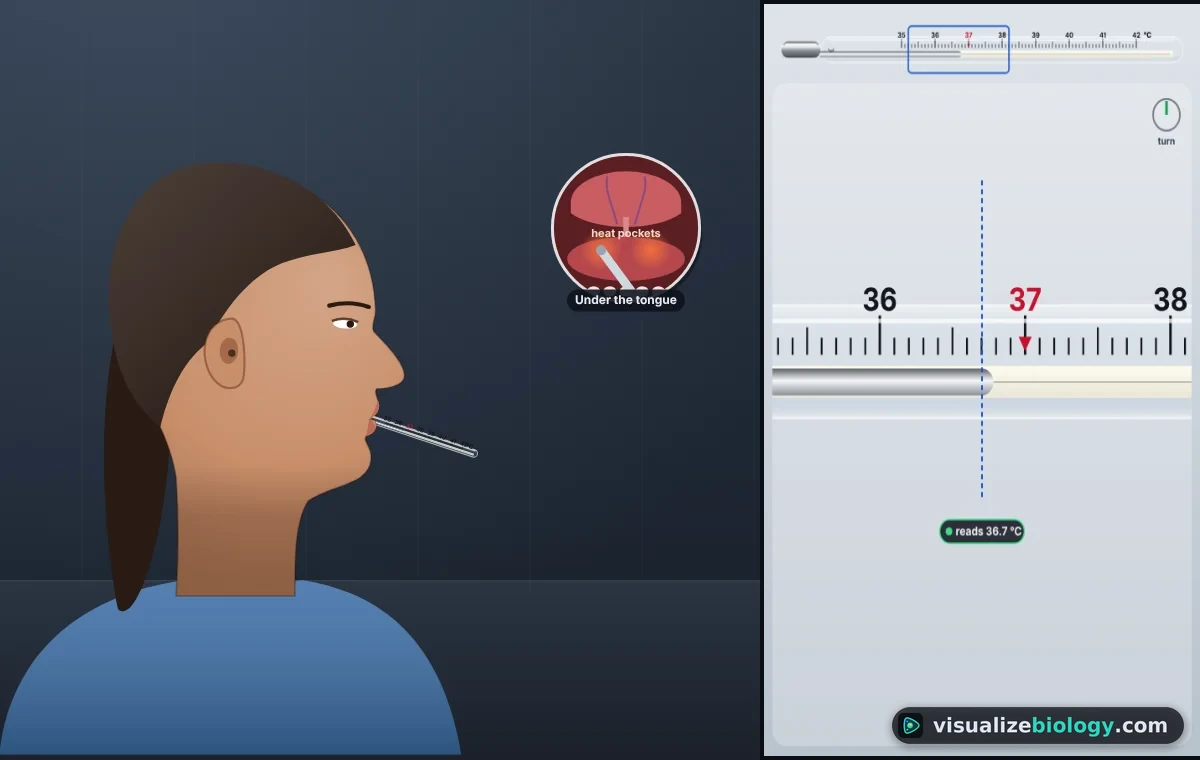
The Read it view shows the whole thermometer at the top and a magnified window of the scale. Drag up or down (or press ↑ ↓) to turn the thermometer until the thread shows as a wide silver band, then read where it ends: each small mark is 0.1 °C (0.2 °F on the US scale), the arrow marks 37 °C or 98.6 °F. The thread stays at the highest temperature it reached until you shake it down.
4 Patients, technique and mistakes
Nine patients: a healthy adult and child, a baby with a fever, a low-grade fever, influenza (the fever is still rising, so he shivers; give paracetamol and watch it break), an older adult with a small fever, a teenager after a run, heat stroke (start cooling) and hypothermia (rewarm). The Technique panel holds the choices for this thermometer and site: the heat pocket and closed lips, the arm held in, pulling the ear, the distance, the behind-the-ear touch, mercury or galinstan and the low-reading scale. Mistakes switches on a hot or cold drink, cold weather, sweat, a hat, a heater, lying on the ear, ear wax and a thermometer brought in from a cold car.
5 The four views
- Read it: the instrument close up, with a reading guide (a learning aid).
- Inside: how this thermometer works, with live numbers (the constriction, the thermistor, the predictive fit, infrared radiation, the temporal artery heat balance, the spot of a no-touch thermometer, the dots, the liquid crystals).
- Graph: the sensor since it went in against the site, the core and the fever line; and the patient's core and set point over the hours with your readings.
- Body: the thermostat (set point against core), shivering and sweating, and what every site reads right now against its fever line.
6 Learning aids and "Show me"
Labels, the magnified insets (the heat pockets under the tongue, the ear canal, how deep for rectal), the reading guide, the forehead heat map and the Status values for the site, core and set point are learning aids. ▶ Show me takes a temperature with the chosen thermometer, step by step. All of these are switched off in Experiment mode.
7 Experiment mode and the lab report
Seven practicals: an oral temperature with a glass thermometer, how long it must stay in, one patient at four sites, infrared technique, a hot drink, a fever's course with paracetamol, and hypothermia. Each shows its aim, what you need and a safety note; the method ticks off as you work, a conclusion question checks your result, and Create lab report builds a PDF with your readings and calculations.
8 Quiz, units and keyboard
- The practice quiz has six topics, including pictures of glass thermometers and dot strips to read; Take the quiz gives five mixed questions and a star rating.
- SI | US switches between °C and °F. The glass thermometer, the dot strip and the forehead strip become the US instruments (94–108 °F every 0.2 °F, dots every 0.2 °F); digital displays switch units.
- Keys: Space place, take out or measure; Enter record; W wait a minute; K shake down; P power; ↑ ↓ turn the glass; L labels; 1–4 the right-hand views; S Status. Right-click a view to save it or copy the readings.
Clinical thermometers: the types, how to read them and what counts as a fever
A clinical thermometer measures body temperature over a short range, about 35–42 °C (94–108 °F), with fine divisions, because a few tenths of a degree separate a normal temperature from a fever. This simulator puts eight kinds used in clinics, hospitals and homes in your hands, on patients whose temperature comes from a working model of the body's thermostat, so you can practise reading each one and see why a reading depends on the site, the timing and the technique.
Types of clinical thermometers
| Thermometer | How it works | Sites and time |
|---|---|---|
| Glass (mercury or galinstan) | A liquid thread in a fine capillary; a constriction holds the highest reading until it is shaken down | Mouth 3 min, armpit 8–10 min, rectal 2–3 min |
| Digital stick | A thermistor whose resistance falls as it warms; beeps when the reading stops rising | Mouth, armpit, rectal; about 30–90 s |
| Hospital predictive | A pre-warmed probe that predicts the final reading from the first seconds | Mouth, armpit, rectal; 4–15 s |
| Infrared ear (tympanic) | Measures infrared radiation from the eardrum | Ear; 1 s; not under 6 months |
| Temporal artery | Scans the forehead for the warmest skin and corrects it for the room | Forehead and behind the ear; a few seconds |
| No-touch forehead | Infrared from a few centimetres away | Forehead; 1 s; screening |
| Chemical dot strip | Single use: each dot changes colour at its own temperature | Mouth 60 s, armpit 3 min |
| Liquid crystal strip | Crystals change colour with skin temperature | Forehead; a rough screen only |
Mercury thermometers are being phased out under the Minamata Convention because mercury is toxic; glass clinical thermometers now use galinstan, a non-toxic alloy of gallium, indium and tin.
How to read a glass clinical thermometer
- Hold it by the end away from the bulb, at eye level, and turn it slowly: the stem is a triangular prism that magnifies the thread into a wide silver band.
- Find the last number before the end of the thread, then count the small marks: each is 0.1 °C on a Celsius thermometer, 0.2 °F on a Fahrenheit one.
- Record to the nearest mark, for example 37.3 °C or 99.2 °F, with the site.
- Shake it down below 35 °C before the next use. The constriction above the bulb lets the thread rise but stops it falling, so an unshaken thermometer still shows the last, highest reading.
Normal body temperature and fever at each site
| Site | Compared with the core | Fever from (AAP) |
|---|---|---|
| Rectal | The reference for the core | 38.0 °C (100.4 °F) |
| Ear, temporal artery | Within a few tenths when done well | 38.0 °C (100.4 °F) |
| Oral (under the tongue) | About 0.3–0.5 °C lower | 37.8 °C (100 °F) |
| Armpit (axillary) | About 0.5–1 °C lower | 37.2 °C (99 °F) |
The famous 37 °C (98.6 °F) is only an average: healthy adults range from about 36.1 to 37.4 °C by mouth, lowest at 4–6 am and highest in the late afternoon. Older adults run cooler and make smaller fevers, so a long-term-care guideline counts a repeated oral 37.2 °C, or a rise of more than 1.1 °C over the person's usual, as a fever. In a fever the brain's thermostat (the hypothalamus) is reset upwards, so the patient first shivers with cold, pale skin and later sweats as the fever breaks. Heat stroke is different: the thermostat is normal but heat builds up faster than it can be lost. The feedback behind both is explored in Hormone Quest, and the skin's part in keeping 37 °C in the Interactive Skin Diagram.
Common errors
- A hot or cold drink changes an oral reading by up to 1.5–2 °C for 15–20 minutes; so do eating and smoking.
- Taking it out too soon. The armpit only warms up once the arm has been held in for several minutes, so a digital beep there often comes too early.
- Ear technique. Without pulling the ear straight, the sensor sees the cooler canal wall.
- Forehead readings are fooled by sweat, cold weather, hats, heaters and the wrong distance, and by the cold, pale skin of a rising fever.
- Hypothermia. A standard clinical thermometer starts at 35 °C; use a low-reading or electronic one.
Who uses this simulator?
Middle- and high-school biology classes use it for homeostasis and negative feedback; health-science, nurse aide (CNA), medical assisting, HOSA and nursing students use it to practise taking and recording a temperature before a skills check. Teachers project it to ask "which reading is a fever?" before revealing the site. It is an educational model built from published physiology and instrument standards, not a medical device: anyone worried about a temperature should ask a doctor or nurse.
Frequently asked questions
How do you read a clinical thermometer?
Hold a glass clinical thermometer by the end of the stem, at eye level, with the numbers facing you, and turn it slowly until the thin thread inside suddenly looks like a wide silver band: the triangular glass works as a magnifier. Read the number where the thread ends. Each small mark is 0.1 °C on a Celsius thermometer (0.2 °F on a Fahrenheit one), so a thread ending three marks after 37 reads 37.3 °C. Shake it down below 35 °C before using it again. A digital thermometer shows the reading on its display when it beeps.
What temperature is a fever?
It depends on where you measure. The American Academy of Pediatrics uses 38.0 °C (100.4 °F) or more for a rectal, ear or temporal artery (forehead scanner) reading, 37.8 °C (100 °F) or more for a reading under the tongue, and 37.2 °C (99 °F) or more in the armpit. Normal body temperature is a range, about 36.1–37.4 °C by mouth, lowest early in the morning and highest in the late afternoon. Any fever in a baby under 3 months needs a doctor straight away.
Which type of thermometer is most accurate?
Measured well, a rectal temperature is the closest to the core and is the standard for babies. Oral digital and glass thermometers are accurate to about ±0.1 °C in a laboratory and are good from about age 4. Ear and temporal artery thermometers are quick and close to the core when used correctly, but technique matters: pull the ear straight, or scan right to the hairline. Armpit, no-touch forehead and liquid crystal strips are best used to screen, and a raised reading should be checked another way.
Explore related simulators
Take the other vital sign by hand in the Manual Blood Pressure Apparatus Simulator, and listen to the heart and lungs of the same kind of patients in the Virtual Stethoscope Trainer. See how sweat glands and skin blood vessels hold the body at 37 °C in the Interactive Skin Diagram, follow negative feedback loops in Hormone Quest, and watch breathing speed up with a fever's extra metabolism in the Respiratory System Simulator.
Sources: American Academy of Pediatrics, HealthyChildren.org, How to Take a Child's Temperature; Mackowiak, Wasserman and Levine 1992, A critical appraisal of 98.6 °F (JAMA 268: 1578); Sund-Levander, Forsberg and Wahren 2002, normal oral, rectal, tympanic and axillary temperatures (Scand J Caring Sci 16: 122); High et al. 2009, IDSA guideline on fever in older adults in long-term care (Clin Infect Dis 48: 149); ASTM E667, E1112 and E1965 and ISO 80601-2-56 (clinical thermometer standards); OpenStax Anatomy and Physiology 2e, section 24.6. The simulator is an educational model, not medical advice.
Updated