
Virtual Earthworm Dissection: Earthworm Anatomy, Segment by Segment
Pin an earthworm to the tray, cut it open beside its dorsal blood vessel and find every organ by counting segments, from the pharynx and the five pairs of hearts to the crop, gizzard and nerve cord. Then look at its cross-section under the microscope, watch its closed circulation and peristalsis in a see-through worm, and count the pulse of a live worm at different temperatures.
What you're looking at
Lab notebook
Every step of your dissection, each cut's accuracy, each organ lifted out and every count is written here. Export a CSV, or turn the session into a PDF lab report.
| # | Specimen | What | Result | Value |
|---|
Concept library
Click "New problem" to begin.
Click "Start quiz" for 5 questions on the earthworm's external features, cross-section, organs, digestion, circulation and breathing, excretion and reproduction, nerves and movement, and calculations.
1 Overview
Simulate puts an earthworm on a dissecting tray, on the left, in four views: External (dorsal or ventral side up), Section (a cross-section under the microscope), Dissection and Systems (a see-through worm). The card on the right shows an Organ page, animated close-ups (How it works) and Graphs. Choose the species in the Worm panel: the nightcrawler, the red wiggler or Pheretima (NCERT).
2 External features and counting segments
- Tap any part to read what it is, its job and an exam fact; hover (on a computer) for its name and segment. ▶ plays a guided tour.
- ↻ Flip over turns the worm to see its underside: setae, the mouth and the genital pores.
- The numbers beside the worm count the segments from segment 1. The small picture at the bottom left shows the whole worm and the part in view.
- 🔍 The hand lens magnifies the grooves, setae and pores.
3 Doing the dissection
- Pick 📌 Pins (the right instrument is picked for you at each step) and tap the two yellow rings.
- With ✂️ Scissors, press on the yellow dot and drag along the yellow line, just beside the dark dorsal vessel. Each cut is graded; a cut on the vessel bleeds.
- With 🤏 Forceps, tap the worm to spread the body wall.
- Tease the septa free along both yellow lines; the flaps are then pinned back.
- Tap the organs to name them and read their segments, then lift the seminal vesicles and the gut out (🤏 or the Organs panel) to see the nerve cord.
✂️ Cut for me does the next step; ▶ watches the whole dissection done for you.
4 Systems, temperature and close-ups
Pick a system in the Systems panel: digestion, the closed circulation, gas exchange through the skin, nephridia, the hermaphrodite reproductive organs, the nervous system or movement. Change the temperature to see the pulse of the dorsal vessel speed up or slow down. Tap any organ to open its Organ page.
5 Experiment mode and the lab report
Five practicals: external features and counting segments, the cross-section, the full dissection (graded), the pulse of a live worm at different temperatures (Q10), and the closed circulation. Each shows its aim, what you need and a real-lab safety note. Labels, segment numbers and "do it for me" are off. Finish with the conclusion question, then press 📄 Lab report (PDF).
6 Units, keyboard and gestures
- SI | US switches lengths between millimetres and inches and temperatures between °C and °F.
- Space plays or pauses, T does the view's next step, 1–4 pick the view, S opens the live readings, Esc clears the selection.
- Right-click the tray or the close-up to save an image or copy the details.
Virtual earthworm dissection: annelid anatomy, segment by segment
The earthworm is the first dissection in many biology classes: a whole animal small enough for one desk, built on a plan that every textbook uses to teach segmentation, a coelom and a closed circulation. Its organs sit in fixed segments, so a dissection is a counting exercise: the hearts in 7–11, the crop in 15–16, the gizzard in 17–18. This virtual earthworm dissection lets you do it step by step with graded cuts, in three species: the nightcrawler Lumbricus terrestris of American labs, the red wiggler Eisenia fetida of classroom wormeries, and Pheretima posthuma, the Indian earthworm of NCERT Class 11 and NEET.
- Specimens
- Nightcrawler (Lumbricus terrestris), red wiggler (Eisenia fetida) and Indian earthworm (Pheretima posthuma)
- You do
- Pin it, cut beside the dorsal vessel, tease the septa, lift out organs, count segments and pulses
- Shows
- External anatomy, a cross-section, 40+ structures by segment, 7 organ systems, the pulse at 5–25 °C
- Modes
- Simulate, Experiment (5 practicals with a PDF report) and Quiz
- Price
- Free, with no account or download; works on Chromebooks, tablets and phones
Earthworm dissection steps
- External anatomy. Find the head end and the dorsal side, the clitellum, the setae and the pores, and count the segments.
- Pin it. Lay the worm dorsal side up on the wax tray: one pin through the head, one well behind the clitellum.
- The dorsal cut. Cut shallowly along the back, just to one side of the dark dorsal blood vessel, from behind the clitellum forward to the head.
- The septa. Spread the body wall; thin septa hold it to the gut at every segment. Tease them free with a needle and pin the flaps back.
- Organs. Identify them by counting segments from the head, then lift the seminal vesicles aside and the gut out to see the ventral nerve cord.
Earthworm external anatomy
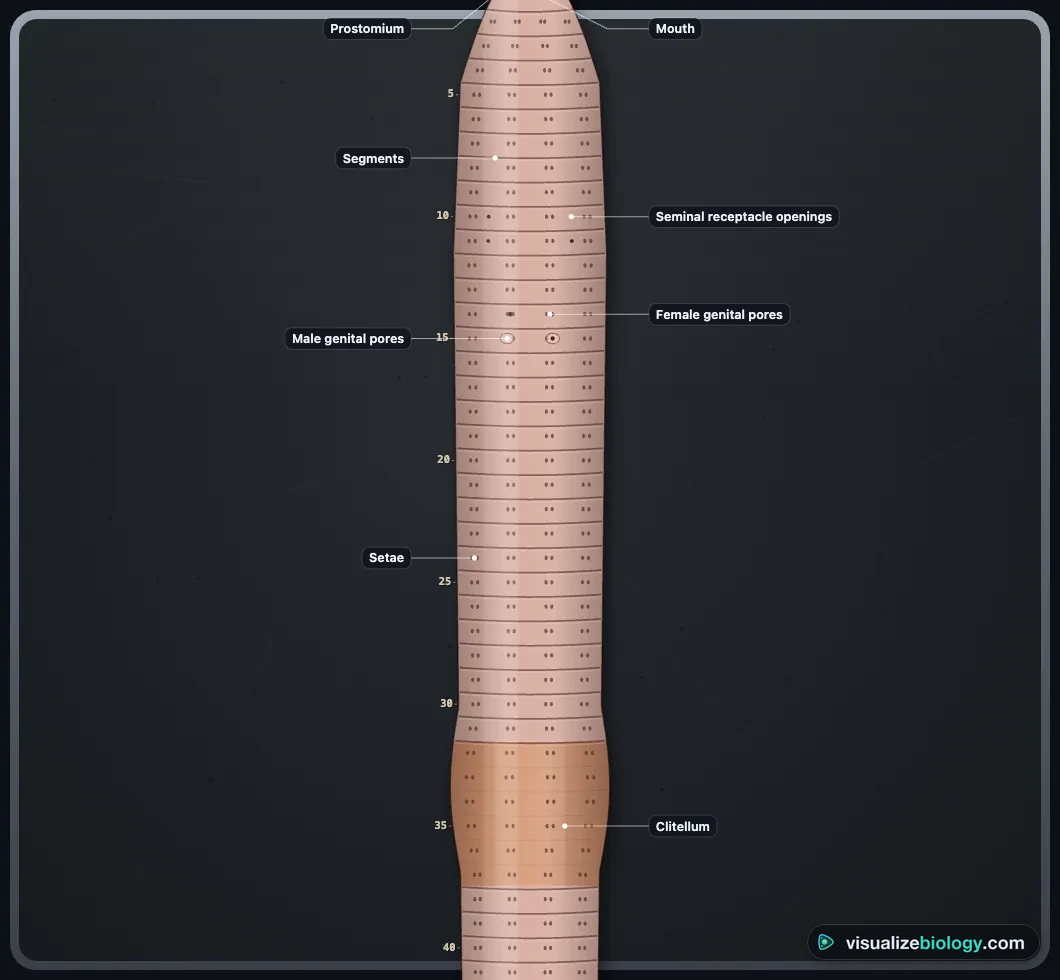
The body is a row of ring-like segments, about 150 in a nightcrawler. At the front a fleshy prostomium hangs over the mouth on segment 1, the peristomium. The clitellum, a smooth swollen band, lies in the front third of a mature worm (segments 32–37 in Lumbricus, 26–32 in Eisenia, 14–16 in Pheretima), so it tells you which end is the head. The dorsal side is darker, with the dorsal vessel showing through; the ventral side is flatter, with tiny bristles, the setae, the female pores on segment 14 and the male pores on 15 (18 in Pheretima).
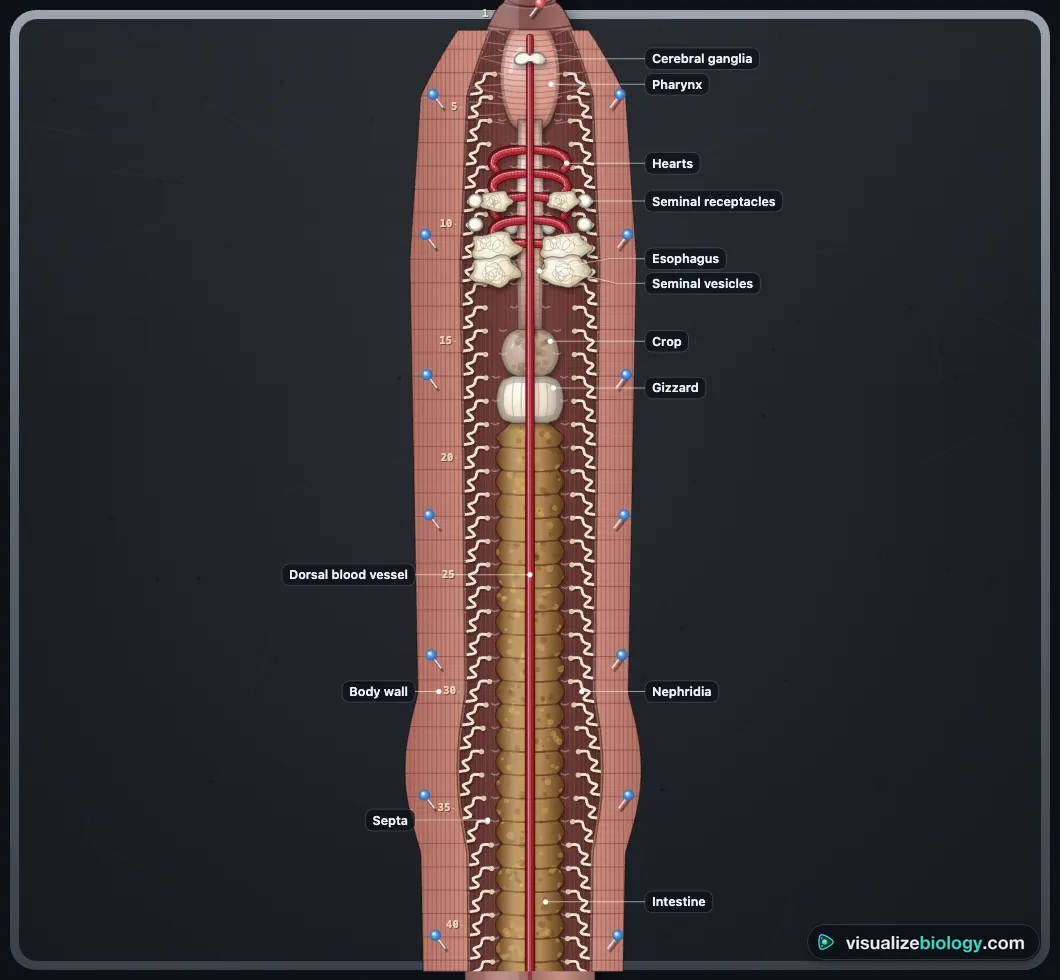
Earthworm internal anatomy: organs and their segments
| Organ | Segments (Lumbricus) | Function |
|---|---|---|
| Pharynx | 2–6 | Muscular pump that sucks in soil |
| Cerebral ganglia (brain) | 3, on the pharynx | Control movement; receive the senses |
| Esophagus and calciferous glands | 6–14; glands 10–12 | Carries food; removes extra calcium |
| Hearts (aortic arches) | 7–11 (5 pairs) | Pump blood from the dorsal to the ventral vessel |
| Seminal vesicles and receptacles | 9–12; 9–10 | Store the worm's own and its partner's sperm |
| Testes and ovaries | 10–11; 13 | Make sperm and eggs: every worm is a hermaphrodite |
| Crop | 15–16 | Stores food |
| Gizzard | 17–18 | Grinds food with swallowed sand |
| Intestine | 19 to the anus | Digests and absorbs; the typhlosole adds surface |
| Nephridia | A pair in almost every segment | Excretion of ammonia, urea and water |
| Ventral nerve cord | Along the floor, under the gut | A ganglion in every segment |
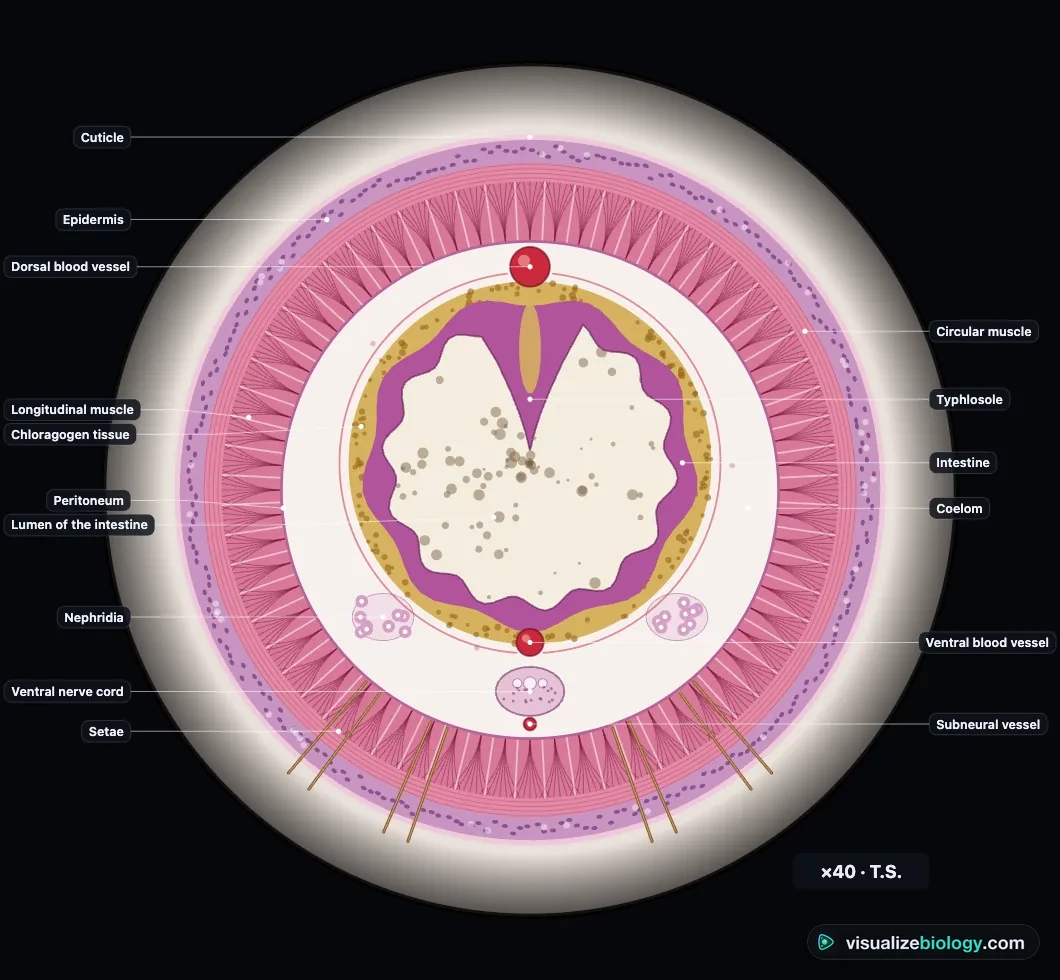
Earthworm cross-section
A section through the intestine region shows a tube within a tube. Outside: a thin cuticle, the epidermis with its mucus cells, a thin layer of circular muscle and a thick layer of longitudinal muscle. Inside: the intestine, whose roof folds down as the typhlosole to increase the surface for absorption, coated in yellow-brown chloragogen cells. Between them is the fluid-filled coelom, with the dorsal vessel above the gut, the ventral vessel, the nerve cord and the subneural vessel below it, nephridia at the sides and setae through the wall.
The earthworm circulatory system and breathing
The earthworm has a closed circulation: blood never leaves its vessels. The dorsal vessel contracts in waves that push blood forward; five pairs of hearts (aortic arches) round the esophagus pump it down into the ventral vessel, which carries it back and out to every segment. Hemoglobin is dissolved in the plasma. With no lungs or gills, the worm takes in oxygen through its moist skin and its net of skin capillaries. In a live worm you can count the waves along the dorsal vessel: about 20 a minute at 20 °C, roughly doubling for each 10 °C rise.
Earthworm reproduction: a hermaphrodite
Every earthworm has testes, seminal vesicles, ovaries and seminal receptacles. Two worms lie head to tail in a mucus tube and swap sperm, each storing its partner's in its seminal receptacles. Later the clitellum makes a band that slides forward, collects eggs from the female pores and the stored sperm, and closes into a cocoon. The young hatch as small worms: there is no larva.
Morphology of earthworm (Pheretima) for Class 11
NCERT's earthworm, Pheretima posthuma, has 100–120 segments and a clitellum on segments 14–16 that splits the body into preclitellar, clitellar and postclitellar regions. It has a single female pore mid-ventral on 14, a pair of male pores on 18, four pairs of spermathecal pores in the grooves from 5/6 to 8/9 and genital papillae on 17 and 19. Inside: buccal cavity (1–3), pharynx (4), gizzard (8–9), stomach (9–14), intestine from 15 with a pair of caeca on 26, four pairs of hearts in 7, 9, 12 and 13, and blood glands on 4–6. Choose Indian earthworm in the simulator to dissect it.
Practicals and course links
| Practical | What you find out | Course links |
|---|---|---|
| External features and counting segments | Head end, dorsal side, where the clitellum lies | NCERT Class 11; high school biology |
| The cross-section | Body wall, coelom, typhlosole, vessels, nerve cord | AP Biology; prepared-slide work |
| The full dissection | Organs by segment; the nerve cord under the gut | NGSS HS-LS1-2; AP Biology |
| Pulse and temperature | Pulse rate of a live worm; Q10 | High school and AP biology |
| A closed circulation | Direction of blood flow; gas exchange through the skin | AP Biology; NCERT |
Who uses this virtual earthworm dissection?
Middle and high school students doing the earthworm lab or its alternative, AP Biology students revising invertebrate body plans, Indian students preparing the earthworm for Class 11 and NEET, and teachers who want a free, no-login dissection that runs on Chromebooks. It is an educational model of a real animal.
Frequently asked questions
How many hearts does an earthworm have?
The nightcrawler Lumbricus terrestris has five pairs of hearts, called aortic arches, looped round the esophagus in segments 7 to 11. The Indian earthworm Pheretima posthuma has four pairs, in segments 7, 9, 12 and 13. They are not true hearts but muscular vessels with valves that pump blood from the dorsal vessel down into the ventral vessel; the dorsal vessel itself is the main pump.
How do you tell the front end and the dorsal side of an earthworm?
The front (anterior) end has the prostomium, a fleshy lobe over the mouth, and the clitellum, the smooth swollen band, is much nearer to it than to the tail. The dorsal side is darker and rounder, and the dorsal blood vessel shows through it as a dark line; the ventral side is flatter and paler and carries the setae and the genital pores.
What are the steps of an earthworm dissection?
Identify the external features and count the segments. Pin the worm dorsal side up, one pin through the head and one behind the clitellum. Make one shallow cut along the dorsal side, just to one side of the dorsal blood vessel, from behind the clitellum to the head. Spread the body wall, tease the septa free on both sides with a needle and pin the flaps back. Identify the organs by counting segments, then lift the seminal vesicles aside and the gut out to see the ventral nerve cord.
How does an earthworm breathe?
An earthworm has no lungs or gills. Oxygen dissolves in the film of water and mucus on its skin and diffuses through the thin cuticle and epidermis into a dense net of capillaries, where hemoglobin dissolved in the plasma carries it round a closed circulation. That is why an earthworm must stay moist: a dry worm suffocates.
Explore related simulators
Compare the earthworm with an insect in the Virtual Cockroach Dissection and with a vertebrate in the Virtual Frog Dissection, and place it among the phyla in the Animal Kingdom Classification Game.
Sources: OpenStax Biology 2e, chapter 28.4; NCERT Biology Class 11 (2006), chapter 7; Edwards and Bohlen, Biology and Ecology of Earthworms (1996); Sims and Gerard, Earthworms (1999). An educational model.
Updated