
Plant Tropism Simulator: Phototropism, Gravitropism and Auxin in Seedlings
Watch oat, cress and bean seedlings bend toward light and turn against gravity, in 2D or 3D, and see the auxin that does it. Cap, cut and split the tip as Darwin, Boysen-Jensen and Went did, spin a clinostat, spray gibberellin, and run six practicals.
What's happening
Lab notebook
Bending, turning up and down, your measurements and every condition you change are written here with the time. Export a CSV, or turn the session into a PDF lab report.
| # | Seedling | What | Result | Value |
|---|
Concept library
Click "New problem" to begin.
Click "Start quiz" for 5 questions on tropisms, auxin, plant hormones and a calculation.
1 Overview
Simulate shows seedlings in a glass tank on the left, in 2D or 3D, and close-ups on the right: How it works (the auxin mechanism for what the seedling is doing now), Graph, Dose (the auxin dose-response curves) and Hormones. One model of auxin drives every view, so what you see is what the model computes.
2 Seedlings, shoot tip and root tip
- Seedlings shows the whole tank. Hold Ctrl or ⌘ and scroll to zoom, then drag. Tap any part to open its card on the right.
- Shoot tip magnifies the top of one shoot: its cells in two files, longer on the side with more auxin, and auxin flowing down.
- Root tip shows the root cap, where statoliths settle toward the ground.
- Auxin colours each half of the shoot by its auxin: the deeper the orange, the more auxin.
3 The clock and the conditions
- Press ▶ (or Space) to run. The strip shows the steps of a tropism: sensing, auxin moving, bending, a new direction, growing on. Click one to jump there.
- In Conditions set where the light comes from and its colour, lay the seedlings on their side, turn them upside down or put them on a clinostat, and set the temperature.
- In Seedling pick oat, cress or bean, treat the tip as in the classic experiments, spray gibberellin or ethylene, paste auxin on one side or remove the root caps.
4 Experiment mode and the lab report
Six practicals: light and seedling growth (the GCSE required practical), gravity and the clinostat, Darwin's caps, Boysen-Jensen and Paál, Went's agar block test and gibberellin on dwarf peas. Each shows its aim, what you need and a real-lab safety note; the method ticks off as you work, and a conclusion question unlocks the PDF lab report with your results, graph and working.
5 Units and keyboard
- SI | US switches between °C and °F and between millimetres and inches.
- Space plays or pauses, → jumps to the next step, N starts new seedlings, 1, 2 and 3 choose Seedlings, Shoot tip and Root tip, A shows or hides auxin, S opens the live readings.
A plant tropism simulator in your browser
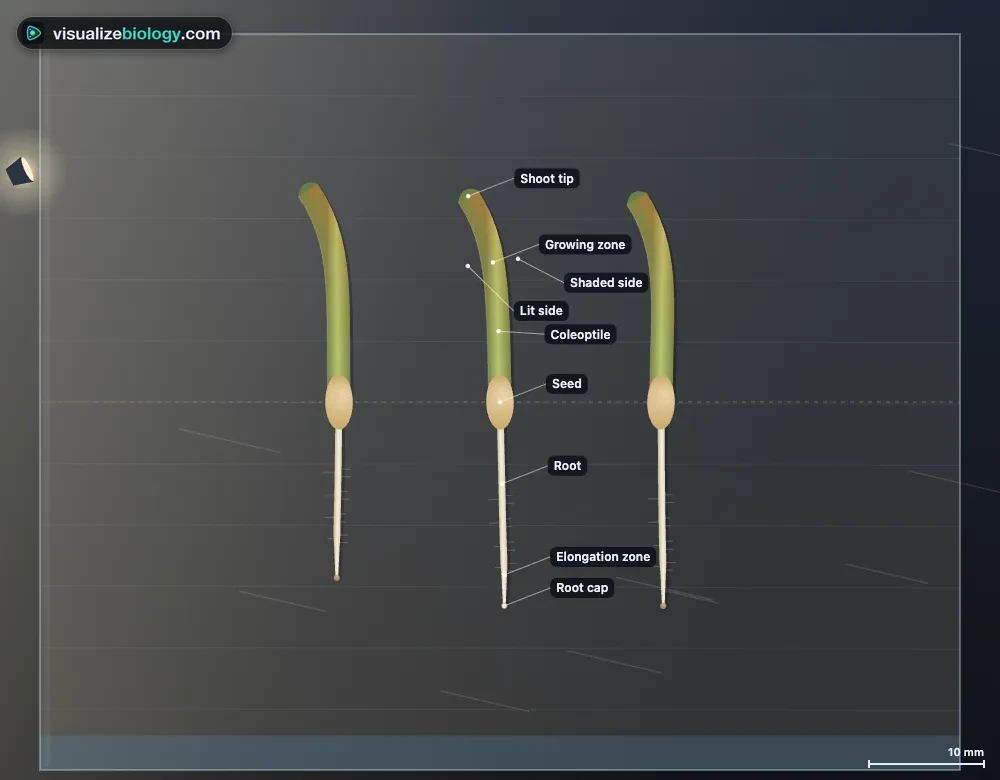
This virtual lab grows oat, cress and broad bean seedlings in a glass tank and lets you watch them respond. Shine a lamp from one side and the shoots curve toward it. Lay the tank on its side and the shoots turn up while the roots turn down. Behind every curve is one model of auxin, the plant hormone that controls these growth movements. Auxin is made in the shoot tip and carried down at about 10 mm per hour. Light or gravity moves it to one side, and the two sides then grow at different rates. Switch on the auxin layer to see how much each half of the shoot holds.
- Seedlings
- Oat coleoptile, cress and broad bean
- Stimuli
- Light from any side, in four colours; gravity in any position; a clinostat
- Classic experiments
- Darwin, Boysen-Jensen, Paál, Went and Briggs
- Modes
- Simulate, Experiment (6 practicals with a PDF report) and Quiz
- Price
- Free, with no account or download; works on Chromebooks, tablets and phones
Phototropism and gravitropism
A tropism is a growth response toward a stimulus (positive) or away from it (negative), when that stimulus comes from one direction.
| Tropism | Stimulus | Shoots | Roots |
|---|---|---|---|
| Phototropism | Light from one side | Grow toward it (positive) | Weak, often away from it |
| Gravitropism (geotropism) | Gravity | Grow up (negative) | Grow down (positive) |
| Hydrotropism | Water | – | Grow toward it |
| Thigmotropism | Touch | Tendrils coil round supports | – |
How auxin causes phototropism
The tip of the shoot detects blue light with a pigment called phototropin. When light comes from one side, auxin is moved across the tip to the shaded side, about 65 % to 35 %, and flows down that side. In shoots, auxin makes cells elongate, so the shaded side grows longer and the shoot curves toward the light. Once the tip points at the light, both sides get equal auxin again and the shoot grows straight. This is the Cholodny–Went model. Red light hardly works, because phototropin does not absorb it.
The Darwin, Boysen-Jensen and Went experiments
| Experiment | Result | Conclusion |
|---|---|---|
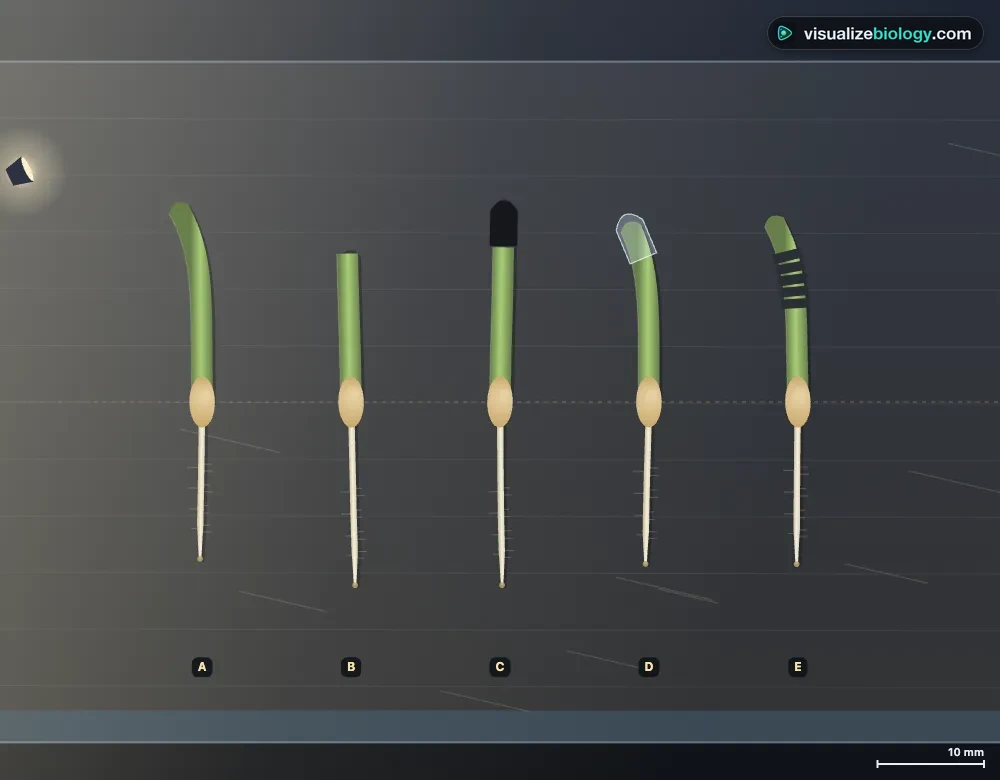
| Darwin (1880): tip cut off or covered by an opaque cap | No bending | The tip detects light |
| Darwin: opaque sleeve below the tip | Bends | A signal travels down from the tip |
| Boysen-Jensen (1913): tip replaced on gelatin | Bends | The signal is a chemical |
| Boysen-Jensen: mica on the shaded side | No bending | The chemical moves down the shaded side |
| Paál (1919): tip put back on one side, in the dark | Bends away from that side | More chemical means more growth |
| Went (1928): agar block from tips on one side of a stump | Bends; the angle depends on the amount | The chemical is auxin and can be measured |
Gravitropism: why shoots grow up and roots grow down
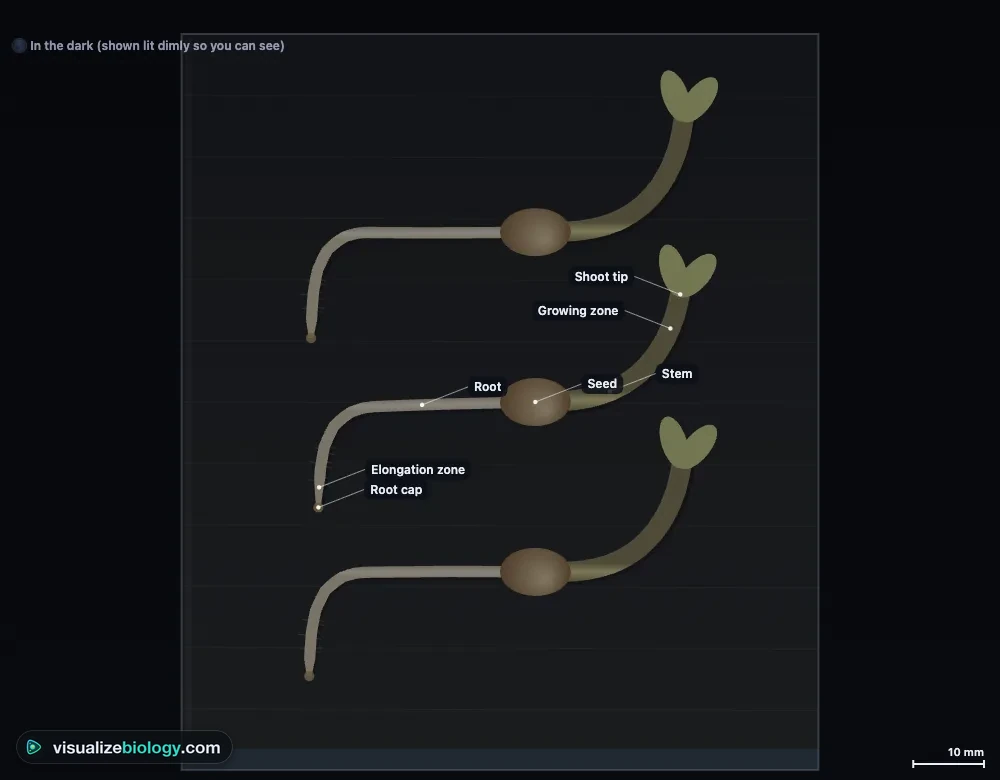
Heavy starch grains called statoliths settle on the lower side of cells in the root cap and the shoot within minutes. Auxin is then moved to the lower side of both organs. Shoot cells grow faster with more auxin, so the shoot curves up. Root cells are far more sensitive, and the same extra auxin slows their growth, so the upper side grows faster and the root curves down. On a clinostat the seedling turns slowly, gravity acts on every side in turn, and it grows straight in whatever direction it points. That makes the clinostat the control in gravity experiments.
The tropism required practical
Grow cress seedlings on damp cotton wool in three dishes: one in a dark box, one in a box with a slit letting light in from one side, and one in light from all round. After a few days, measure the height of at least 10 seedlings in each dish and the angle each leans from vertical. The independent variable is the direction of the light. The dependent variables are height and angle. Control the species, temperature, water and time. Seedlings grown in the dark are tallest but pale (etiolated). Only the one-sided dish bends.
Plant hormones and their uses
| Hormone | What it does | How it is used |
|---|---|---|
| Auxin (IAA) | Cell elongation, tropisms, apical dominance, root formation | Rooting powder, selective weedkillers (2,4-D), seedless fruit |
| Gibberellins | Stem elongation, ending seed dormancy, flowering | Larger seedless grapes, malting barley, promoting flowering |
| Ethylene | Fruit ripening, leaf fall, the triple response of seedlings | Ripening bananas after transport |
| Cytokinins | Cell division, side shoots | Plant tissue culture |
| Abscisic acid | Stomatal closure in drought, dormancy | Research into drought-tolerant crops |
Practicals and course links
| Practical | What you find out | Course links |
|---|---|---|
| Light and seedling growth | Phototropism and etiolation in cress | AQA GCSE 4.5.4 required practical; IGCSE 14 |
| Gravity and the clinostat | Roots down, shoots up, with a control | GCSE, IGCSE, A-level 3.6.1.1 |
| Darwin's caps | The tip detects light | A-level; AP Bio 8.1; IB C3.1 |
| Boysen-Jensen and Paál | The signal is a chemical | A-level; IB |
| Went's agar block test | A calibration curve and the 65 : 35 split | A-level; AP Bio |
| Gibberellin and dwarf peas | A log dose response | A-level; IB |
Frequently asked questions
What is the difference between phototropism and gravitropism?
Phototropism is growth in response to light from one direction: shoots grow toward light (positive phototropism). Gravitropism, also called geotropism, is growth in response to gravity: roots grow down (positive gravitropism) and shoots grow up (negative gravitropism). Both are controlled by auxin moving to one side of the shoot or root.
How does auxin make a shoot bend toward light?
Auxin is made in the shoot tip. When light comes from one side, it is moved to the shaded side (about 65 : 35) and flows down that side. In shoots auxin makes cells elongate, so the shaded side grows longer and the shoot bends toward the light. Once the tip points at the light, auxin is even again and the shoot grows straight.
Why do roots grow down when auxin builds up on their lower side?
Roots are far more sensitive to auxin than shoots. Statoliths in the root cap settle on the lower side and auxin is moved there, but the extra auxin inhibits elongation in roots. The upper side grows faster, so the root bends downward. In a shoot the same extra auxin speeds growth, so it bends up.
Explore related simulators
Before a seedling can bend, it has to germinate. Watch water, temperature and gibberellin start a seed growing in the Seed Germination Virtual Lab. Shoots grow toward light because their leaves need it: test light, CO₂ and temperature in the Photosynthesis Lab. Abscisic acid closes stomata in a drought: see it at work in the Leaf Structure & Stomata Virtual Lab.
Sources: Darwin and Darwin (1880), The Power of Movement in Plants; Went (1928), Rec. Trav. Bot. Néerl. 25; Briggs et al. (1957), Science 126, for the lateral redistribution of auxin; Thimann (1937), Am. J. Bot. 24, for the dose-response of shoots and roots; Taiz, Zeiger et al., Plant Physiology and Development, 6th ed.; OpenStax Biology 2e, chapter 30.6. This is an educational model.
Updated