
Plant Respiration Virtual Lab: Germinating Seeds in a Respirometer
Plants respire day and night, and germinating seeds respire fastest of all. Set up respirometers of germinating peas, dry peas and glass beads over KOH in a water bath, in 2D or 3D, and read the oxygen they use from the pipettes. Change the temperature, take out the KOH to find the respiratory quotient, ferment yeast, and run six practicals including AP Biology Lab 6.
What's happening
Lab notebook
Every pipette reading (at 0, 5, 10, 15 and 20 minutes after the clamps close) and every change you make is written here, with the raw and the bead-corrected volumes. Export a CSV, or turn the session into a PDF lab report.
| # | Respirometer | What | Result | Value |
|---|
Concept library
Click "New problem" to begin.
Click "Start quiz" for 5 questions on respiration, the respirometer, the factors that affect it and a calculation.
1 Overview
Simulate shows respirometers in a water bath on the left, in 2D or 3D, and close-ups on the right: How it works (the respiration pathway at the focused vial's rate), Gases (O₂ in, CO₂ out and what the KOH does), Graph and Temperature. Tap a respirometer to follow it in the close-ups; tap any part to open its card.
2 Running the respirometers
- Press ▶ (or Space). For 7 minutes the clamps are open and the vials warm or cool to the bath. Then the clamps close and coloured water moves along each pipette as gas is used.
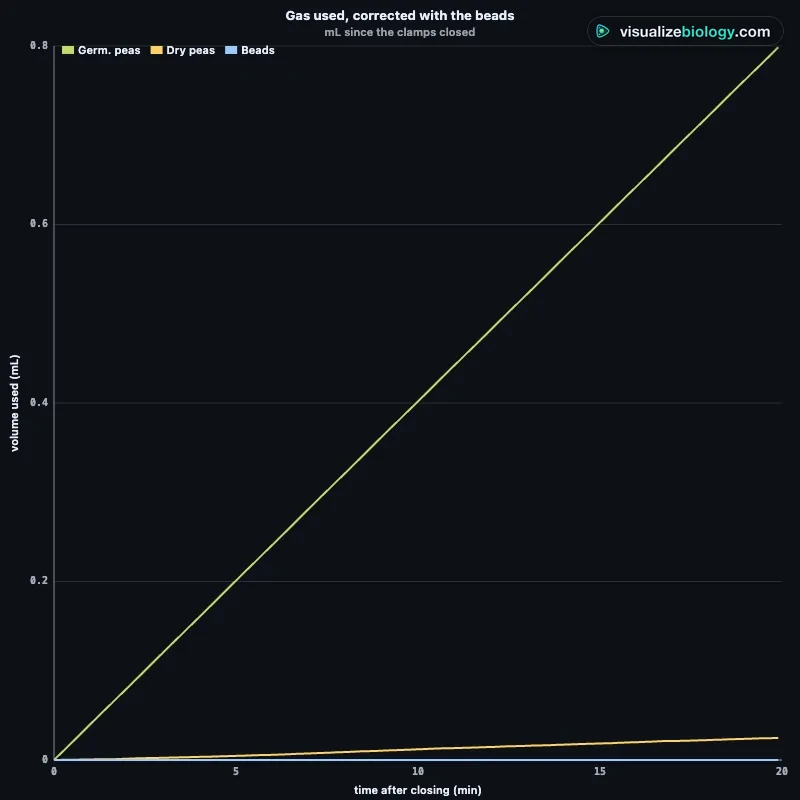
- Readings go into the notebook every 5 minutes for 20 minutes. The Corrected graph subtracts the glass beads.
- Bath, Vial and Scale choose the camera; the lens on the bath view magnifies the scale at the front.
3 The set-up
- The rail on the bath sets its temperature and puts KOH in or out.
- Respirometers: choose what goes in each vial (germinating, dry or boiled peas, glass beads, sunflower seeds, yeast), add or remove vials, the number of seeds and days of soaking; for yeast, the sugar and whether an oil layer keeps oxygen out.
- Apparatus: a 1 mL pipette or a capillary with a mm scale, and the thermostat.
4 Experiment mode and the lab report
Six practicals: AP Lab 6, temperature and Q10, why the beads, the respiratory quotient, yeast respiration (AQA RP9) and soaking. Each shows its aim, what you need and a real-lab safety note; the method ticks off as you work, and a conclusion question unlocks the PDF lab report with your table, graph and working.
5 Units and keyboard
- SI | US switches between °C and °F; volumes stay in mL, as in every lab.
- Space plays or pauses, → skips ahead, N starts a new run, 1, 2 and 3 choose Bath, Vial and Scale, S opens the live readings.
A plant respiration virtual lab with real respirometers
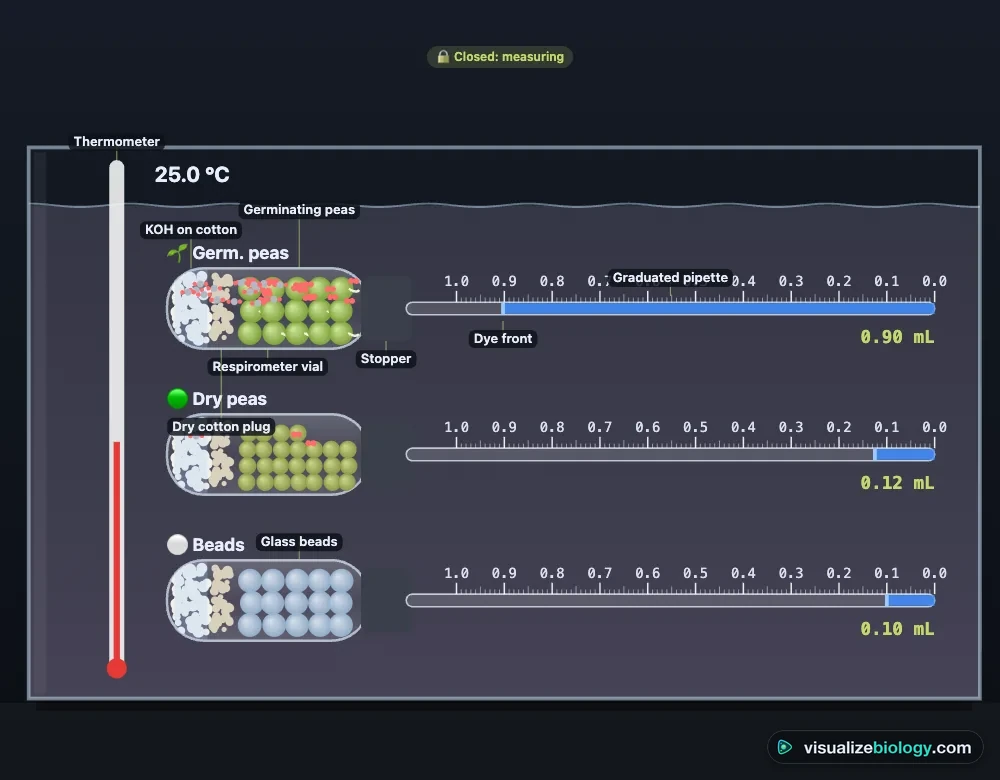
Plants respire all the time, day and night, in every living cell: leaves, roots and, fastest of all, germinating seeds. Each cell releases energy from food by cellular respiration. This virtual lab sets up the classic experiment for you: volumetric respirometers of germinating peas, dry peas and glass beads lying in a water bath, as in AP Biology Lab 6. Each vial holds cotton soaked in potassium hydroxide (KOH) under the seeds. As the peas take in oxygen, the KOH absorbs the carbon dioxide they give out, the air in the vial shrinks, and coloured water creeps into the graduated pipette. You read the pipettes every 5 minutes, as you would at the bench. Behind the drawing is a model of respiration, so changing the temperature, the seeds or the KOH changes the readings the way it would in a real lab.
- Samples
- Germinating, dry and boiled peas; glass beads; sunflower seeds; yeast
- Apparatus
- Vials over KOH, a 1 mL pipette or a capillary, a water bath from 5 to 50 °C
- Courses
- AP Biology Lab 6; A-level respirometer and RQ practicals; AQA RP9
- Modes
- Simulate, Experiment (6 practicals with a PDF report) and Quiz
- Price
- Free, with no account or download; works on Chromebooks, tablets and phones
Respiration in plants and seeds
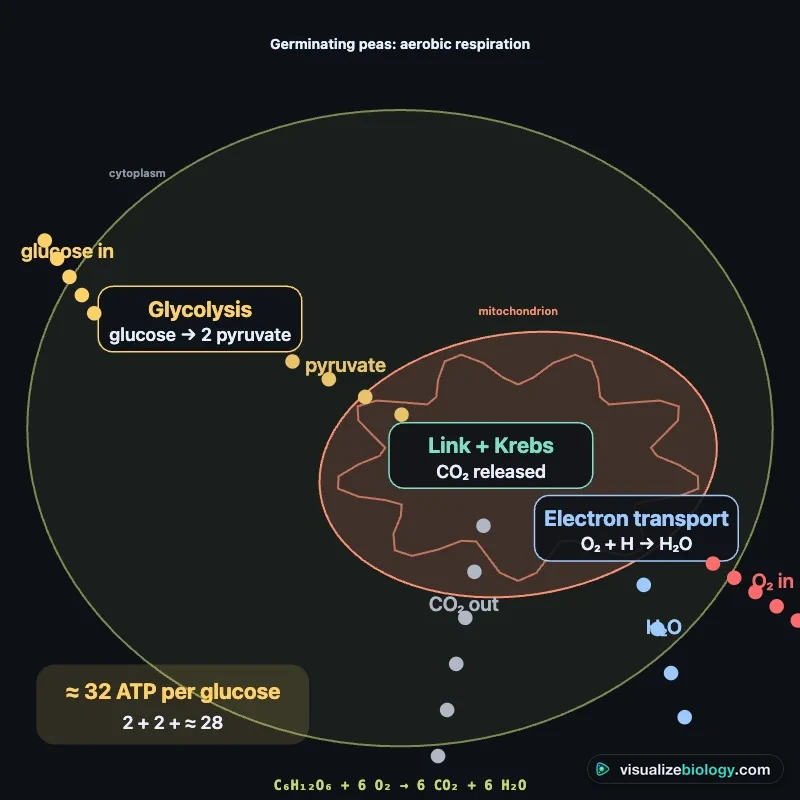
Cellular respiration releases energy from glucose to make ATP. In aerobic respiration, glucose and oxygen give carbon dioxide and water: C₆H₁₂O₆ + 6 O₂ → 6 CO₂ + 6 H₂O. Glycolysis splits glucose in the cytoplasm and makes 2 ATP. The link reaction and the Krebs cycle in the mitochondria release the carbon dioxide. The electron transport chain on the inner mitochondrial membrane uses the oxygen and makes most of the roughly 32 ATP per glucose. Plants respire all the time, day and night. Respiration is not breathing: seeds respire but do not breathe.
How a respirometer works
A respirometer measures how fast an organism uses oxygen. It is a sealed vial joined to a pipette or capillary. KOH, NaOH or soda lime absorbs the CO₂ the seeds give out, so any fall in gas volume equals the oxygen they take in. Gas also expands and contracts with temperature and pressure: 1 °C changes 30 mL of air by about 0.1 mL, nearly as much as a few minutes of respiration. So the vials sit in a water bath and are left to equilibrate for 7 minutes before timing. A vial of glass beads with the same air space acts as the thermobarometer. Subtract its change from the others and only respiration is left.
AP Biology Lab 6: germinating vs non-germinating peas
In Investigation 6 you compare 25 germinating peas, dry peas topped up with glass beads to the same volume, and glass beads alone, at room temperature and at about 10 °C. The germinating peas use far more oxygen, about 0.04 mL per minute at 25 °C in this model. Soaking (imbibition) has switched on the enzymes that turn their starch into glucose for the growing embryo. Dry peas are alive but almost dormant. In the cold bath every rate falls, because respiration is a chain of enzyme-controlled reactions. To find each rate, plot the corrected volume against time and take the slope.
The effect of temperature on the rate of respiration
Between about 5 and 40 °C the rate of respiration roughly doubles for each 10 °C rise. This factor is called the temperature coefficient, Q10, and it is about 2.3 for germinating peas in this model. Above about 40 °C the enzymes begin to denature and the rate falls steeply. The Temperature close-up draws the whole curve and marks your bath on it.
The respiratory quotient (RQ)
RQ = CO₂ given out ÷ O₂ taken in. Run one respirometer with KOH, so its change x is the oxygen used. Run another with water in its place, so its change y is the oxygen used minus the carbon dioxide made. Then RQ = (x − y) ÷ x. Carbohydrate gives an RQ of 1.0, which is why peas without KOH barely move the front. Protein gives about 0.9 and lipid about 0.7, so oily sunflower seeds have a lower RQ. An RQ above 1 means some respiration is anaerobic.
Yeast respiration: aerobic and anaerobic (AQA required practical 9)
AQA's required practical 9 investigates a named variable on the respiration of single-celled organisms. Under a layer of oil, yeast ferments glucose to ethanol and carbon dioxide, which gives only 2 ATP per glucose and uses no oxygen. With no KOH, the gas it makes pushes the liquid back along the pipette. Its rate rises with temperature to about 40 °C, and it depends on the sugar: glucose is fastest, sucrose nearly as fast, maltose slower, and lactose is not used.
Practicals and course links
| Practical | What you find out | Course links |
|---|---|---|
| Germinating vs dry peas at two temperatures | Germination and temperature raise the rate | AP Biology Investigation 6 |
| Temperature and Q10 | A rate–temperature curve and Q10 | Edexcel B CP9; OCR; AP Bio 3.6 |
| Why the glass beads? | The thermobarometer correction | AP Bio; all A-level boards |
| Respiratory quotient | RQ of carbohydrate vs lipid | OCR 5.2.2; Edexcel A CP16 |
| Yeast and temperature | Fermentation and an optimum | AQA A-level required practical 9 |
| Soaking time | Germination switches respiration on | GCSE, IGCSE 12, AP Bio |
Frequently asked questions
Why do germinating peas respire faster than dry peas?
Dry peas are alive but dormant: with so little water their enzymes barely work. Soaking lets the seed take up water (imbibition), which activates enzymes such as amylase to break down the stored starch into glucose. The growing embryo needs ATP, so it respires tens of times faster: in this lab about 0.04 mL of oxygen per minute for 25 peas at 25 °C, against almost nothing for dry peas.
What is the purpose of KOH and glass beads in a respirometer?
Potassium hydroxide (KOH) absorbs the carbon dioxide the seeds give out, so the fall in gas volume equals the oxygen they take in. The vial of glass beads has the same volume but nothing alive: it is a thermobarometer, showing any change caused by temperature or air pressure. Subtracting the beads' change from the peas' change leaves only the change caused by respiration.
How do you calculate the rate of respiration and the RQ from a respirometer?
Rate = corrected change in volume ÷ time, or the slope of the graph of corrected volume against time, in mL of oxygen per minute (divide by the mass of seeds to compare samples). For the respiratory quotient, run one respirometer with KOH (change x = oxygen used) and one without (change y = oxygen used minus carbon dioxide made): RQ = (x − y) ÷ x. Carbohydrate gives about 1.0, lipid about 0.7.
Explore related simulators
Respiration uses the oxygen and glucose that photosynthesis makes: compare the two in the Photosynthesis Lab. Soaked peas respire fast because they are germinating: watch water, temperature and gibberellin start a seed growing in the Seed Germination Virtual Lab. The enzymes that set the rate also have an optimum temperature: measure one in the Enzyme Kinetics Virtual Lab.
Sources: College Board, AP Biology Investigative Labs, Investigation 6 (Cellular Respiration); AQA A-level Biology required practical 9; Pearson Edexcel A-level Biology B Core Practical 9 (respirometer); Taiz, Zeiger et al., Plant Physiology and Development, 6th ed., chapter 12; OpenStax Biology 2e, chapter 7. This is an educational model.
Updated