
Menstrual Cycle Simulator: Hormones, Ovulation and What Changes at Fertilization
Watch FSH, LH, estrogen and progesterone run a whole cycle by feedback, on a real 3D uterus and ovaries: follicles grow, one is selected, the egg is released, the corpus luteum works for two weeks and the lining is shed. Then add sperm and see fertilization, implantation and hCG keep the corpus luteum alive, so the period never comes.
What's happening
Lab notebook
Every event of the cycle (the LH surge, ovulation, the period, fertilization, implantation, a positive test) is written here with its cycle day, with your practical results. Export a CSV, or turn the session into a PDF lab report.
| # | When | What | Result | Value |
|---|
Concept library
Click "New problem" to begin.
Click "Start quiz" for 5 questions on the phases, hormones, fertilization, the pill and IVF, and a calculation.
1 Overview
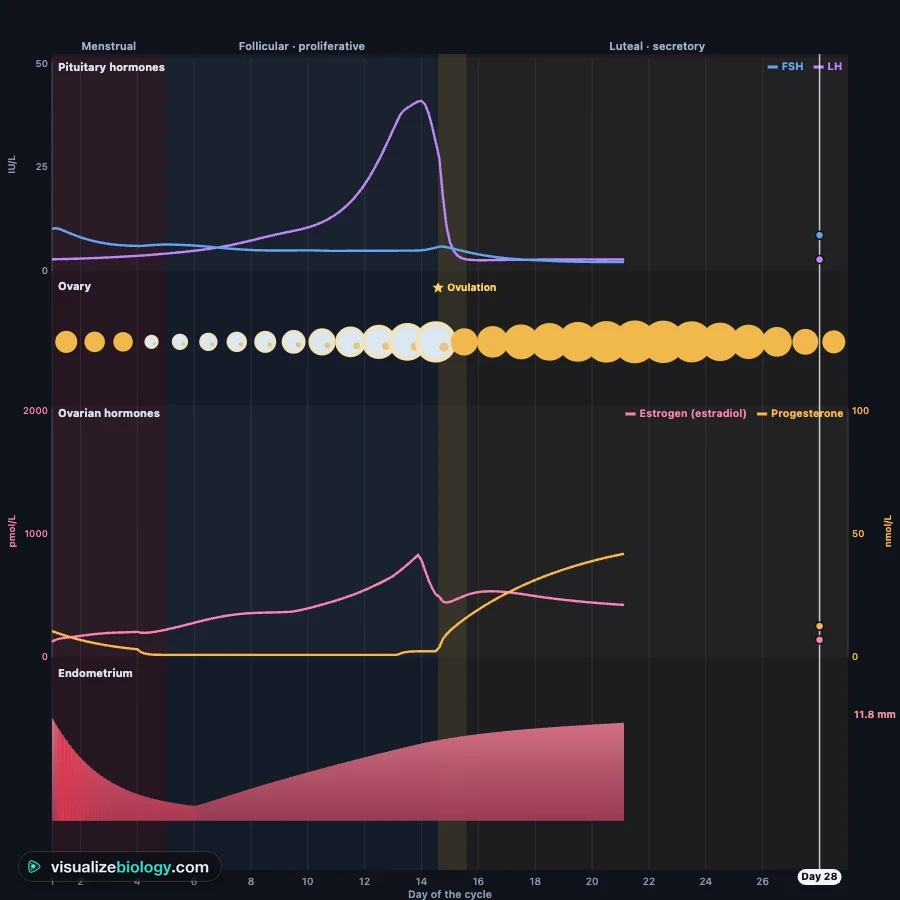
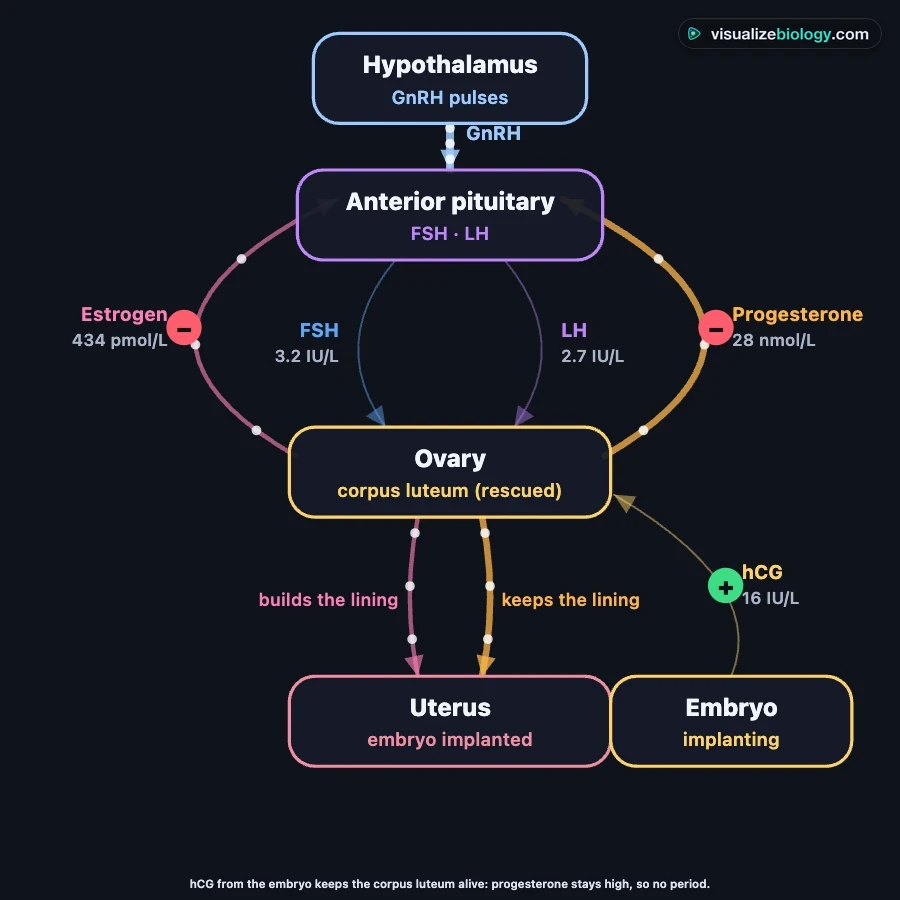
Simulate shows the uterus, tubes and ovaries on the left, in 2D (a section drawn in real millimetres) or 3D (a real uterus, tubes and ovaries you can turn), and close-ups on the right: the Chart (the textbook four-panel figure), the Feedback loop, the cycle Calendar and Graphs over several cycles. Tap any part to open its card.
2 Running the cycle
- Press ▶ (or Space). Teach speed slows down for the LH surge, ovulation, fertilization and implantation; 1 d/s and 3 d/s run at a steady pace.
- › (or →) skips to the next event; the strip of events jumps straight to one.
- Whole, Ovary, Tube and Lining choose the 2D camera (keys 1–4); hold Ctrl or ⌘ and scroll to zoom.
3 Fertilization and the cycle types
- Cycle chooses the cycle to watch: a typical 28-day cycle, With fertilization (sperm on day 13, so the egg is fertilized and implants), a short or long cycle, a cycle without ovulation, the combined pill or IVF stimulation.
- Sperm & embryo sets the day sperm enter and when the embryo implants, and shows the real-world chance of conceiving from that day.
4 Experiment mode and the lab report
Six practicals: read the chart, feedback, with and without fertilization, the pregnancy test, the pill and IVF. Each shows its aim, what you need and a note; the method ticks off as you work, and a conclusion question unlocks the PDF lab report with your table, graph and working.
5 Units and keyboard
- SI | US switches estradiol between pmol/L and pg/mL, progesterone between nmol/L and ng/mL and temperature between °C and °F. FSH, LH and hCG are IU/L (= mIU/mL) in both.
- Space plays or pauses, → skips to the next event, N starts again, F switches fertilization on or off, 1–4 choose the camera, S opens the live readings.
An interactive menstrual cycle simulator, from the first day of a period to fertilization
The menstrual cycle is a conversation between the brain, the pituitary gland, the ovaries and the uterus, carried by four hormones: FSH, LH, estrogen (oestrogen in the UK) and progesterone. Textbooks show it as a fixed graph. In this simulator the graph is not drawn in advance: a model of the hypothalamus, pituitary, ovary and uterus is stepped hour by hour, and the cycle emerges from its feedback. Follicles compete, one wins, its estrogen triggers the LH surge, the egg is released, and the corpus luteum keeps the lining for about two weeks. Switch on fertilization and the same model shows why a pregnancy stops the cycle.
- Organs
- A real 3D uterus, uterine tubes and ovaries (HuBMAP Human Reference Atlas), and a 2D section in real millimetres
- Hormones
- FSH, LH, estradiol, progesterone, inhibins and hCG, in SI or US units
- Scenarios
- Typical, short and long cycles; no ovulation; fertilization on any day; the combined pill; IVF
- Courses
- GCSE and IGCSE hormones in reproduction, NGSS HS-LS1-3, IB D3.1, NCERT Class 12 human reproduction
- Price
- Free, with no account or download; works on Chromebooks, tablets and phones
The phases of the menstrual cycle
Day 1 is the first day of bleeding. During menstruation (about days 1–5) the functional layer of the endometrium is shed, about 35 mL of blood and tissue. In the follicular phase a group of follicles grows in one ovary and their estrogen rebuilds the lining (the proliferative phase of the uterus). Ovulation comes about day 14 of a 28-day cycle. In the luteal phase the empty follicle becomes the corpus luteum, whose progesterone makes the lining secretory, with coiled glands and spiral arteries. The ovarian cycle and the uterine cycle are the same days seen from two organs. The luteal phase is close to 14 days in almost every cycle, so short and long cycles differ in their follicular phase: ovulation is about 14 days before the next period.
Menstrual cycle hormones: FSH, LH, estrogen and progesterone
GnRH from the hypothalamus makes the anterior pituitary release FSH, which makes follicles grow and secrete estrogen, and LH. Rising estrogen and inhibin B hold FSH down (negative feedback). As FSH falls, smaller follicles die, and only the follicle that has gained LH receptors keeps growing: one dominant follicle is selected. When estrogen stays above about 700 pmol/L for a day and a half, the pituitary switches to positive feedback and releases an LH surge. The egg is released about 34 hours after the surge begins. Progesterone from the corpus luteum keeps the lining, raises body temperature by about 0.3 °C and, with inhibin A, holds FSH and LH down. When the corpus luteum dies, progesterone falls, the lining is shed and FSH rises again: the next cycle starts by itself.
Ovulation and the corpus luteum
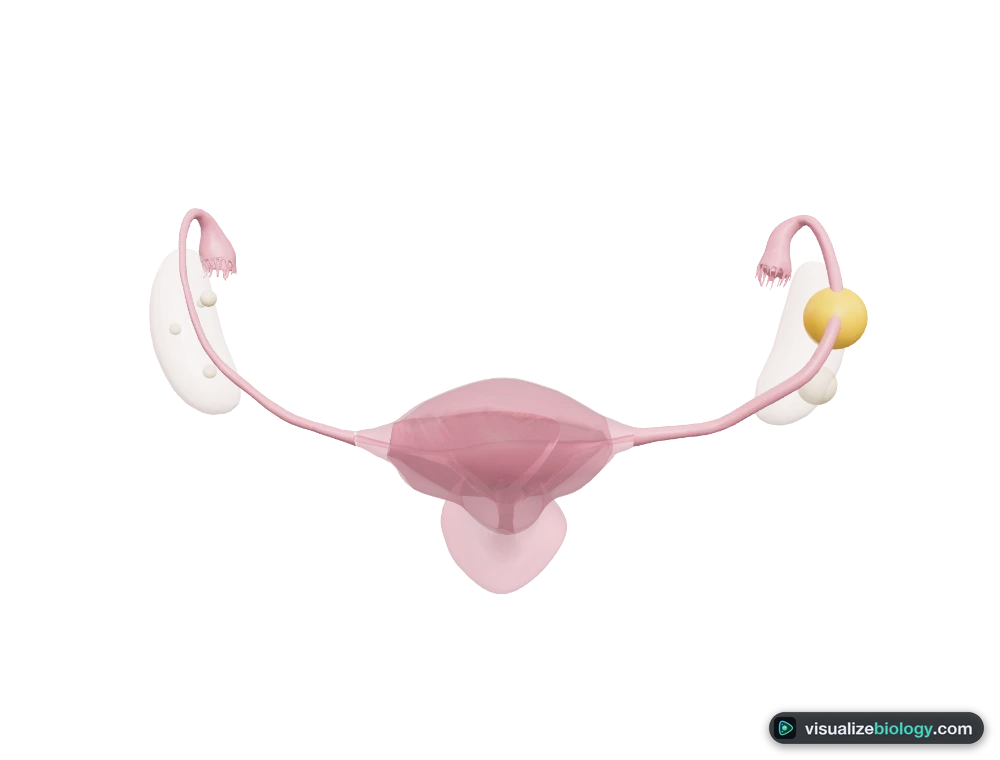
In the 3D view the ovaries are see-through, with the model's own follicles at their real diameters inside. The dominant follicle grows about 1.5–2 mm a day, bulges from the surface at 18–24 mm and bursts at ovulation. The fimbriae of the uterine tube sweep the egg into the tube. The follicle then fills with blood and becomes the yellow corpus luteum, which works for 12–14 days and shrinks to a white scar, the corpus albicans.
What happens to the menstrual cycle when an egg is fertilized
Sperm can survive about 5 days in fertile cervical mucus and the egg about 24 hours, so sex in the 6 days ending on ovulation day can lead to fertilization (Wilcox 1995). Fertilization happens in the ampulla. The embryo divides as cilia move it towards the uterus: a morula arrives on day 3–4, a blastocyst forms on day 5, and it implants in the secretory lining 6–10 days after ovulation. Its trophoblast makes hCG, which acts like LH on the corpus luteum. Instead of dying after 14 days, the corpus luteum keeps making progesterone, so the lining stays, no period comes and no new follicle is selected. hCG doubles about every two days; a urine test detects it from about 25 IU/L, usually around the day the period was due. What happens to the embryo next, week by week, is in the Human Embryo Development Simulator.
How the pill and IVF use the cycle's hormones
The combined pill supplies estrogen and a progestogen every day. Like the corpus luteum, they hold FSH and LH down, so no follicle matures and no surge happens; the bleed in the placebo week is a withdrawal bleed. In IVF, daily FSH injections keep many follicles above their threshold so several mature, an antagonist blocks an early surge, an hCG trigger matures the eggs and they are collected 36 hours later. This is an educational model of one typical body, not medical advice, a period tracker or a fertility calculator.
Practicals and course links
| Practical | What you find out | Course links |
|---|---|---|
| Read the menstrual cycle chart | Which hormone peaks when, and why | GCSE 4.5.3.4, IGCSE 16, NY Regents lab |
| Negative and positive feedback | What the surge and the corpus luteum need | A-level, IB D3.1, NGSS HS-LS1-3 |
| With and without fertilization | How hCG keeps progesterone up | GCSE, NCERT Class 12 |
| When does a pregnancy test work? | hCG timing after implantation | Health science, A-level |
| How the combined pill works | Contraception by negative feedback | GCSE 4.5.3.5, IGCSE |
| IVF stimulation | FSH and multiple follicles | GCSE 4.5.3.6 (HT), IB |
Frequently asked questions
What are the 4 phases of the menstrual cycle?
Menstruation (about days 1–5), when the functional layer of the endometrium is shed; the follicular phase, when FSH makes follicles grow and their estrogen rebuilds the lining; ovulation (about day 14 in a 28-day cycle), when an LH surge releases the egg; and the luteal phase (about 14 days), when the corpus luteum makes progesterone to keep the lining ready for an embryo.
What do FSH, LH, estrogen and progesterone do in the menstrual cycle?
FSH from the pituitary makes follicles grow and secrete estrogen. Estrogen rebuilds the endometrium, inhibits FSH and, when high for about a day and a half, triggers a surge of LH. The LH surge causes ovulation and turns the follicle into the corpus luteum, which makes progesterone. Progesterone maintains the lining and, with inhibin, holds FSH and LH down until the corpus luteum dies and the period starts.
What happens to the menstrual cycle when an egg is fertilized?
The embryo implants in the endometrium about 6–10 days after ovulation and its trophoblast makes hCG. hCG acts like LH on the corpus luteum, so it keeps making progesterone instead of dying after 14 days. Progesterone stays high, the lining is kept, no period comes and no new follicle is selected. hCG in urine is what a pregnancy test detects, usually from about the day the period was due.
Explore related simulators
The pituitary, ovaries and their hormones sit in the whole hormone system of the Endocrine System Simulator. The egg the follicle releases was made by meiosis, and after implantation the Human Embryo Development Simulator follows the embryo to birth. Feedback loops like this one also keep blood glucose steady in the Blood Glucose Regulation Simulator.
Sources: OpenStax Anatomy and Physiology 2e, chapter 27; Stricker et al. (2006), reference values for LH, FSH, estradiol and progesterone, Clin Chem Lab Med 44: 883–887; Wilcox, Weinberg and Baird (1995), N Engl J Med 333: 1517–1521; Wilcox, Baird and Weinberg (1999), N Engl J Med 340: 1796–1799; Hoff, Quigley and Yen (1983), J Clin Endocrinol Metab 57: 792–796; Harris Clark et al. (2003), Bull Math Biol 65. 3D organs: HuBMAP Human Reference Atlas, CCF 3D Reference Object Library v1.2 (Visible Human Female uterus, uterine tubes and ovaries), CC BY 4.0, scaled to reproductive-age size. This is an educational model, not medical advice.
Updated