
Digestive system lesson plan: follow a meal through the body in 45 minutes
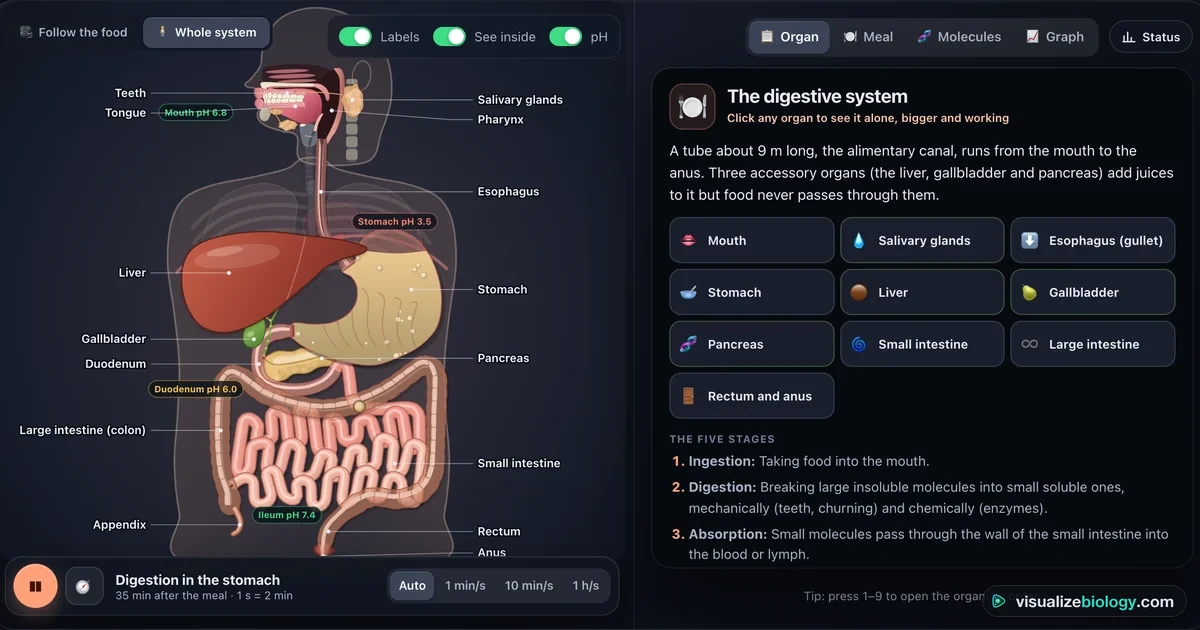
Digestion is one of the first body systems students meet and one of the easiest to get subtly wrong. Most students can label a diagram. Far fewer can tell you what happens to a sandwich between the stomach and the colon, or why bile speeds up fat digestion when it isn't an enzyme. This guide is a 45-minute lesson that uses the free Human Digestive System Simulator to make the process visible and then tests it with a real enzyme practical.
All the numbers quoted here come from the simulator's model, so you can use them as the answer key.
Where digestion lessons usually lose students
Here is a scene many biology teachers will recognise. The class labels a diagram of the gut perfectly. Then you ask, "So where does the burger go after the stomach?" and a third of the hands point at the liver. The diagram showed the liver right next to the stomach, joined by a duct, so it must be part of the route.
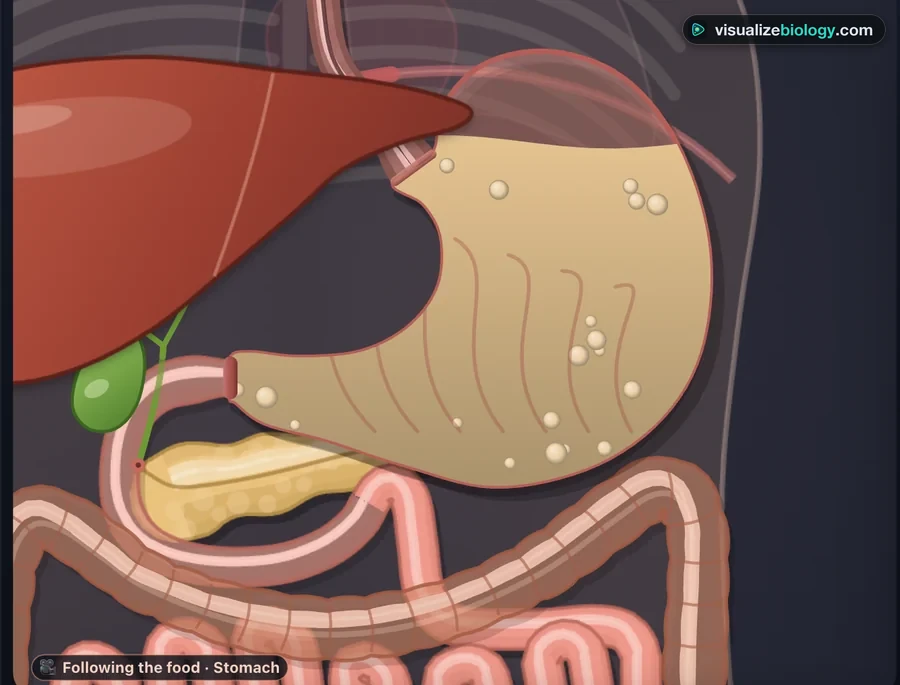
A static diagram can't show order or time. The simulator can: press play and the meal moves through the canal as parcels you can follow, while the accessory organs only add their juices from the side. That one picture fixes the most common misconception before you've said a word about it.
Before the lesson
- Devices. It runs in any browser, including Chromebooks and phones, with no account. It opens in 2D everywhere; laptops can switch to 3D.
- Links. ?food=burger&eat=1 starts a burger straight away, and ?experiment=phamylase opens the pH practical. The tool page's share bar makes a classroom QR code.
- Worksheet. One blank table with three columns (organ, what happens to the food, enzyme or juice) is all students need.
The 45-minute plan
- 0–5Predict. "A glass of water, a balanced plate and a burger with fries go into three stomachs. Which leaves first, and which last?" Students commit to an order.
- 5–15Follow the food. Students play the balanced plate with labels on and fill in the table as the food passes each organ. Then they compare stomach emptying for the three meals (answers below).
- 15–30The effect of pH on amylase. On the virtual spotting tile, each pair runs pH 7 plus two other pH values and records the time until iodine stays orange-brown. Pool the class's times on the board.
- 30–40Bile and lipase. Students run the Lipase, milk and bile practical at 37 °C with and without bile and explain the difference in one sentence.
- 40–45Exit ticket. Three questions (below).
What students should find
Stomach emptying
In the model, the time for half a meal to leave the stomach grows with its energy, and fat slows it further. These are the half-emptying times students will see:
| Meal | Energy | Half gone from the stomach after |
|---|---|---|
| Glass of water (250 mL) | 0 kcal | about 12 minutes |
| Two slices of white bread | 154 kcal | about 43 minutes |
| Balanced plate (rice, chicken, vegetables) | 428 kcal | about 106 minutes |
| Burger and fries | 660 kcal | about 171 minutes |
The pattern matters more than the exact minutes. Students who predicted that "solid food leaves first because it's heavier" now have evidence against it.
pH and amylase
At 37 °C the model gives these end-point times. Rate is calculated as 1000 ÷ time, the usual way to turn end-point times into rates in this practical.
| pH | 4 | 5 | 6 | 7 | 8 | 9 |
|---|---|---|---|---|---|---|
| Time (s) | 1020 | 152 | 52 | 41 | 72 | 295 |
| Rate (1000 ÷ s) | 1.0 | 6.6 | 19.2 | 24.4 | 13.9 | 3.4 |
The optimum is close to pH 7, which fits salivary amylase working in the mouth. A good extension question: why is starch digestion in the stomach slow, if amylase is still in the food? (At pH 2 to 3.5 the enzyme's active site changes shape, so it stops working.)
Bile and lipase
At 37 °C, the milk with bile loses its pink colour in about 197 seconds; without bile it takes about 512 seconds. Bile has no enzyme in it. It breaks the fat into tiny droplets, which gives lipase a much larger surface to work on. Students who write "bile digests fat" have the effect right and the cause wrong, and this practical is the moment to separate the two.
An extension that makes good discussion: how big is the gut's surface?
The simulator's Surface area of the small intestine practical multiplies the tube's area by the factors for its folds, villi and microvilli:
× folds (3) × villi (10) × microvilli (20) = about 300 m²
That is the figure many textbooks give, often as "the size of a tennis court". Measurements published in 2014 put the inside of the whole gut nearer 32 m², about 30 m² of it in the small intestine, because the folds, villi and microvilli don't all multiply so neatly in a living gut. Showing students both numbers is a good way into how models simplify and why scientists measure. Even 30 m² is about 17 times the area of your skin, which is why the small intestine absorbs so well.
- Name one organ that makes a digestive juice but that food never passes through. (The liver, gallbladder or pancreas.)
- Amylase took 41 s at pH 7 and 295 s at pH 9. Calculate both rates. (24.4 and 3.4)
- Bile is not an enzyme. Explain how it speeds up fat digestion. (It emulsifies fat into small droplets, giving lipase a larger surface area.)
Misconceptions to listen for
- "Most digestion and absorption happens in the stomach." Protein digestion starts there, but most chemical digestion is finished, and almost all absorption happens, in the small intestine.
- "Enzymes are killed by heat." Enzymes aren't alive. They are denatured: the active site changes shape. In the temperature practical, the end point is fastest at about 42 °C (33 s), slows sharply above 45 °C, and at 60 °C the iodine stays blue-black because the starch is never digested.
- "Digestion and absorption are the same thing." Digestion breaks large molecules into small ones; absorption moves the small ones into the blood or lymph. The Visking tubing practical shows why digestion must come first: glucose passes through the tubing, starch doesn't.
Adapting it for your class
Middle school: keep to Follow the food and the Parts of the digestive system practical, which asks students to click each organ from its job. GCSE and IGCSE: the plan above covers the food tests and enzyme required practicals (AQA GCSE Biology 4 and 5). AP and A-level: add the temperature practical and plot rate against temperature, then move on to the Enzyme Kinetics Virtual Lab for Km and Vmax. The body menu also has lactose intolerance and celiac disease; the simulator is an educational model, so use those to explain mechanisms, not to discuss individual students' health.
Where to go next
Questions teachers ask
What age group is this digestive system lesson for?
The core plan suits students aged about 13 to 16 (middle school to GCSE and IGCSE). Younger classes can stop after following the food and naming the organs; AP and A-level classes can add the temperature practical and enzyme kinetics.
Do students need real equipment for the amylase practical?
No. The spotting tile, buffers, iodine and timer are all in the simulator, so the lesson works without a lab. If you run the real practical afterwards, students already know the method and what results to expect.
Is the simulator accurate enough for exam preparation?
The model uses published values for enzyme pH and temperature behaviour, stomach emptying and the length of each part of the gut, and it is reviewed by a medical doctor. It is an educational model, not a medical tool, so it simplifies some details, such as the surface area of the small intestine discussed above.
Sources
- OpenStax, Biology 2e, chapter 34 "Animal Nutrition and the Digestive System".
- AQA, GCSE Biology (8461) specification, section 4.2.2.1 and required practicals 4 (food tests) and 5 (the effect of pH on amylase).
- Helander, H. F. and Fändriks, L. (2014). Surface area of the digestive tract, revisited. Scandinavian Journal of Gastroenterology 49(6), 681–689.
- Times and pH values in this guide are the outputs of the model in the Human Digestive System Simulator.